
“Richard Parker reminds me of the cathedrals of Europe; finely crafted, beautiful in appearance…and a sound that soars. This ukulele delights all of my senses.”
(Anne L. Founder/Director of INCLUSIVE ensemble)
Available instrument builds – Summer 2025
Note: I’m almost caught up with the builds delayed so extensively by our cancer journey and my subsequent shoulder surgery, and while parts of the website remain stubbornly out of date, I’m chipping away on that as well.
Another developing story: most builds until now have been commissions, defined from the beginning with the player. However, certain high-spirited woods now brazenly insist I build according to their wishes. Listed below, most are only partially built and can still be customized. Making the best of this overachieving but imperious bunch, I rationalize that they offer a welcome head start to a backlog that raged like a forest fire over the past several years.
Unless otherwise noted all builds below are standard tenor body size, and can be either 17″ or 17.9″ (Lyric) scale. Builds that are spoken for are marked with strike-through. Additional pictures and information are sometimes available on my Facebook and/or Instagram feeds, though I’m still behind there as well.
- Saoirse – Skellig Lyric, Swiss or Engelmann spruce, Brazilian rosewood
- Severus – GT or baritone, Swiss spruce, bubbly African Blackwood w/sapwood, POC neck
- Dragonfly – GT or baritone, Sinker redwood (Little Mac sister set), 5-piece back of Macassar ebony and The Tree mahogany
- Mr. Fox – GT or baritone, sinker redwood, intensely curly Honduran mahogany, Madagascar or Brazilian rosewood details
- Rivendell – Lyric tenor, Engelmann spruce, 3-4 piece back of curly Euro maple and Richard Parker myrtle
- Lorien – Concert (Lyric or standard), bearclaw Swiss spruce, Richard Parker myrtle, POC neck
- Macavity – Lyric tenor, sinker redwood, Little Mac Macassar 3-piece back
- Orodruin – sinker redwood, Madagascar rosewood “volcano” back, scoop bevel
Ellington– 13-fret tenor, sinker redwood, Amazon rosewoodAriel– Grand concert, Swiss spruce, Amazon rosewood. (Matt Stead) (Originally built for the amazing classical ukulele player (Donald Bousted), who cancer took from us suddenly)Little Mac– sinker redwood, Macassar ebony (Marcy Marxer)Evenstar– Swiss bearclaw moonspruce, “Richard Parker” myrtle, inlays by Larry Robinson, Port Orford cedar neck (Sabine Walter)Hildegard– Lyric tenor, Engelmann spruce/East Indian rosewood (Elisabeth Pfeiffer)Panther– Lyric tenor (17.9″ scale), Rowdy Creek river-salvage redwood, East Indian rosewoodSparrowhawk– Lyric tenor, sinker redwood, Macassar ebony and burled African blackwoodSaubhagya– Lyric tenor, western redcedar, Brazilian rosewoodSiegfried– Lyric tenor, sinker redwood, Macassar Ebony (Art Levine)Dragon– tenor, Swiss spruce, Amazon rosewood (James Hill)Irian– GT, sinker redwood, Brazilian rosewood, Larry Robinson inlayErebor– Lyric tenor, western redcedar, Madagascar rosewood, Larry Robinson inlayMerlin– Baritone, Swiss spruce, magical myrtle (James Hill)Beatrice– concert, Swiss spruce, Amazon rosewood (Giovanni Albini)Rocket– Lyric tenor, sinker redwood, Macassar ebony (Kevin Carroll)Zion– Lyric tenor, bearclaw Engelmann spruce, ziricoteWhite Tree– Lyric tenor (17.9″ scale), Swiss bearclaw spruce, African blackwood, rosette and headstock inlays by Larry RobinsonBrandywine– 17″ scale, Rowdy Creek river-salvage redwood, prodigiously curly claro walnutChameleon– baritone, Swiss bearclaw moon-spruce, African blackwood (Philip Griffin)Aila– Lyric concert, sinker redwood, “Little Mac” Macassar ebony, Larry Robinson inlay (Cynthia Kinnunen)Duke– Lyric Tenor, sinker redwood, Amazon rosewood (Gerald Ross)Nikita– baritone, Swiss bearclaw spruce, East Indian rosewood (James Hill)Kōkako– Lyric tenor, sinker redwood, Macassar ebony (Philip Griffin)Ella– 19″ baritone, sinker redwood, East Indian rosewood (Marcy Marxer)Dread Pirate Roberts– sinker redwood, African blackwood (Cathy Fink)Sam-I-Am– GT, Port Orford cedar, Oregon myrtleVivienne– GT, sinker redwood, “The Tree” mahogany, Larry Robinson inlayFée Belle– sinker redwood, East Indian rosewood- Misty – GT, Rowdy Creek redwood, East Indian rosewood, slothead.
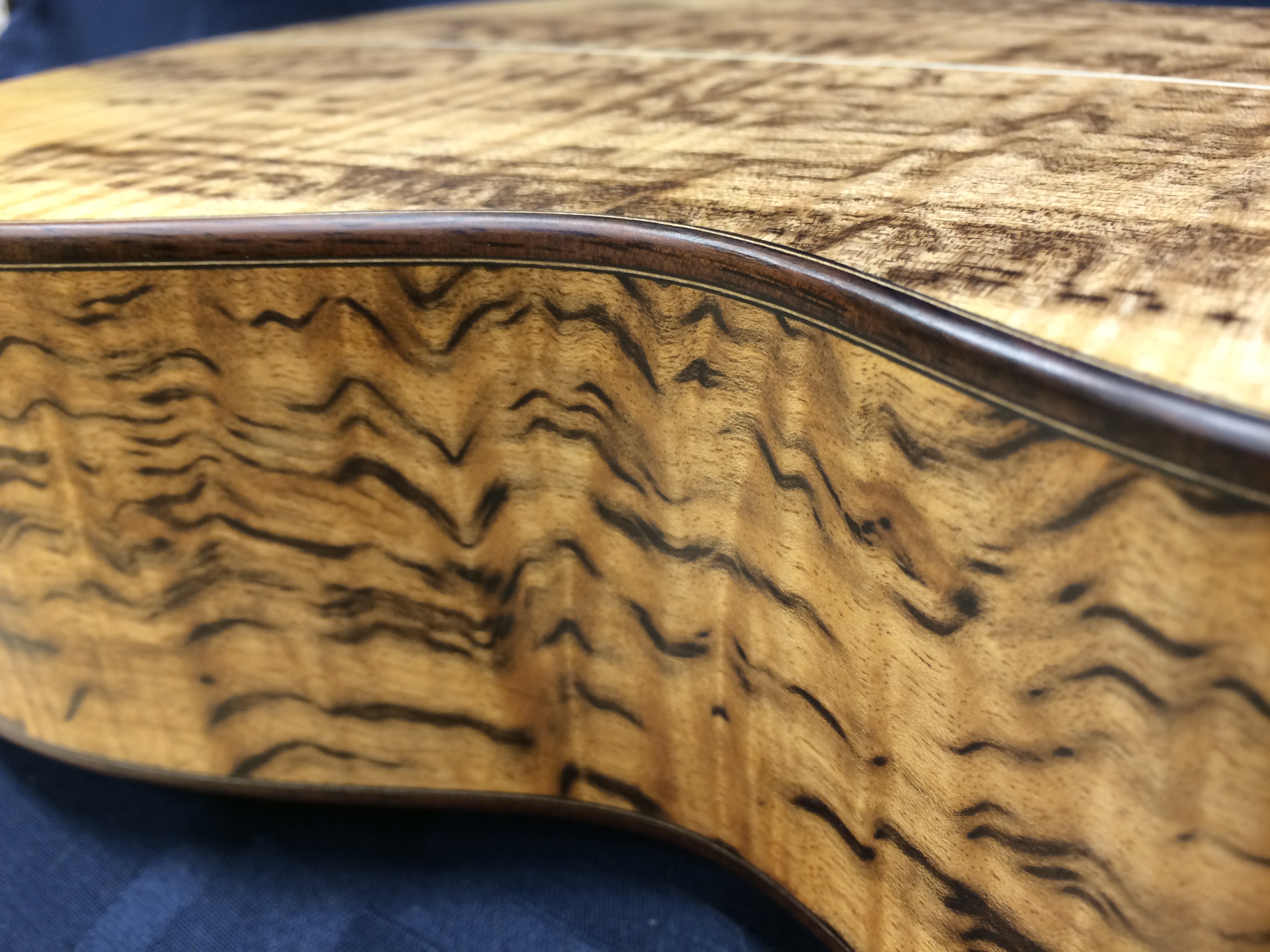
Anduin– Swiss spruce, Ziricote.River– Swiss bearclaw moonspruce, African blackwood (James Hill)Carmen/Mirai– Swiss bearclaw moonspruce, Koa, slothead (Arden Fujiwara)Prim– Swiss bearclaw moonspruce, “Richard Parker” myrtle (Suz Doyle)Katniss– Swiss bearclaw spruce, “Richard Parker” myrtle (Kimo Hussey)Black Orc– Swiss bearclaw spruce, African blackwood, blackwood rosette, Port Orford cedar neckLakshmi– Swiss bearclaw spruce, East Indian rosewood (Marianne Brogan)/(Nova Karina Devonie)Vorc– Swiss spruce, Madagascar “volcano” rosewood (Suz Doyle)Richard Parker– Swiss spruce, mind-boggling myrtle (picture at top of page), Port Orford cedar neck (Anne Loewen)
Models
- Lyric Tenor Ukulele – 17.9″/455mm scale. Named for the vocal type of legendary singer Luciano Pavarotti, this longer-scale tenor shares the standard tenor body but adds more finger room and an extra shot of espresso to the expressive, singing, and delightful voice of the Standard Tenor. Excellent for standard C6 as well as chocolatey drop tunings, which can extend as far down as baritone–a sprightly little baritone that fits easily in overhead bins when touring/traveling!
- Standard Tenor Ukulele – 17″/432mm scale. The Standard is a rich, strong tenor that adds the influence of great classical guitars to its Hawaiian roots. Ideal for standard C6 and D6 (Canadian) tunings.
- Skellig – Rugged and not-so-shiny (with an old-school varnish finish), the Skellig started as a new model but turned into a “philosophy” (although that word is too lofty) that can be applied to any of the models here. It’s a sensibility I learned in the violin family and golden era Martin/Gibson worlds–performance and beauty without the modern orientation toward “showroom perfection”. While my work always leaned this way, most of my instruments have been “shiny” because of the undeniable beauty and wider audience, though I kept the shiny finish classical-guitar-thin for better sound. But only a year after delivering a gloriously glossy tenor called River to James Hill in 2017, I saw it had become “Insta-vintage”😱, seemingly 30 years of de-glossing by virtue of his crazy playing and touring schedule. It took a long time to commit to exploring this more, but it finally clicked while traveling in western Ireland prior to the outstanding 2024 Ukulele Festival of Great Britain–maybe it was all that pub time listening to sessions? And (search “Skellig Michael”) what’s not to like with a little Star Wars connection as well?!
- Grand Tenor (GT) Ukulele – 19″/483mm scale, or 17.9″/455mm (Lyric Tenor) scale. Designed for Hawaiian jazz uke master Kimo Hussey, the GT’s curvy baritone-sized body sits in your lap like a perfect-sized puppy (or cat if you prefer), happily offering additional resonance, complexity, warmth, and sustain, and more spacious fingering (all without licking your face, or sinking its claws into your leg). Standard 13th fret neck-join puts the bridge in the classical guitar “sweet spot” (12th fret neck-join for the Lyric Tenor scale). Extra-versatile for creating distinctive sonorities with drop and/or altered tunings, making even standard chord shapes sound suddenly lush and new.
- Baritone Ukulele – 20 1/8″/51cm scale, or 19″/483mm scale. The well-known 20.125″ (Martin) scale provides a 14th fret neck-join, for standard baritone G6 tuning plus the wide world of altered tunings. Also available with the 19″/483mm scale, which provides more comfortable finger stretches–if Marcy Marxer says so it must be true! Insider tip: with the right strings, a baritone sounds deluxe tuned up to Bb6, yet still has string tension less than a classical guitar.
- Little Five – A comfy GT-sized body with five strings tuned to different pitches (five courses in geek-speak), right between a uke’s four and a guitar’s six. With roots in the ukulele’s ancestral rajão as well as modern playing (search on “Keith Richards 5 string guitar”, or “Taylor Jacob Collier”), the L5 opens up a treasure trove of juicy chord voicings, classic fingerpicking patterns, extended melody range, and counterpoint possibilities. As a starting point think “Bari-Tenor”, tuned low D to high A (DGCEA); both warmth and sparkle (bonus: two “bass” strings). Optionally drop a whole step (or even an entire 4th) if it fits your voice better or fills a needed range in your group’s mix. Venture further with CGCEG (open C), or something with fifths…then swap in a re-entrant 5th string for re-entrant sizzle while retaining all the melody notes of a low G uke (plus tunings from the banjo universe)…and then imagine the 4th string re-entrant as well (rajão tuning) for a distinctive sonic palette with delicious close-voiced chords. A sweet and versatile five string orchestra for singer-songwriters, fingerstyle or classical artists, and other adventurous souls.
Whatever the model, every instrument is a carefully conceived individual: a dance with the wood, designed and built to delight.
Standard features
My standard build includes every feature that I want in a uke.

- Beautiful, tonally and structurally excellent body woods.
- Multi-stage graduation (“voicing”) of top and back.
- Protein glue for bracing joinery.
- Paua abalone rosette.
- Custom “V” end graft.
- A thin, acoustically responsive finish.
- Sculpted high performance rosewood tie bridge.
- Comfortable and fast neck of Honduras mahogany, with a silky smooth satin finish.
- Extra-fine ebony fretboard, highly visible position markers, traditional flat profile.
- Butter-smooth fretwork.
- Delicious headplate wood with signature crescent moon inlay.
- Gold or black Gotoh UPTL tuners with black knobs.
- Bone nut, ~1.5″/38+mm width.
- Bone or Tusq saddle, fluorocarbon strings.
- Hardshell case.
…and most important: my greatest care throughout the build process.
“Pricing”
Important Notice: As of August 26, 2025 I will not be operating as a business until further notice due to insurance complications as my daughter Meghan’s family takes over the property where my shop resides. This doesn’t mean that I’m out of business; it simply means that until further notice I can accept only reimbursement for out-of-pocket expenses like cases and shipping. We’ll see if this means an unexpectedly early start to the non-business model discussed in the next section–never a dull moment around here!
—
Why is “Pricing” in quotes? Over time I’ve realized that every aspect of money and business—orders, deposits, backlogs, and so on—draws off energy I’d rather use on ever more expressive instruments and the music, joy, and community they could create in your hands. With age 70 coming in hot and enough amazing wood for three lifetimes, I’m moving toward eliminating the business aspects in order to focus entirely on core goals.
This is unfamiliar terrain and the approach will likely change as we figure it out, but I’m evaluating a “pay it forward” model starting perhaps as soon as 2027. Rather than paying me, you’ll send your hard-earned money to Doctors Without Borders, Mercy Corps, Oxfam, Seva, the Nature Conservancy, Givewell, or another organization working in areas of great need. Perk: you get the tax deductions! This is all new and uncertain, so we’ll talk to develop a common ground.
For now I’ll leave the 2024 pricing discussion below as a guide, since value is still a relevant question.
—
Most builds land between $4000 and $7000 even with spectacular woods, though the rarest woods, custom cases, and/or major inlays by Larry Robinson and others go higher. That’s a lot, I know; I have thoughts on that below. I also stretch to make things possible for professional uke players and teachers, many of whom are already “paying it forward” in the challenging field they’ve dedicated themselves to.

If the prices give you pause, I understand; I have a mandolin from a legendary contemporary maker, a real gem. It cost a multiple of my uke prices, and I repeatedly decided not to get it–luckily I repeatedly changed my mind! Knowing this scary feeling, I’ll do my best to help you.
Finally, while spectacular woods and exotic details may add enjoyment, they are not about great tone, playability, or reliability. Without exception I build with meticulous care, using woods I trust and that sound and look beautiful to me. I don’t hesitate to provide my standard instrument to performers at the highest level.
Contact me to discuss exactly what you want.
<February 2021 update: African blackwood, Macassar ebony, Amazon rosewood, and a few other already-scarce woods I love are disappearing from suppliers. Thankfully I have a number of seasoned sets, and other great sounding woods–East Indian rosewood (EIR) for instance–are still abundant. But the prices of hard-to-get species are inevitably moving upward, as they did long ago for Brazilian rosewood. A few years back the Santa Cruz Guitars website showed $16,800 to upgrade a guitar to top flight Brazilian rosewood!!> <May 2024: I just found a great set of The Tree (an ultra famous mahogany) for $14,000!😱>
“Why should I get your instrument rather than…?”
Let’s be honest: tons of music and fun can be had with modest instruments. And–a reality check for custom builders–there are relatively affordable instruments with pretty woods, super glossy finishes, serviceable tone, the latest hot features, and (with skillful setup and tweaking) good playability. There are weaknesses of course, but it’s nonetheless remarkable.
That said, a truly fine custom instrument is a different beast. Blending my 50+ year pursuit of craft and sound with your needs, we create a musical partner for you that has exceptional responsiveness, expressive range, playability, touchability, and beauty, with delight and longevity that bloom over the years. These resist easy measurement but resonate strongly in my memory; the experience of playing truly magical instruments and studying with masters pulls me toward them on every build.
So why one of my instruments? Because you sense the delight; you feel a pull to live with and make music on this kind of instrument, and you have a good feeling about working together.
A clue that I’ve found revealing (for tools as well as instruments) is whether I gravitate toward it; whether it pulls me into holding it, using it, exploring and enjoying it. The legendary luthier and teacher Jeffrey Elliott uses a wonderful term: allure–a constellation of qualities that brings you back again and again.
This site attempts to give you a sense of what I’m like, how I build, and an intimate view of my instruments–insofar as the internet can–to help you sense whether you feel that pull, the tug of delight and allure.

“But…it’s so expensive!”
Still reading!? You are dedicated.
You’re right—it is expensive. If it weren’t for my experience with handmade instruments I’d constantly be apologizing for my prices. Sometimes I still do, and here I am explaining them!
Summarizing what I’ve said elsewhere, my best advice for choosing an instrument is to check the quality of materials and construction, then follow your sense of allure and delight as regards looks, sound, feel, and all the intangibles.
Consider a $6500 instrument—a serious purchase, I agree! To help navigate this I’ll discuss comparisons below. But while important, prices have rather surprisingly ended up fading from mind on things I love. What seems to matter more is the joy, grace, connection, and even healing that an object or activity helps spark into life.
Consider this ukulele, then, in the context of other (2024) prices: a third of a top of the line Bernina sewing machine; ~20% of a nice Harley-Davidson touring model or basic Toyota Tacoma; a nice (but not extravagant) trip to Europe for one; a small heat pump (installation extra); a well equipped 16″ Macbook Pro with a premium photo printer; and so on with comparisons more pertinent to your life. Among uke manufacturers, Kanilea and Kamaka for instance have factory instruments costing more, and that’s before starting to customize, which can run past $10,000. Don’t rush—let it ferment. Does the uke keep bubbling back up, or does it fade?

Now let’s explore the world of handmade instruments. Really fine ukes require all the skill and most of the work of a guitar, but generally sell for quite a bit less. Why is this?
It is largely due to the vast number of ukes that cost under $200. Against that backdrop, a $500 uke sounds high end, and some music stores present them as such. A $5000-$9,000 ukulele, much less $20,000? “Inconceivable!!”
…until you explore fine instruments a bit further. Let’s set aside the astonishingly expensive violin world and stick to examples of quality mandolins and guitars:
- F5 mandolin by Lynn Dudenbostel – $23,000 (2016, used). The simpler 1A model costs around half. Gilchrist, Nugget, Monteleone, and others are similar (when you can find one).
- East Indian rosewood/spruce (or cedar) classical guitar from Jeffrey Elliott – starts at $19,000 (2016)…but there is a 12 year wait list and no new orders are being taken. Dealers own all the remaining wait list positions and mark Jeff’s prices up by 50% to 100%.
- Factory guitars regularly inhabit this territory: built from the same myrtle tree as my tenor ukuleles Richard Parker and Evenstar, a gorgeous 2020-ish McPherson guitar was $28,000. Wow!
There are of course fine instruments that cost less than these well-known US makers (with numerous factors affecting the price), but instruments between $10,000 and $30,000 are common from fine makers and dealers.
Here’s an even bigger surprise: most of these instruments belong to folks of relatively ordinary means. Back in the 90’s someone at a bluegrass festival lent me his $10,000 mandolin to perform in an impromptu band, feeling that my $1000 vintage Gibson wasn’t up to the task. I was stunned, but later realized that there were numerous valuable instruments gathered round the evening campfires and resting in tents and campers all around the meadow. I’ve played several $200,000+ mandolins at festivals (that’s not a typo!), though that clearly leaves the realm of “ordinary means”!
Guitars, mandolins…so what? Are there ukuleles in this price range? Yes: at least one above $20,000 that I’ve seen, and a modest number over $10,000. From $5000 to $10,000 however, yes indeed—tables of them at the 2016 Ukulele Guild of Hawaii exhibition.
Underpinning these prices are forces grounded in the nature of highly detailed work, and in our views about life:
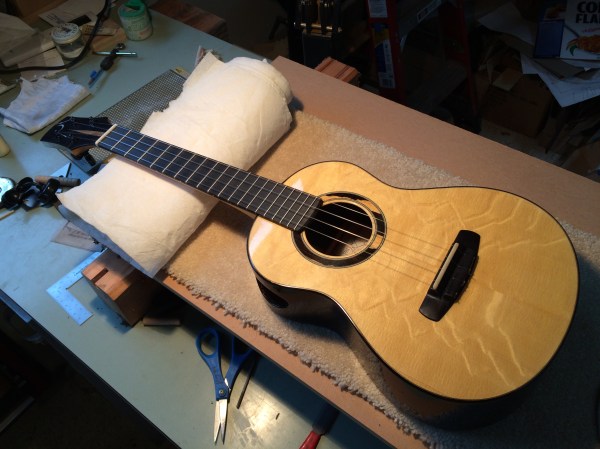
- On the maker side: without resorting to factory methods, four to maybe fifteen instruments per year is a full plate. (Some manage more, but I personally suspect they use droids). Working 250+ hours a month, in 2016 my baseline instrument had $600-700 of material expense and I completed five that year (my biggest year ever). Factor in the cost of shop space, overhead, maintenance, business insurances, shipping, professional and dealer discounts, health care, taxes, and so forth–you can do the math.
- On the buyer side: some players–at some point in their life–decide that the joy of a fine instrument is at least as compelling as a car down payment or big vacation…and will last a lifetime (actually, more with good care). And heck, in the ukulele world one can have outstanding high G, low G, and baritone ukes for less than an Elliott or Dudenbostel!
So there you have an introduction to custom lutherie pricing. Perhaps now (like me) you will be amazed at the prices of great ukes for altogether different reasons.

Pat Megowan Stringed Instruments
 Pat Megowan Stringed Instruments