Well whadyaknow, take two

Last September in a blog entry I celebrated a personal first–my mahogany sideboard’s appearance in a book–and commented “only 5 billion more publications to catch up with Sam Maloof”.

A few weeks ago a friend mysteriously ordered me to do a Google image search on “Maloof trestle table”. Incredibly, one of Maloof’s trestle tables looked EXACTLY like my sideboard, even down to the lighting and backdrop. Well whadyaknow!

Oh wait…it is my sideboard, courtesy of Google’s search algorithm and my silly comment. A timely  coincidence with NPR’s “On The Media” this evening, which had a segment on personally targeted search results that Google and other search and social media programs increasingly deliver.

Having mentioned Maloof four times in this post, perhaps someone will order one of his famous rocking chairs from me. I’ll do a nice job…

Repeat offense

What is it about March? Our perennially late February daphne coming into full bloom, the Ides of March, St. Patrick’s and St. Joseph’s days, the start of spring, the first restless geese heading north…and the urge to make a dining table. Naturally. 
Or maybe it’s the annual guild show falling on the first weekend in April, and a notion that designing and building a table in a week isn’t as obviously ridiculous as a chest of drawers or china hutch. If the woodworking referees gave yellow cards for foolishness, I’d have been sent off the field last year after on a second yellow for this:
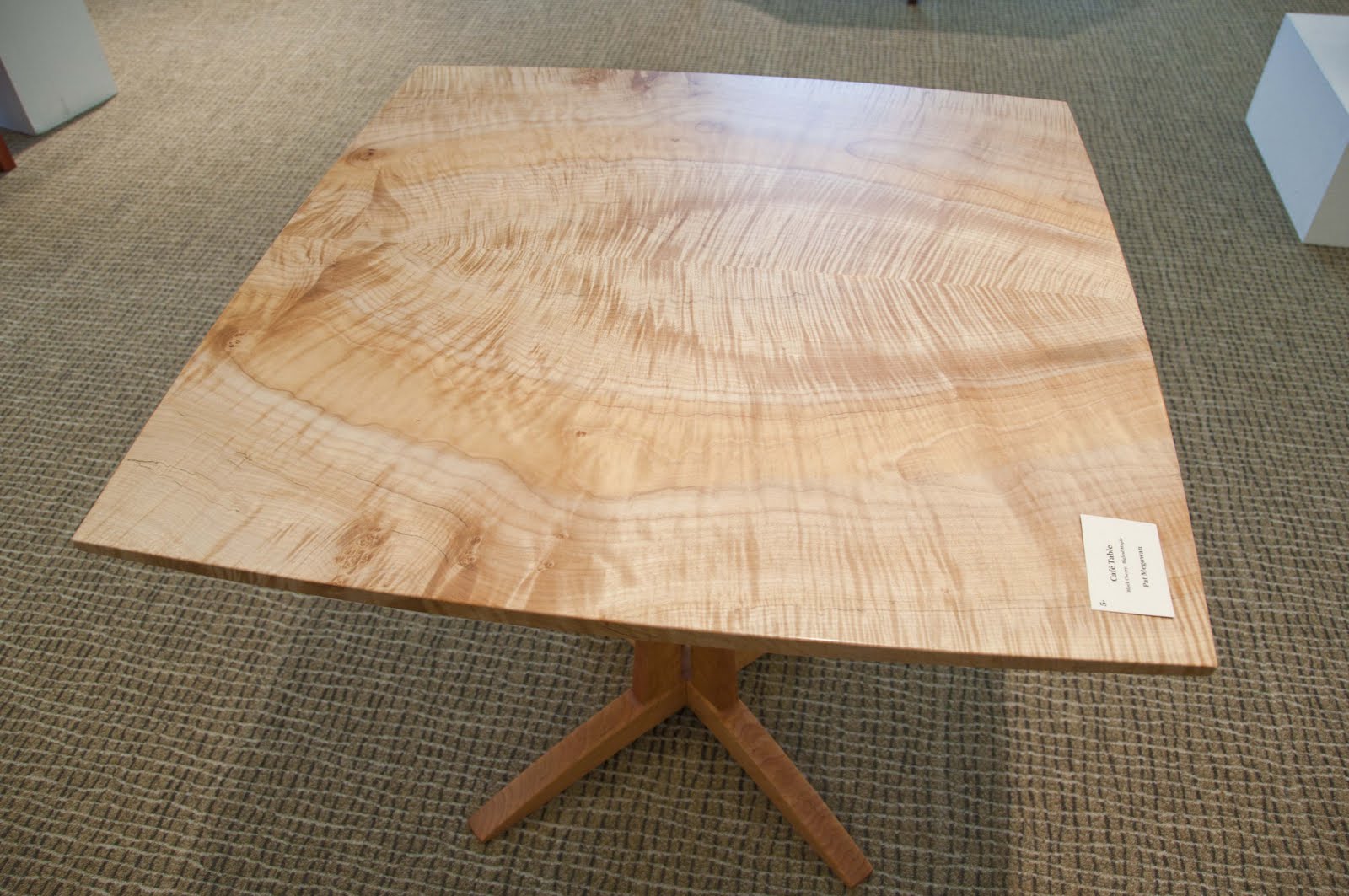
Maybe the ref was looking the other way. In any case, the third year running was the tightest schedule yet, six and a half days until the show load in. The goal was a pedestal table that would look good with last year’s trestle table. 
These boards from local sawyer Stu Hemphill were just the right size for a generous cafe table.

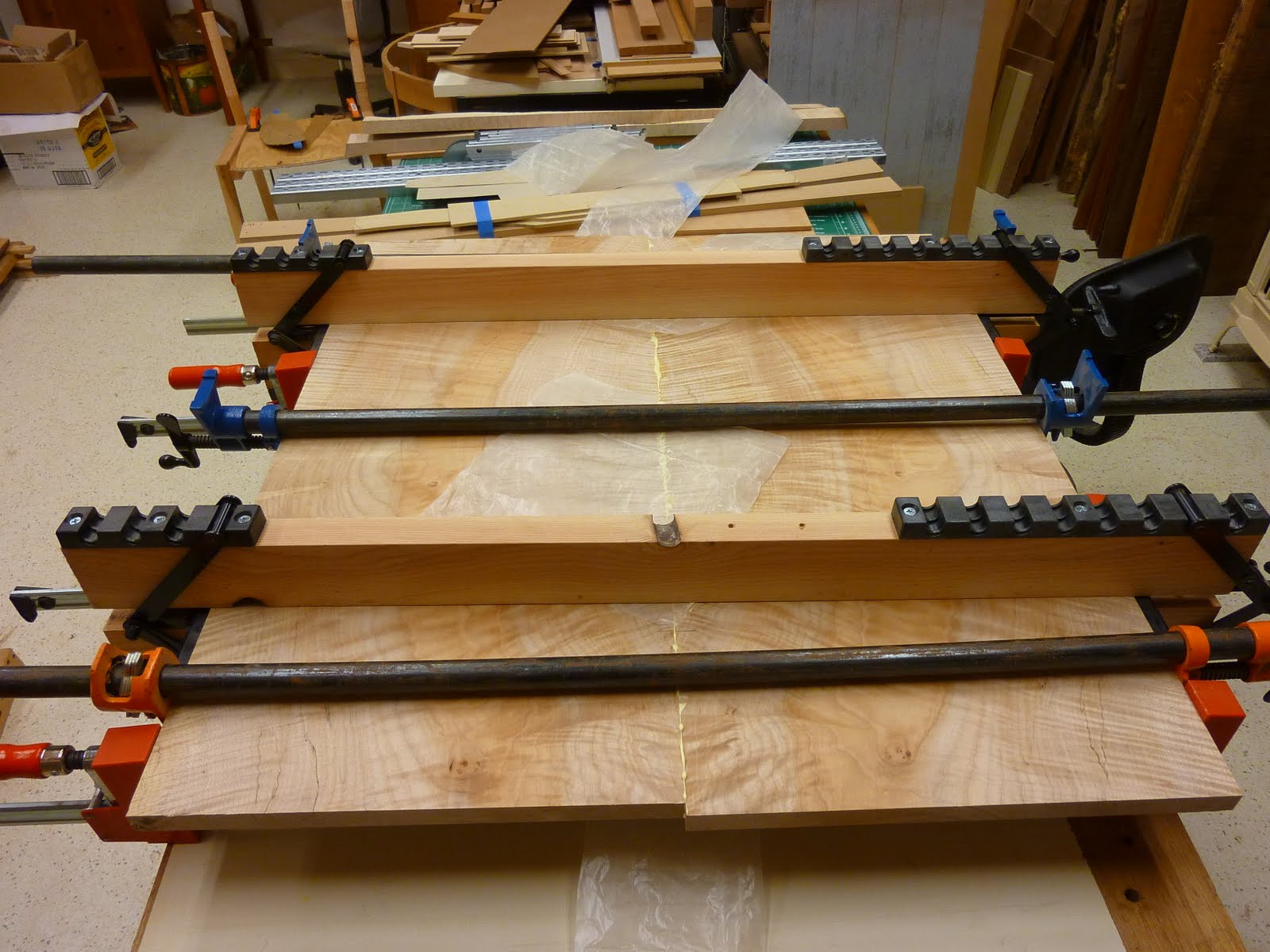
So it was off to the races. After trimming the planks were 17″ wide, proving yet again that whatever size jointer you get–mine is 16″, enormous by small shop standards–it’s never enough. Nonetheless day one ended with the top glued up, a key milestone given how long finishing takes.

The following day I prepped the top for finish with a secret weapon: a high angle smoothing plane from my friend Konrad Sauer. Cute as a bug, smooths wild wood better than magic.

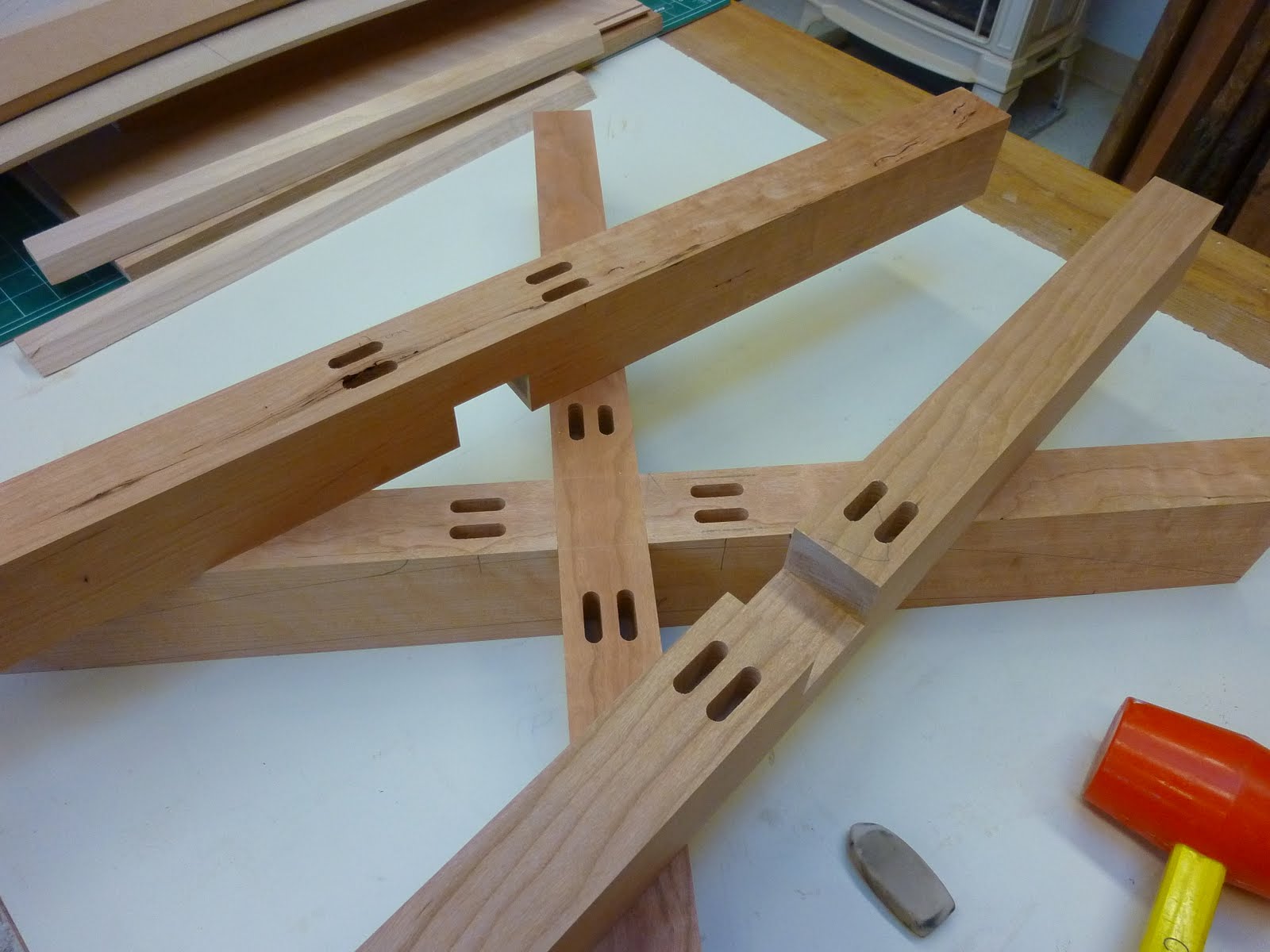
On to joinery, lots of it.

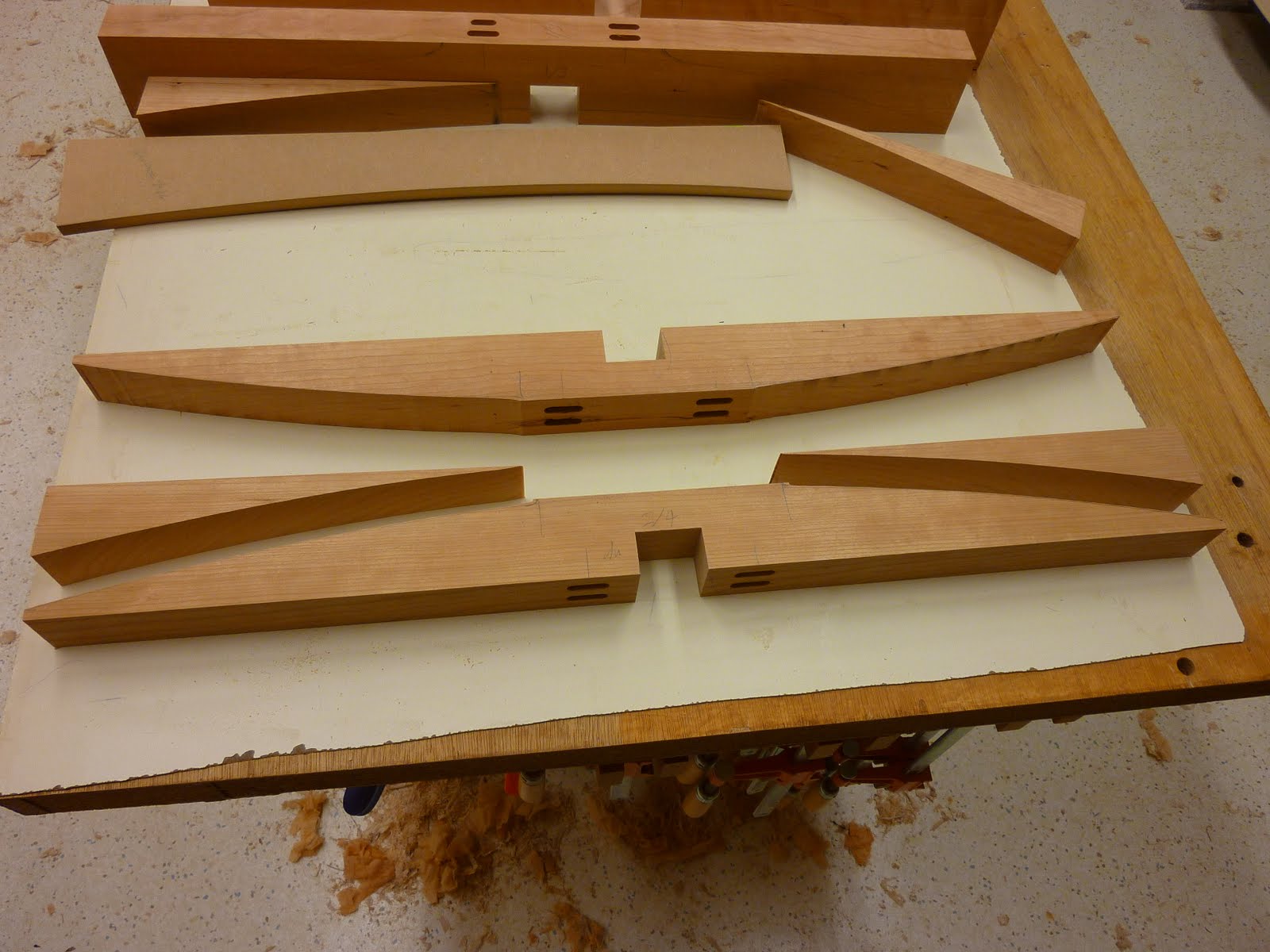
And then the apparently mandatory dyslexia moment–can you see what went wrong on the crosspieces that support the table top?

Yep, I cut the curve on the wrong side of the lower piece. The attempted repair

would have been strong enough and inobvious to most, but I’d have regretted it forever so instead made a new piece ever so carefully.

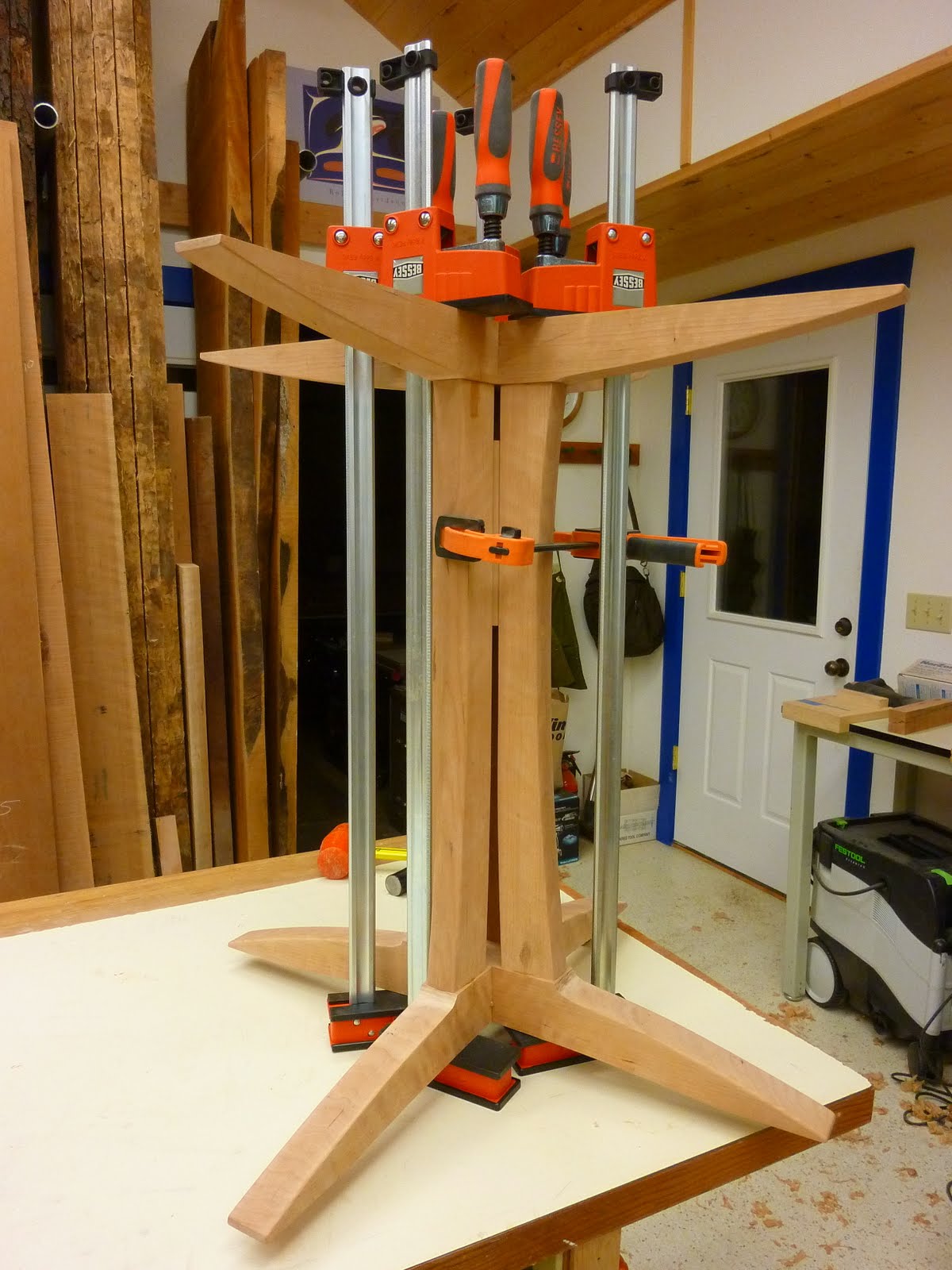
Given how things interlocked it seemed best to glue up the entire bottom in one go, an exciting but hazardous prospect. Old Brown Glue made it possible; it has a long working time and lubricates rather than locking up like the more common white and yellow glues. It requires gentle heating to get the right consistency and strings out like hot mozzarella, but after a glue up like this the subliminal suggestion of pizza is best acted on at once.

By the time glue had dried the show setup was barely 30 hours away, not enough time to carve the foot to leg joint as I had envisioned. But it was appalling to consider leaving it like this:

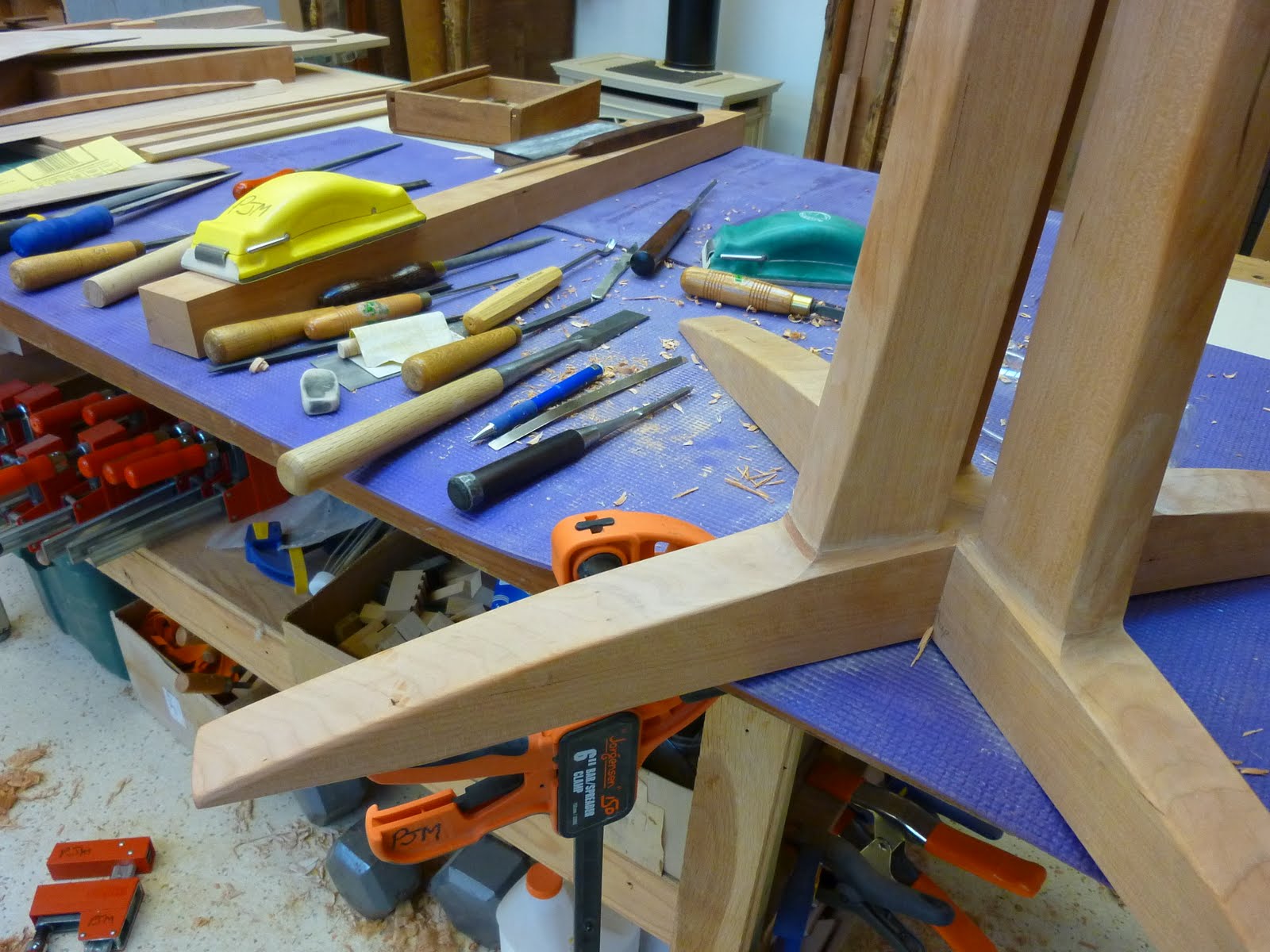
Oh well, it’ll have to be a bit late. This would have been easier before glue up, now it was tricky to approach from a workable direction.

Although it doesn’t show here the cherry is quite curly, which makes the carving trickier. I went through quite a few tools looking for solutions.

Much nicer!

Fast forward: at the show, one hour after the doors opened. Tables look lonely w/out chairs, so I snatched some from my friend Bill Storch’s table. Bill puts up with a lot–he’d already sprayed the table top finish and cured it in his sauna, a story for another time. But he got the last laugh, his table with chairs won best in show. Nice work!

Konrad, commenting on the subtle wood choice this time around, said that a red air raid siren would be a perfect finishing touch.

Talk about the pot calling the kettle black. Here’s a piece of his work:

What might have been

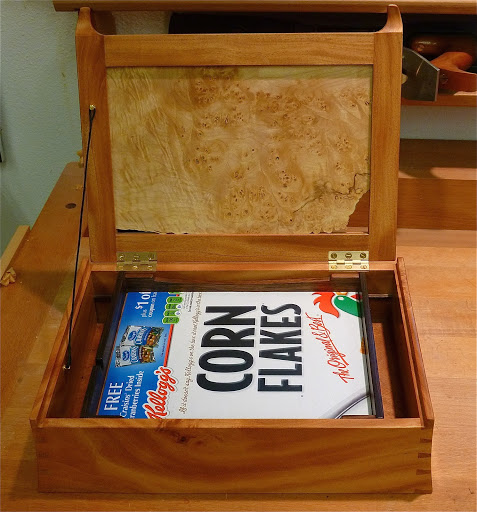
The Cuban mahogany box is now in the care of UPS, speeding to Seattle for a just-in-time appearance in the Annual Box Show at Northwest Fine Woodworking. The last few days had more adventure than I might have wished, including an out-of-proportion circus concerning the bottom of the tray.

I like to open a box and find a prize inside, kind of like Cracker Jacks. Lacking time to make an elaborate tray I scoured my wood supply for something special and stumbled on some maple left from a tree taken down for the renovation of Kearney Hall at Oregon State. Most of that wood went to a gift commissioned by OSU for the major donor in the project:

but a single sawn veneer remained. Its strong graphics complemented the Macassar ebony of the tray sides and provided a satisfying surprise when the lid was raised. I made up a panel with the veneer (an overnight stay in the vacuum press), but it tore out badly when I planed it to thickness the next day. I tried to remove the tearout in the usual way with a handplane, but the panel was small and warped slightly from the pressing and resisted. 
Anxious to get this minor piece of the project complete, I tried to emulate my friend Bill Storch–who can perform miracles with a belt sander–and safely sand the tearout away. The panel tried a new trick: each time I sanded a side, the panel would warp the opposite way, presumably something to do with the heat that sanding generated. Stopping often to check the work and flip it for a balanced result, I gradually removed tearout until, just as the last torn fibers were disappearing…a ghostly pencil mark appeared in the center. 
A pencil mark? How can a pencil mark appear while sanding? Sanding makes pencil marks disappear, and anyhow there wasn’t a pencil mark in the first place. Except for one on the side I had glued down. 
Bad words. 
Yes, even though there appeared to be plenty of margin when checking the process, the center had become so thin that you could see the pencil mark on the glue face, and the bland face of the core. 
It would have been nice,

but no luck. I thought about inlays and various other fixes but the sand-through was in an awkward spot and there was nothing to do but cover it.

This was probably my favorite option:
but I wasn’t sure the gallery would approve, so I went conventional in the end, shown here with the chisel used to carve the handles:

In this close up you can see a bit of the striped Macassar that I liked with the sadly unusable maple.

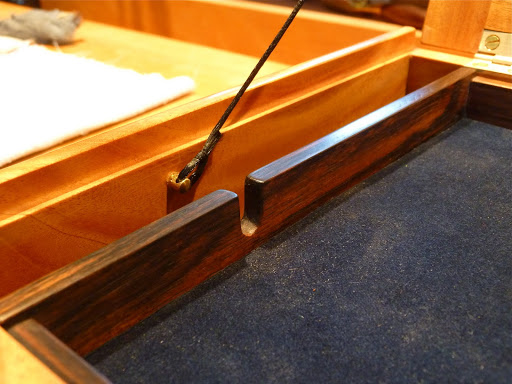
And here is one of the handle/pull/grabber-do things.

I started using these after watching everyone lower the lid on my madrone box (pictured in previous post) by grabbing the corners even though there is a perfectly good handle in the center. They are also fun to make, though they resist being finalized; I recarved them slightly three or four times after applying the finish, the last time barely an hour before packing it to ship. They need to be just so. 

Fine old Cuban

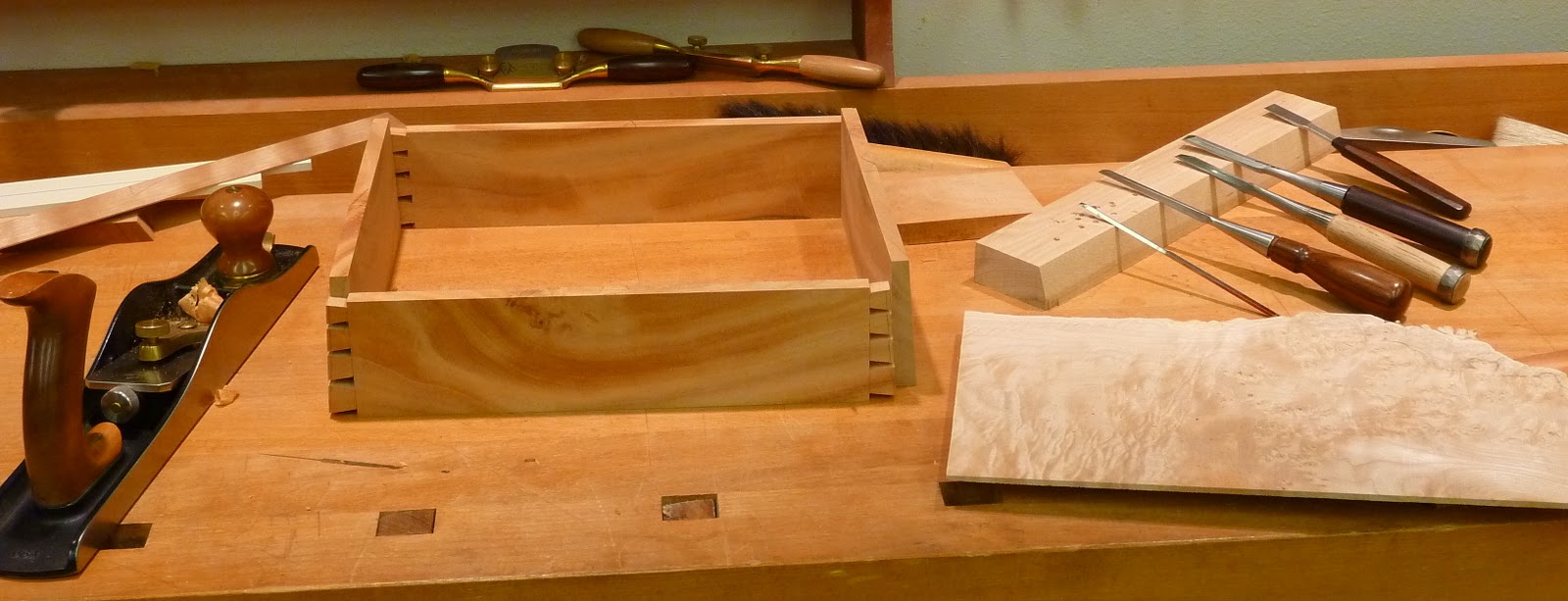
Mahogany that is. An odd shaped scrap broke from the end of a big plank where a bark inclusion had weakened the connection. I need wood for a entry to the rapidly approaching box competition at Northwest Fine Woodworking, a great Seattle gallery. This material is famous for its good working qualities…so it’s off to the races.

It’s hard to see but a big knot makes much of the scrap unusable. On the other hand, when I opened up the plank there were nice pin knots next to the bad knot.

There they are behind the corner I just finishing sawing.

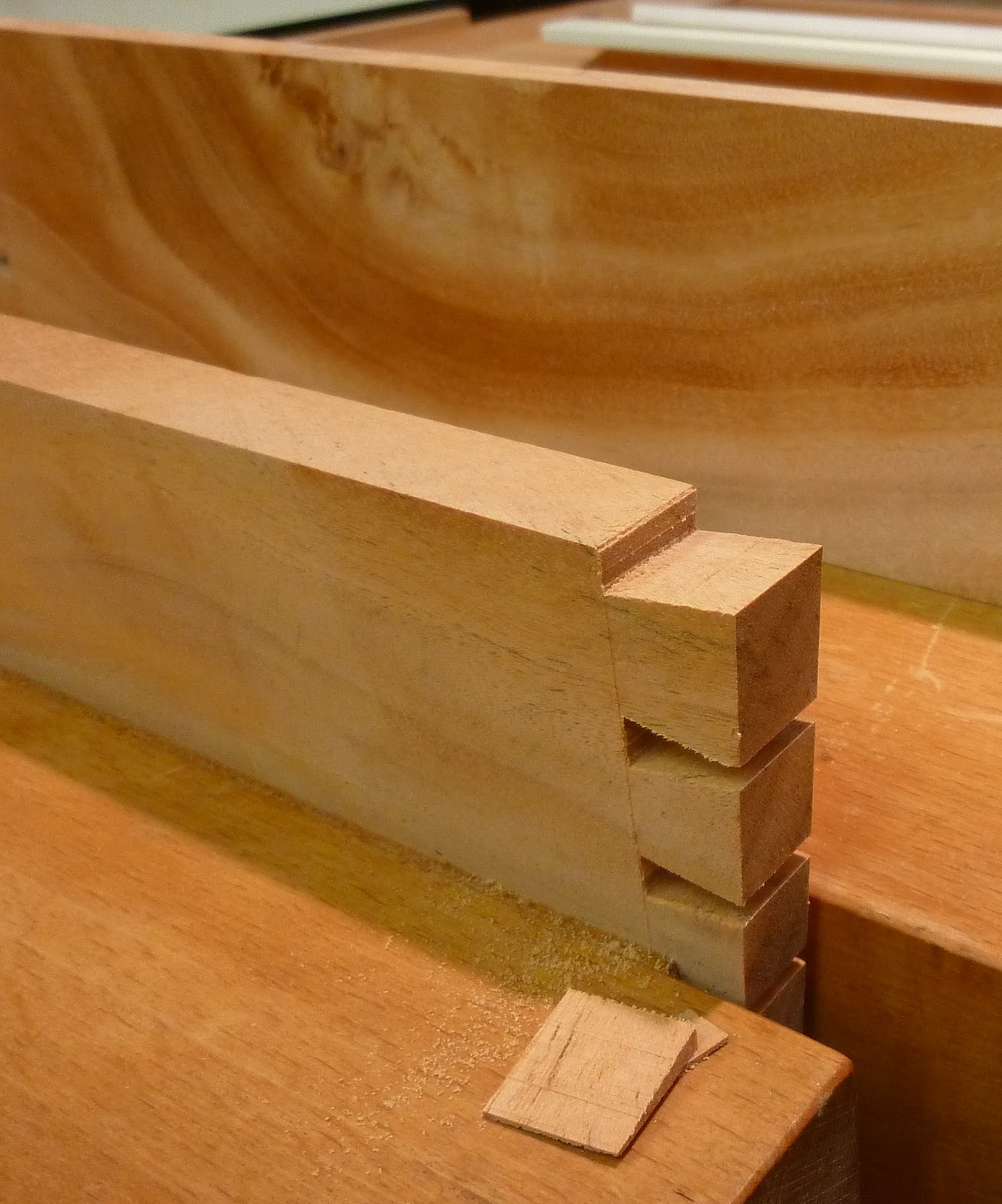
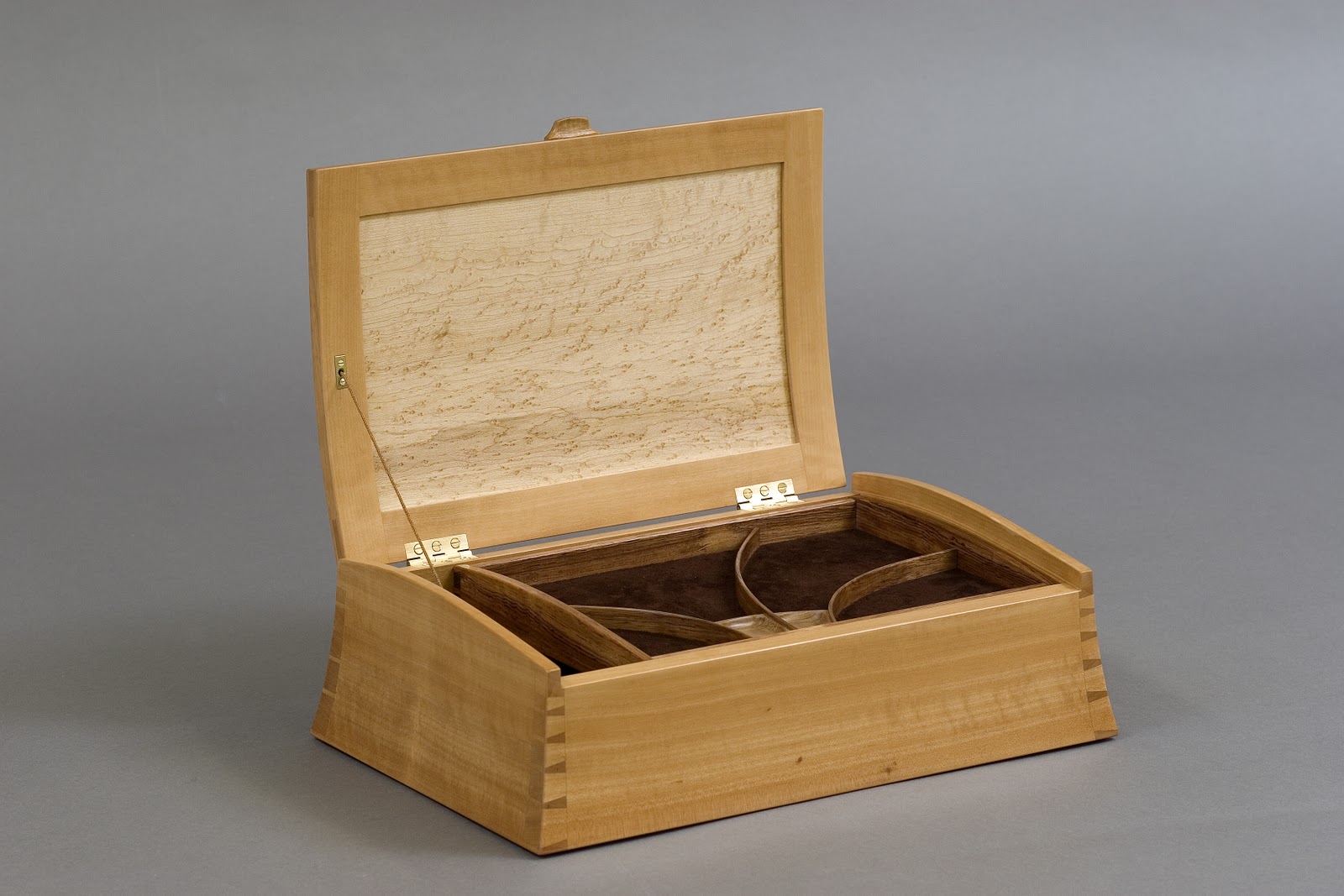
I also decided to taper and curve the corners of the box. However, given the schedule I will refrain from doing that to the inner shoulder of the dovetails, which would add many hours of work as it did to this box:

Starting to look like a box

Here’s the top, some bigleaf maple burl left form a box for my big sis Colleen. And more pin knots, why not! I’ll blend them somehow.

What do you see?

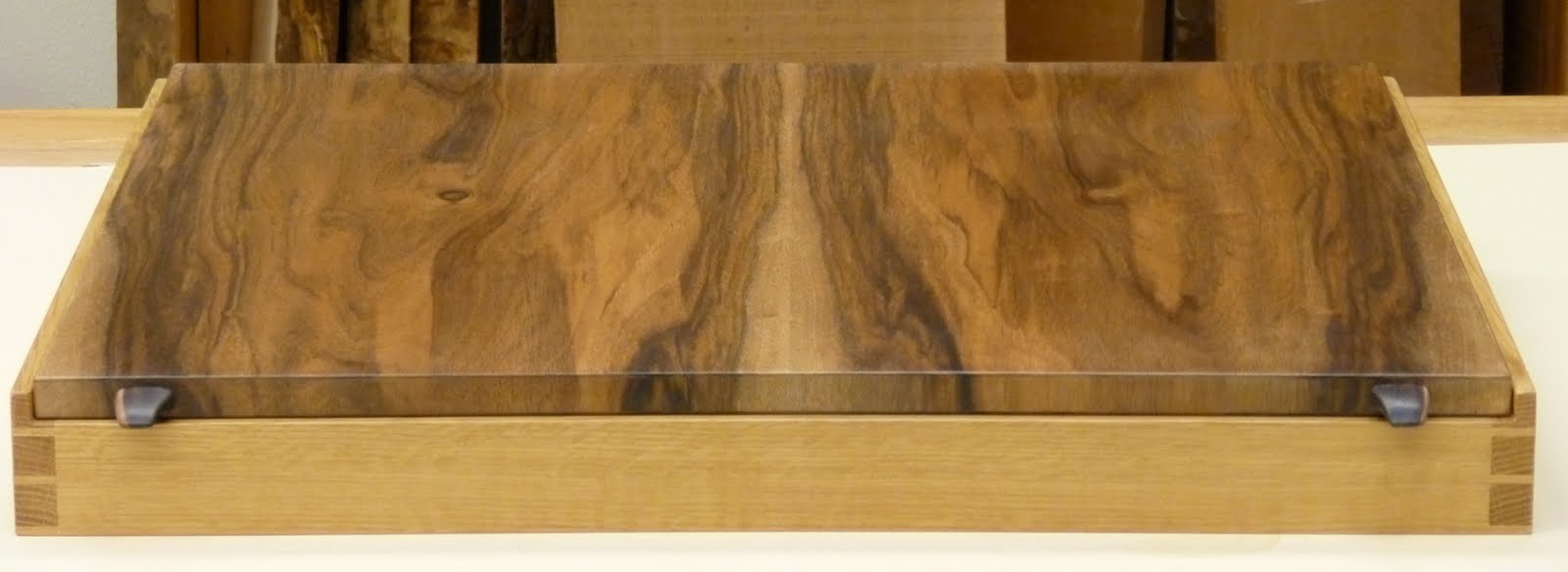
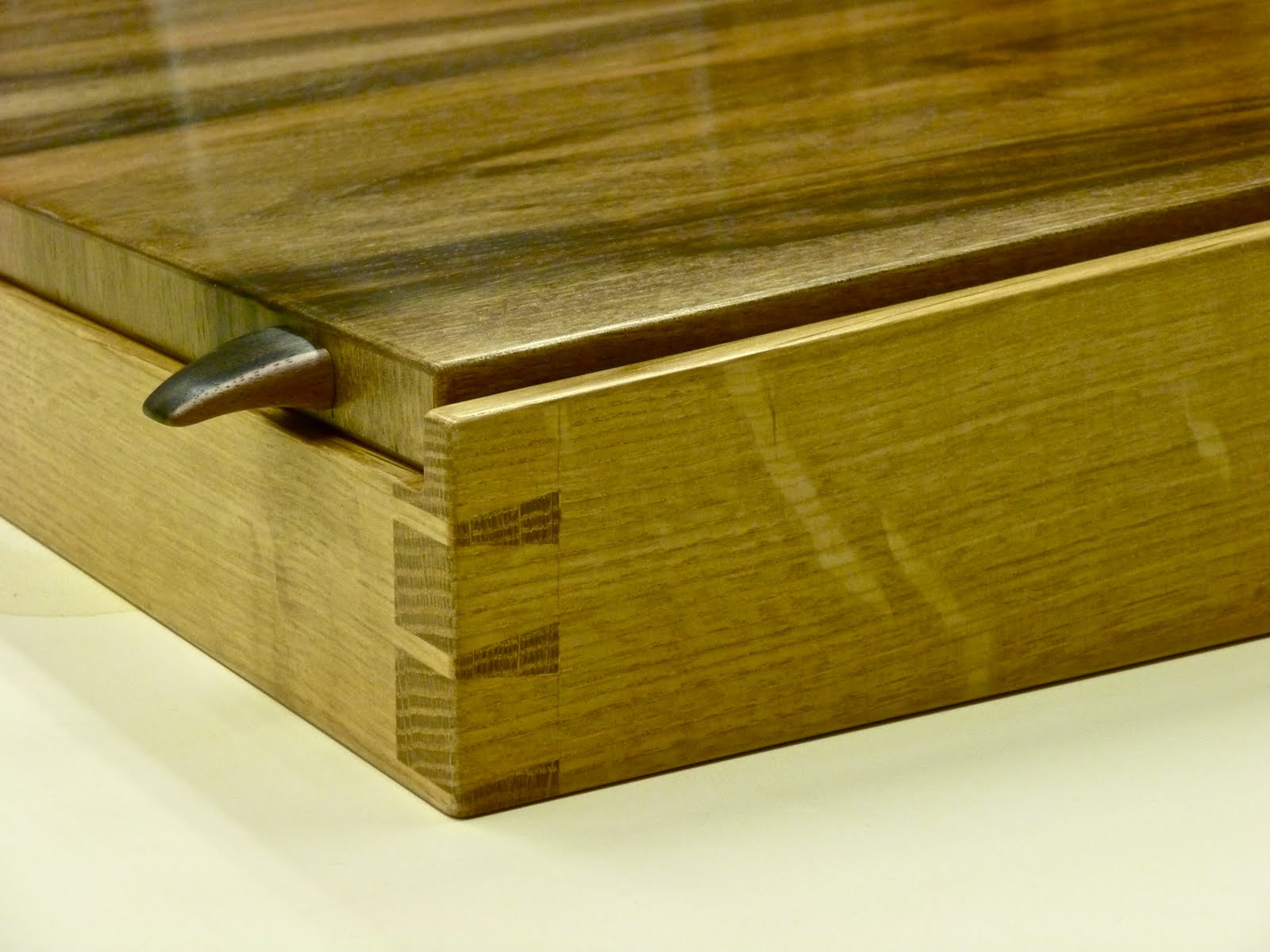
A recent piece in English walnut and Oregon white oak–a lap desk for a Benedictine Abbot. The walnut is so graphic it was like a week long Rorschach test. Depending on the orientation I saw a heron, sturgeon, lion, horse, pelican, lobster claws…but at least no partridge in a pear tree.

The pulls are Macassar ebony. Since everyone seems to handle box lids by the corners, I put the handles there–so now they’ll use a credit card to pry it open at the middle!

I’d like to use this wood combo again–they both work very nicely.

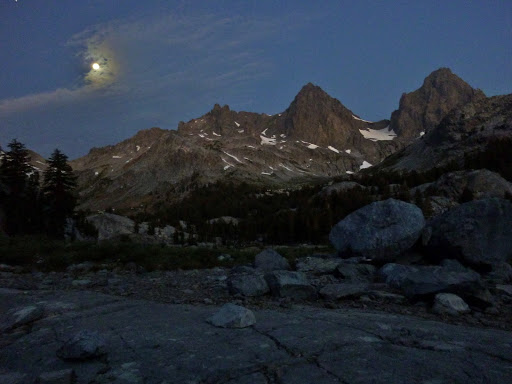
Narnia

Maybe? 
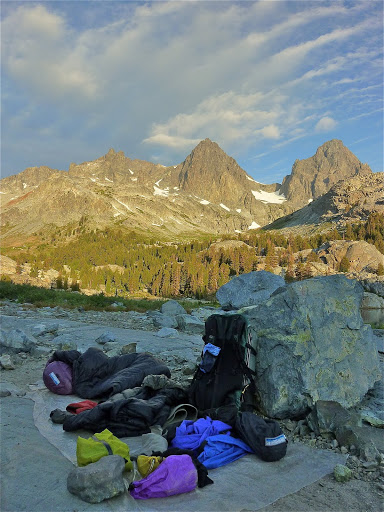
The Narnian campsites are somewhat spartan, but Reepicheep would not be fazed:
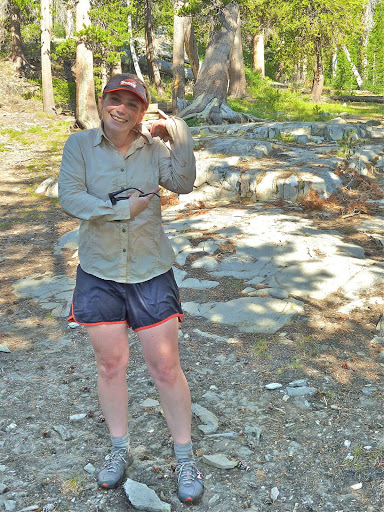
Meghan the Bold, faithful co-explorer, after an unexpected encounter with lake-effect gravity:

And the feasting was grand…peach pie at 10,000 ft. sped Meghan’s recovery. 

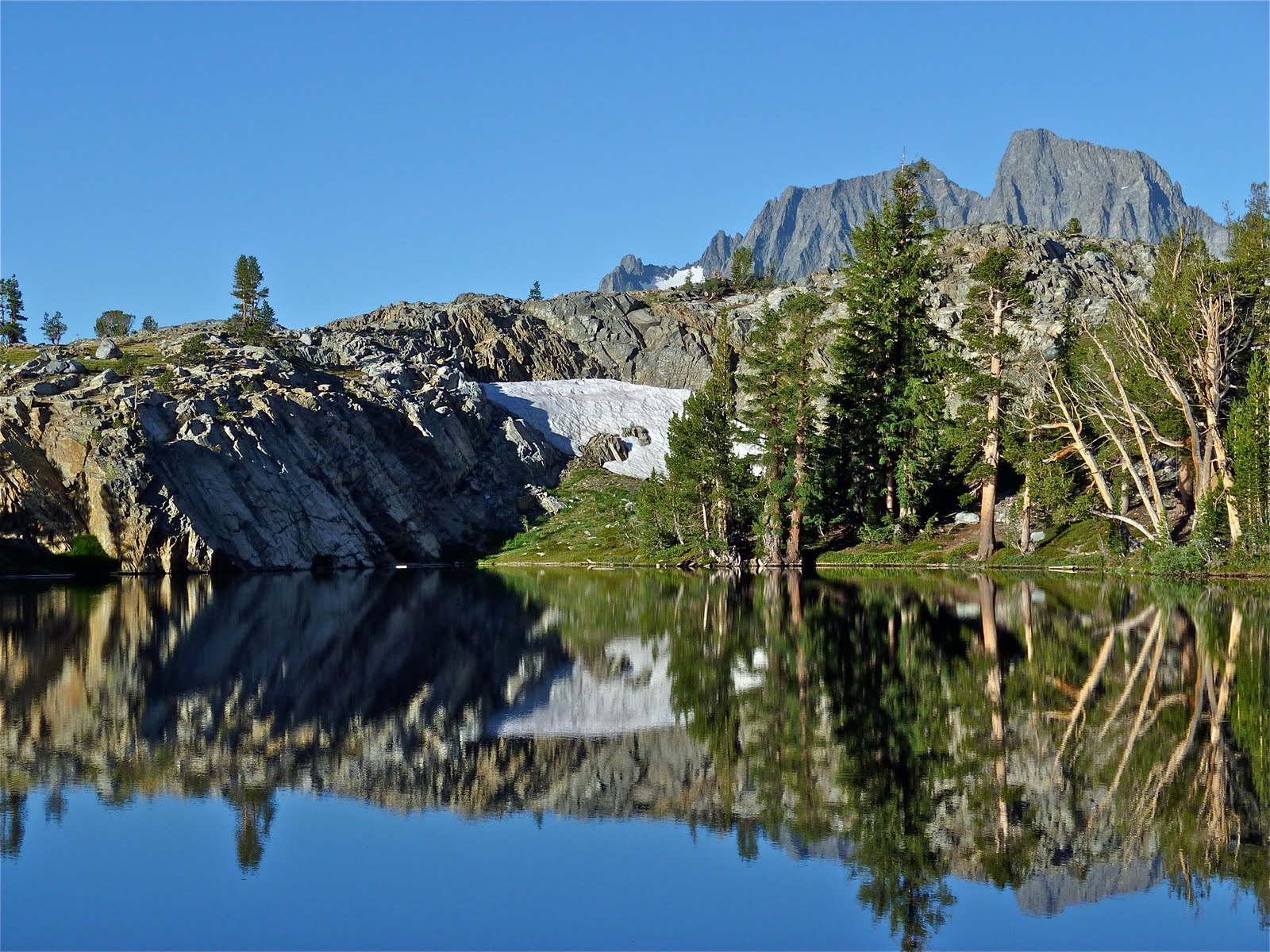
If these bear a striking resemblance to Ediza Lake in the high Sierra near Mammoth Lakes, and the smokin’ fresh peach pie at Saddlebag Lake, that’s just a mighty big coincidence.

I must have slept soundly

Hiking past campers at Clark lake early the next morning, they said bears had visited camp and that they had used an air horn to drive them away.

“No, you’re joking!”.

“Not at all. We banged pans, yelled, and used an air horn.”

I have to say the new sleeping pad is exceptionally comfortable.

Day 3 can be summarized as:

Thousand Island Lake. Foolishly, after several hours I hiked on, planning to return in a day or two. Five miles and dinner later I finished the day by climbing Donahue Pass (which had looked so distant the night before), wandering a few feet into Yosemite National Park to gaze down shadowy Lyell Canyon toward Tuolumne Meadows–it was uncomfortably close to nightfall–and dragging back to camp. I was dragging all the way up as well, looking for any excuse to quit, but the trail is so well graded it seemed lame to turn back.

Camped nearby were Doug and Joanne, serious travelers and keen on natural history, and we talked as moon and stars took over the sky. They mentioned that the Perseids meteor shower was still happening, and waking later I slipped on my specs just in time to catch a cross-the-sky shooting star. Nothing like luck; I usually see little during the Perseids.

Day 4 started with slow creekside ramblings in the upper Donahue basin

but ended with a slow gimpy five mile walk back to Thousand Island Lake after jamming my knee on a mis-calculated jump. Argh! Then again, any day ending at Thousand Island is not a complete Argh.

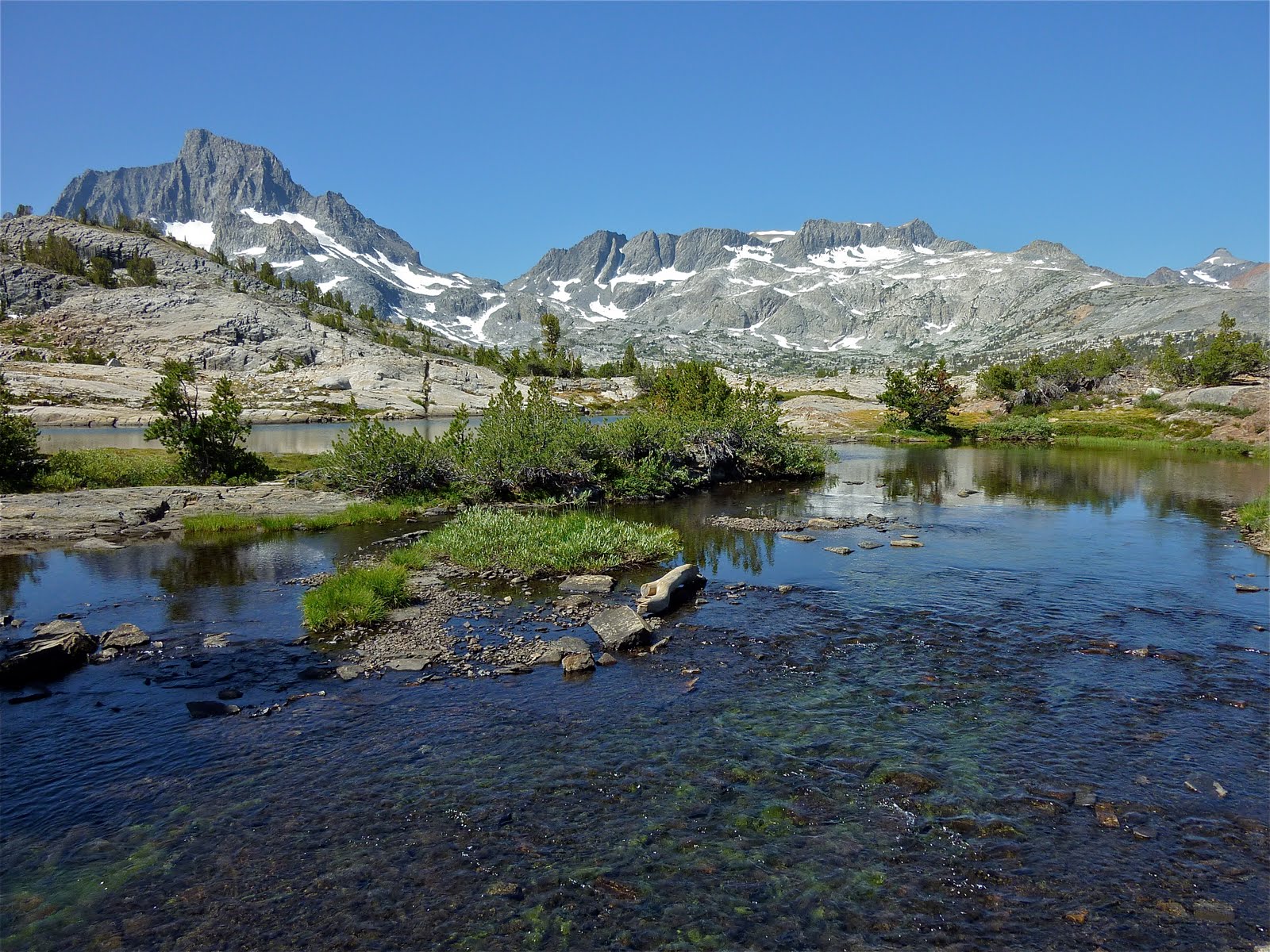
My trusty tent echoes the shape of Mt. Banner. Up here near the head of the lake it’s not the cast of thousands camping just two miles away near the outlet (first photo).

Day 5 was a lingering morning at the lake, then a ginger ten mile march to the roadend, where I’ve since nursed the jammed knee with mochas and easy day hikes. And blogging.

What not to leave behind

Recall that the air was pulsing with insects. Many of them wanted my blood. I covered up what I could and reached for the mosquito repellent. Squeeeeeze…squeeeeeeeeeeze…oh no. Seems my DEET had evaporated, or maybe been sabotaged by ninja mosquitoes. Which brings me to

Day two: leave pack behind, hike back to road, shuttlebus back to car, drive to town, get DEET (and grab the pen, spoon, and cup I’d left in the car), have mocha, reverse travel steps–huff, puff–and after ~11 miles arrive back where I started the day (except now it’s 80 degrees). Pack up, move a couple miles into trees and call it good.

Camped off trail at the top of a pass, there were no bugs.

The view from camp was nice: the largest Clark Lake due north, backed by peaks along the eastern edge of Yosemite National Park. When the US Cavalry had patrol duty over Yosemite–which then included the Mammoth backcountry I’m traveling through–they came via passes near the right hand peaks. A trail still goes through there, but the famous John Muir and Pacific Crest trails come this way via a pass just left of the leftmost distant peak.

The watering hole wasn’t bad looking either. 

A friendly family camped in the trees purified water for me with a little Star Trek device that uses UV light to kill possible nasties. The owner had to put on dark glasses to use it. Fascinating what you encounter in the backcountry.