Blog

Veneer, no apologies

Solid wood = top quality. NOT! Well, not necessarily, anyhow. It depends on the design, the veneer, and the workmanship. It’s true that there is a lot of lousy veneered furniture, cellophane thin veneers used in places likely to receive wear or damage, cores of particle board or other materials assembled in ways that nearly guarantee early failure.

However, some of the finest furniture ever made was veneered, so it’s possible. This desktop will be veneered AND it will be bomber! Here’s a preview (from a later step fitting the end caps):
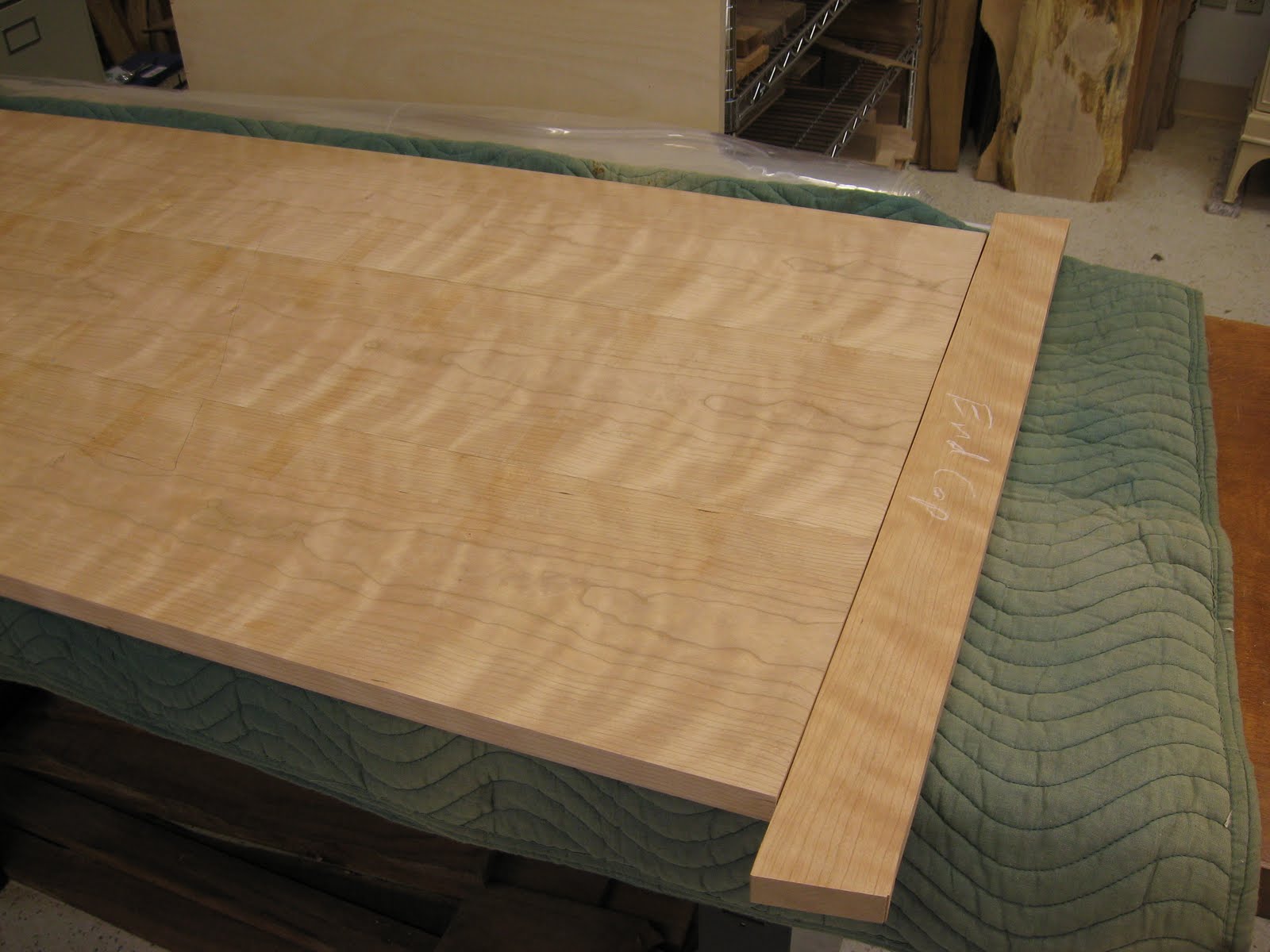
Makes me want to keep this desk too.

It starts with veneers that are much thicker than usual – between 1/16″ and 3/32″. At this dimension the veneers are stout enough to repel significant abuse but–and this is critical–thin enough to NOT act like solid wood once it’s glued to the core. Thicker wood moves powerfully as it absorbs and loses moisture–which it does continually in response to humidity changes, even when finished–but centuries of experience has shown that veneers of this thickness can behave very well.

For most of furniture history “thick veneers” were the sole choice, as tools to economically produce thin veneer didn’t exist. Veneer use was limited to the finest furniture because it was so laborious. These very thin “boards” were painstakingly hand-sawed out of the log, often by two man teams with one poor fellow down in a pit getting a sawdust shower. Thank God for big bandsaws today! I sawed the veneers a bit thick at ~1/8″, knowing that the dull-ish bandsaw blade would cut unevenly and need a fair bit of clean up later, which would take the thickness down to target.

Next we want a quality core: flat, stable, able to hold fasteners strongly. This desk uses 3/4″ Baltic birch, a super high-grade plywood that is tougher than many solid timbers. Before veneering I glued bands on all 4 edges, using cherry from the same plank as the veneers for the edges that would eventually show, and a less precious wood on the ends where it will be covered by the “bread-board” end caps.

After attaching the bands I carefully handplaned them flush with the plywood. Mmm, look at that cherry.

Here is the edgebanded top ready for trimming:

(The following day while setting up to trim on the table saw I managed to drop this assembly and a huge crosscut sled on myself while crawling underneath to adjust something–OUCH! Had to repair some dings too).

When the veneers go on they further lock in the edge bands, and the matching wood will look very clean and natural. Before going on, though, the bandsaw marks on the glue side of the veneer have to be smoothed. Most shops use a sander, but lacking that a handplane did the job:

Then plane perfect edges on the veneers in preparation to edge glue them to each other:
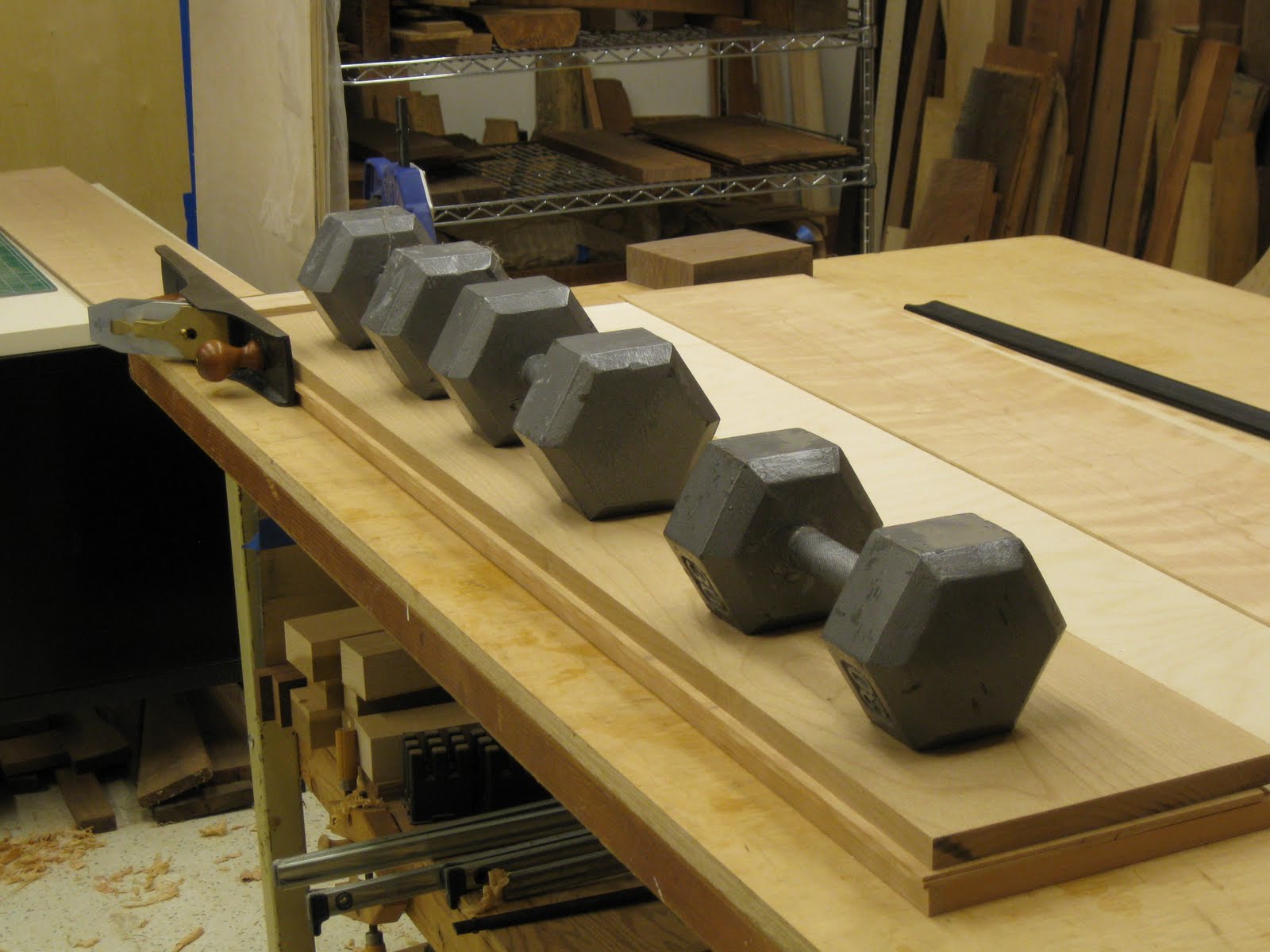
Changes in the weather affected humidity in the shop and the veneers didn’t want to lay flat, but some weights pressed them into line. Planing with the plane riding on its side like this is called “shooting” an edge joint.

The veneers were then glued edge to edge (“clamped” with tightly stretched blue tape) to create a single thin sheet the size of the desk top. I had also prepared a set of veneers for the underside of the top, needed to balance the assembly to prevent warping. Since not everyone edge-glues veneers before pressing I decided to skip that step on the bottom veneers as an experiment, instead just taping them together with special veneer tape.

Finally it was time to press the whole assembly together with the vacuum press, essentially a super big ziplock attached to a vacuum pump; slip the glued up assembly in, seal the bag, turn on the pump, and marvel at how much force air can apply. The shop was a bit cold, so I put an electric blanket on top:
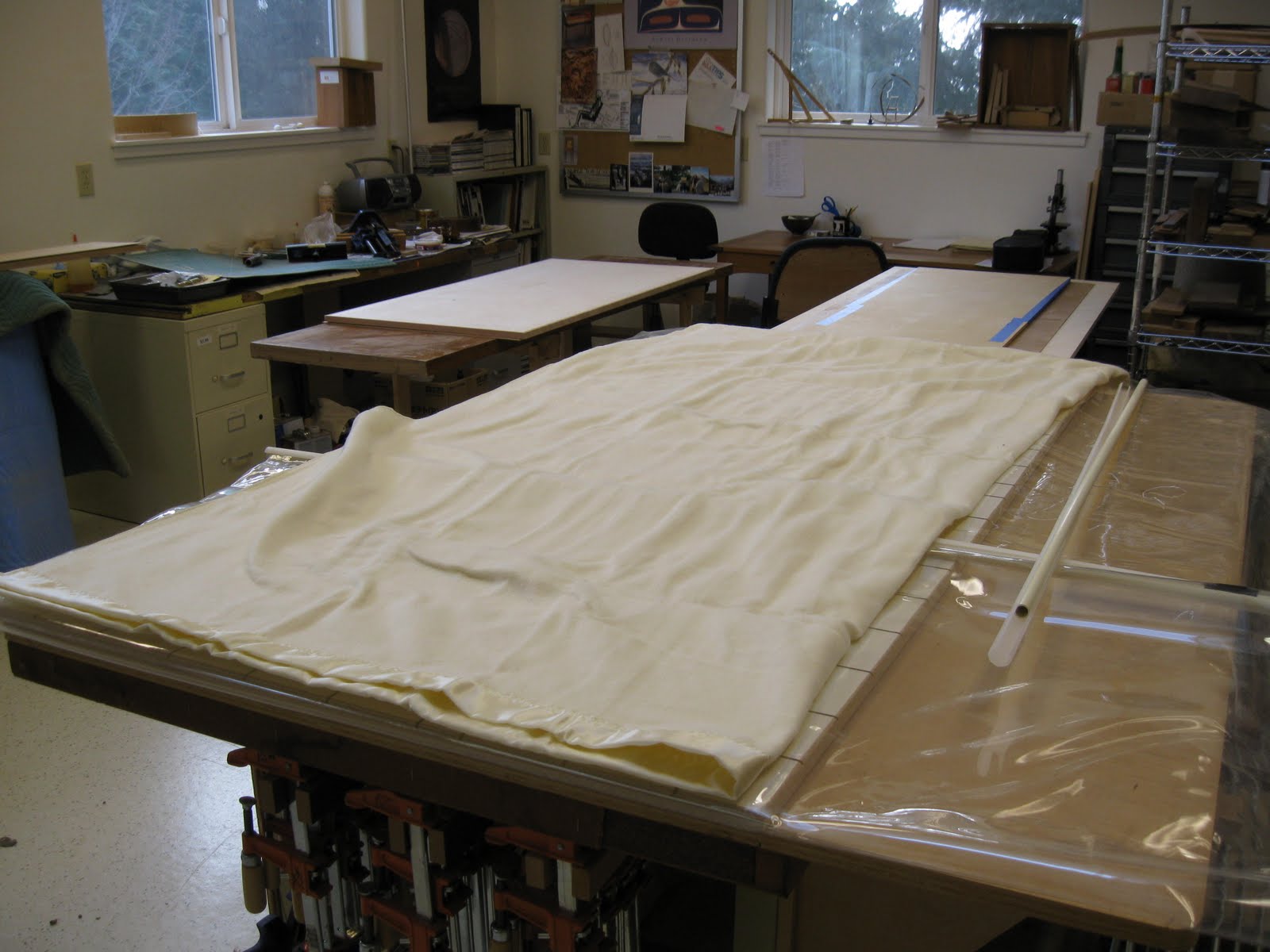
This was the dry run, so the bag closure rod is sitting on the right no yet in use. You can just see the grooved melamine sheet under the blanket edge, acting as a platen for the assembly, the grooves providing channels for the air to escape as the vacuum pump operates.

Having done a dry run I expected things to go smoothly, but the above mentioned experiment (not edge gluing the backer veneers) nearly resulted in catastrophe. Upon contact with glue the 4 backer pieces curled like potato chips and broke the veneer tape. In a panic I rejoined them with stronger blue tape, slapped the cherry veneer on the other side, taped the whole mess to maintain some alignment and zipped it into the bag as the backers tried to break loose again. The vacuum tamed it, but that was a close call. Had they curled just a bit more I would have had to scrape off the drying glue…it could easily have been a total loss. Good thing I didn’t use a water based glue, which would normally be appropriate for a flat assembly but which would have caused even more violent warping than the Unibond 800.

Approximately 24 hours later you’d never guess the harrowing struggle; the veneered assembly came out of the bag flat as can be and has stayed that way ever since. This morning I detailed the front and back edges with shapes that attractive and comfortable to the touch, a task easier to do before the breadboard ends go on. The thick veneer shows another great virtue here–it’s thick enough to allow shaping, whereas thin veneers lead to hard angular edges that are easily damaged.

This is a veneered piece that makes no excuses.

Desk job

I spent a lot of years behind a desk. This time it’s different…not just behind, but in front, on all sides and angles, underneath, on top, inside out. After posting nothing but hiking pictures for months it’s time to catch up with the shop, and the latest project is a desk for a good friend.

It started out in oak to match the other woods in the room, mostly plywood, two pedestals, eminently usable for the writing, photography work, and deep ruminations that go on at the tiny desk currently in place, but when Warren and Peggy came to pick oak boards from my stash a chance encounter with a cherry dresser triggered an avalanche of change.

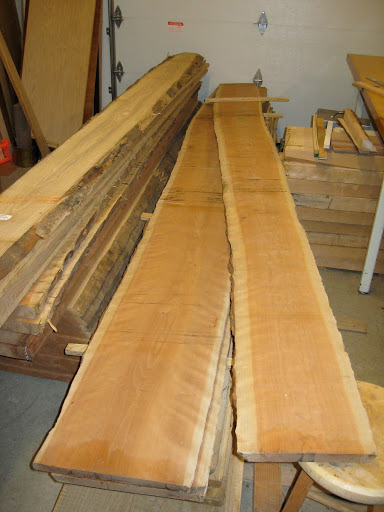
It didn’t hurt that I had planks like this hanging around the shop:


This plank is from an amazing tree that Dan at Horizon Woods told me about. It had two stems, each with nearly 40′ of clear straight wood as much as 27″ in diameter. Six logs of matching wood so nice you could have it for dessert–look at that color with no finish, steaming, or anything!

And this one, the instant choice for the desk top:

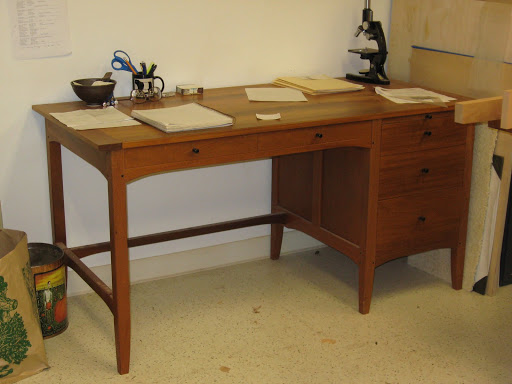
Cherry seemed to call for a more refined design–like this one, which just happened to be in the shop:

I designed this desk years ago before I had the skills to build it, and John Fisher (another College of the Redwoods grad) did a fine job making it. I am very excited to build it this time! The original drawings were not to be found, so the first order of work was to carefully measure and redraw the whole thing. Seemed slightly recursive to draw plans on the desk that is the subject of the plans.

Once the revised plans were approved it was time to make big pieces of wood into smaller ones. One big reason I like to order wood by the log comes into play now – I can select wood from different portions of the tree to control the grain orientation for the different parts. This first section of plank had nice legs at the outer edges where the rings run about 45 degrees to the faces, and drawer faces or panels from the center of the plank, a nice use for the more swirly flat grain found there.

I always feel butterflies cutting up nice wood–will the choices work well, will the wood move like crazy, will there be hidden defects? Here we go working out those commitment issues on the bandsaw:

Another round of sawing yielded a collection of roughly 1/8″ thick veneers for the desk top. It was a major workout, as my big resaw blade was getting dull. Thankfully the heavy work had a nice payback:

November?! No Way!

But the calendar insists…sigh.

September and the Sierra already seem distant, especially since the infamous Oregon rains started in earnest. Worse yet I’ve gained some weight back already–the horror! For years I have planned to make my fortune by writing “The John Muir Trail Diet”, an honest method to lose weight, increase muscular and cardio fitness, and increase appreciation for both the natural and built worlds. Two hundred plus miles of backpacking in mountainous terrain each year for a svelte, strong, flourishing you. Gaining part of the weight back after only a couple months is NOT SUPPOSED TO HAPPEN. Ten years ago it didn’t happen, so presumably it’s a fluke, an aberration in the data and the fit of my clothes. Harumph.

Maybe it’s because I did not walk a thousand miles. In fact the walk covered just 425 miles; not an inconsiderable distance, but far short of my plan (such as it was) and hardly a warm up for a serious thru-hiker (e.g. one who walks the entire Pacific Crest Trail in one year).

For 300 miles or so I walked like a typical thru-hiker, rising early and walking long to cover twenty or more miles. I mentally catalogued beautiful places and intriguing side trips for future visits but walked on, dallying only occasionally to watch wildlife or take pictures.

The miles flew underfoot at twice the daily rate of any prior walk. One evening a month along, snug in camp as the sky blazed after a storm, I looked north to pick out where my previous camp had been.

It was way the heck out there; so many ridges, summits, and valleys in between. And the camp environs from two nights before–nearly 50 miles distant–was indistinguishable. Amazing.

Two days later in town to resupply, however, I couldn’t keep images from the previous stretch straight; campsites, springs, mountains, wildlife, rain storms, they slid about and formed multiverse histories that didn’t align with the order of images in my camera. Was Ebbett’s pass the one with the great people and the fruit bowl for thru-hikers, or was that Carson? The coyote was the day after the cinnamon bear…wasn’t it? I was “homesick” for places from just 48 hours earlier. My experience of any given place along the trail was so brief that calling it a visit seemed like overstatement–it felt more like a filmstrip.

Thankfully the next few weeks featured visits and day-hikes with family, a perfect pretext for a wholesale abandonment of discipline: if a spot looked nice, we’d plop down; if a side trail looked tempting, we’d take it; if there were rocks by the creek, we’d toss some in; if there was ice cream at the Tuolumne store–and when isn’t there?–why sure!

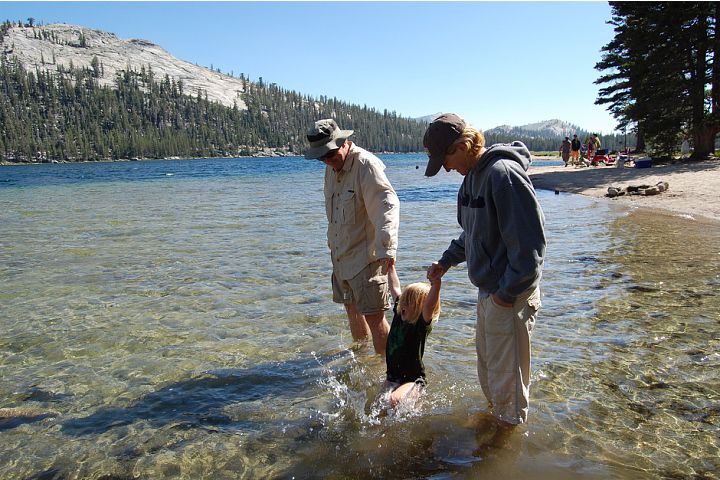
Trail mileage plummeted but my enjoyment and sense of connection to these amazing places soared. And that, as they say, made all the difference. There was camping and supreme lake splashing w/niece Jen and Nicole and their irresistible daughter Sophie, a week of hiking, weasel chasing, and eating at the Whoa Nellie Deli with my wife Ann and daughter Meghan, and a choice tour of Mammoth trails and coffee shops with brother Blair.

For nearly a month I explored an area that would have taken a week at the earlier pace, from the Burger Barn in Bridgeport south to the Looney Bean in Mammoth Lakes, and from wonder-of-the-world contender Tenaya Lake east to the fabulous Whoa Nellie Deli (where people often marvel that one of the best meals they had ever eaten was at a Chevron station in the middle of nowhere. I took everyone who visited, and if you ever visit me in the Eastern Sierra I’ll drag you too).

I returned home to visit in early September and never made it back to the Sierra. There were reasons, but they’re not important now. Next time the hike goes deeper into September, and maybe the weight will stay off and I can write that book. Or maybe it’ll have to be Cool Local Eateries of the Eastern Sierra–looks like more research…

Ha!

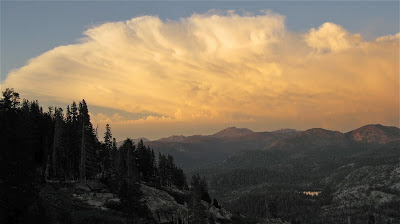
Had trouble uploading photos after computer changes, but finally figured it out. Lots of catching up to do, but at least I can begin. For the moment here are two images from the northern Sierra:

Distant thunderheads over the Carson range just south and east of Lake Tahoe


Round Top, looking south over Carson Pass


Midsummer in the Sierra…ahhh.

The company of trees

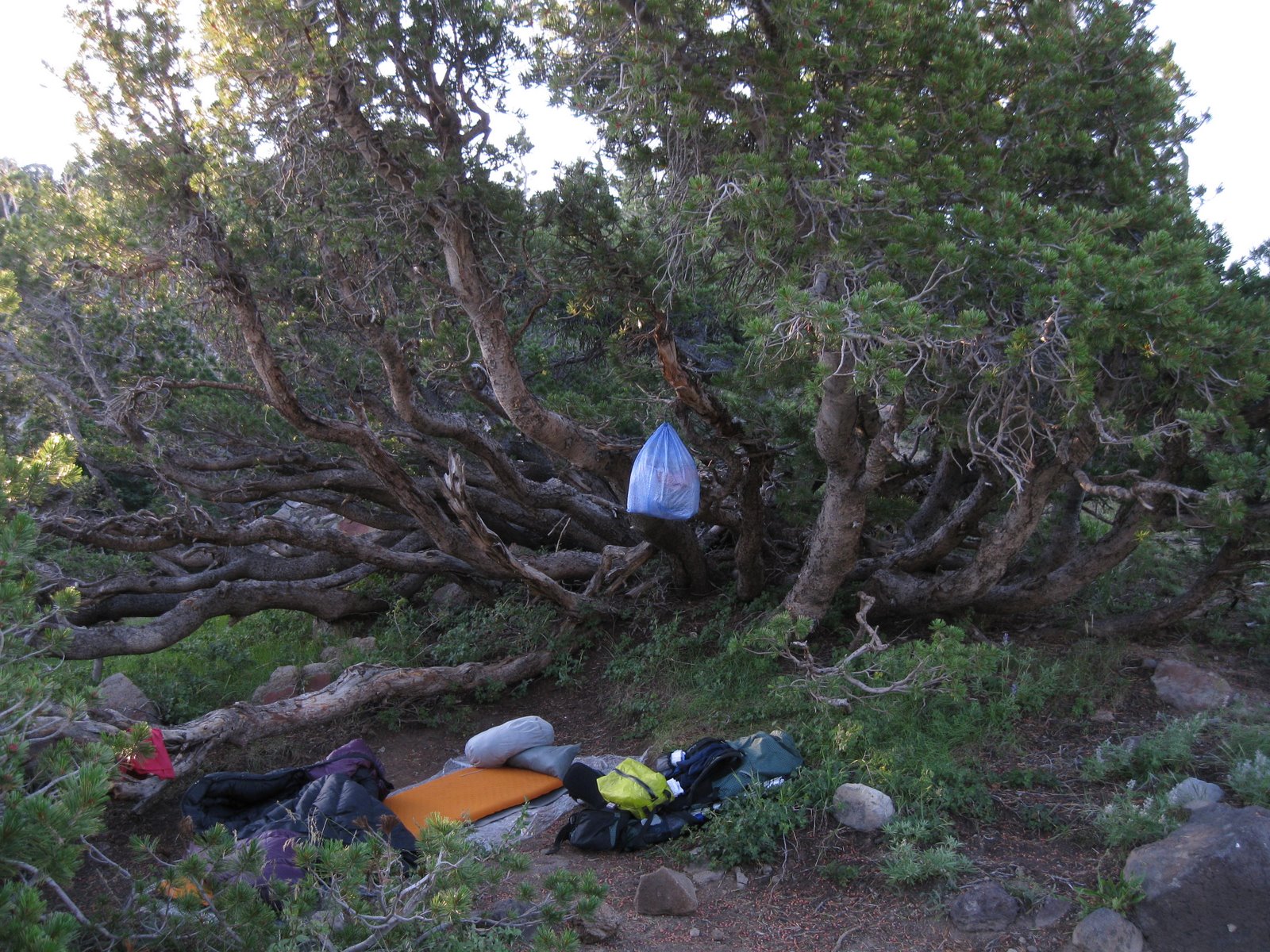
Trees in the morning–a whitebark pine over my bedsite.


Trees at midday–a western white pine anchors my lunch site on a granite knob in otherwise volcanic terrain.


Trees at evening–high in the canyon of the E. Fork Carson on my birthday.


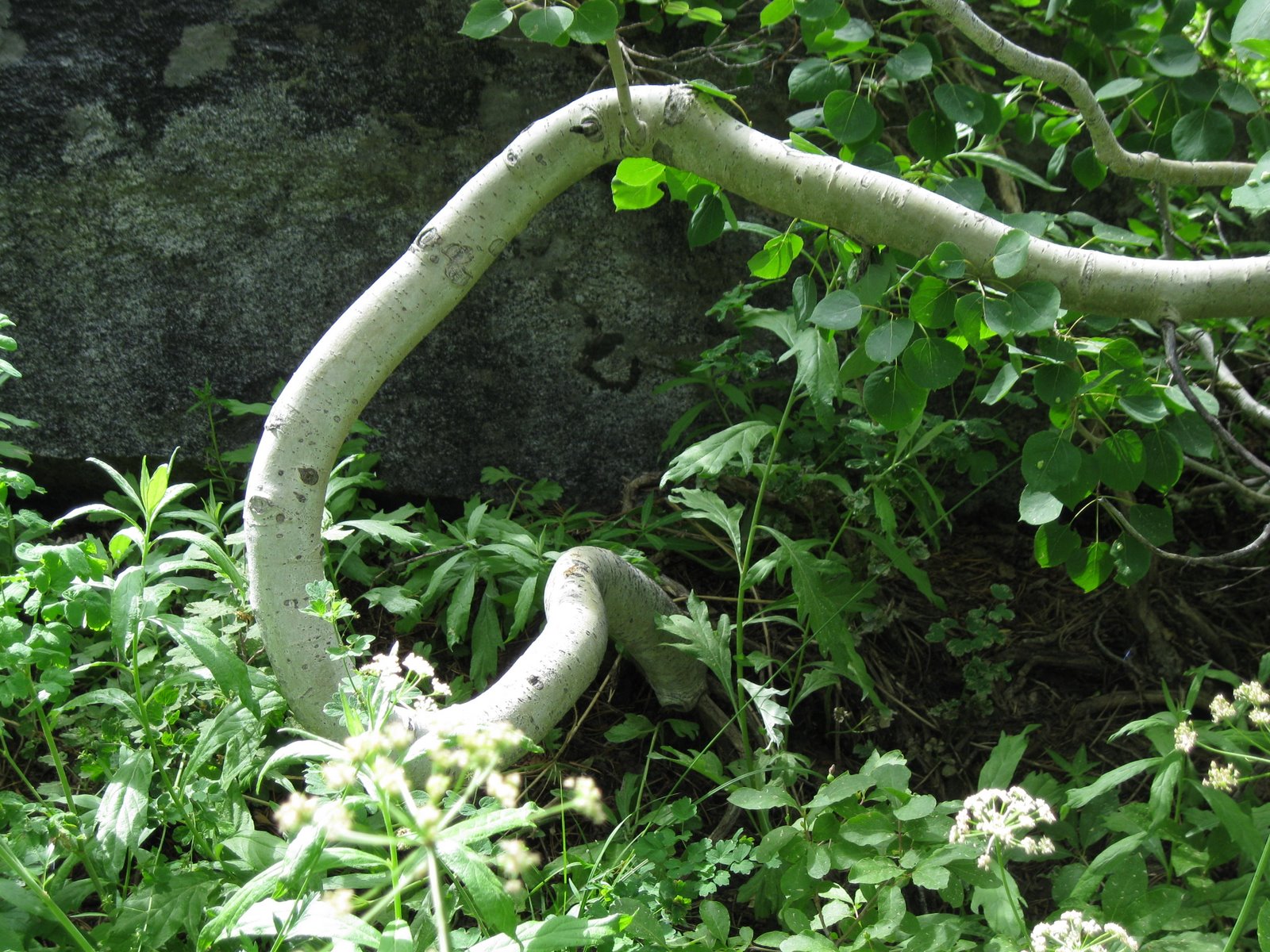
This little aspen is having a tough time going vertical with the heavy snow loads in the Tahoe area.


But this big lodgpole above Carson Pass hasn’t had it easy either. Near here I weathered an intense thunderstorm with flashfloods and big hail that churned a nearby lake into a froth and knocked unripe cones down by the gazillion.

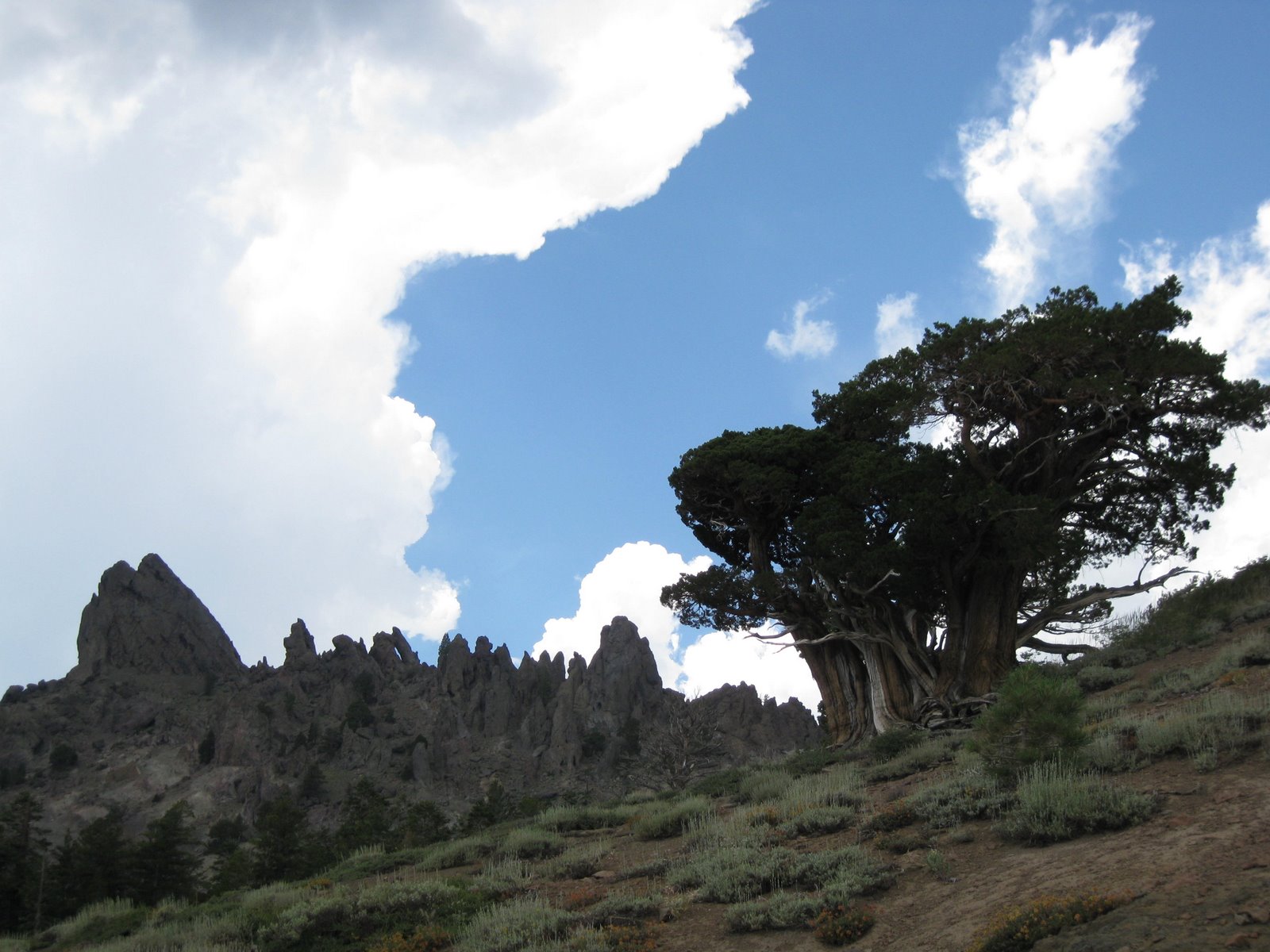
I love junipers. One of the first big ones was just a couple miles up trail from the little aspen.

Many beatiful junipers grow in the crazy volcanic landscape between Carson and Ebbett’s passes, south of Raymond Peak.


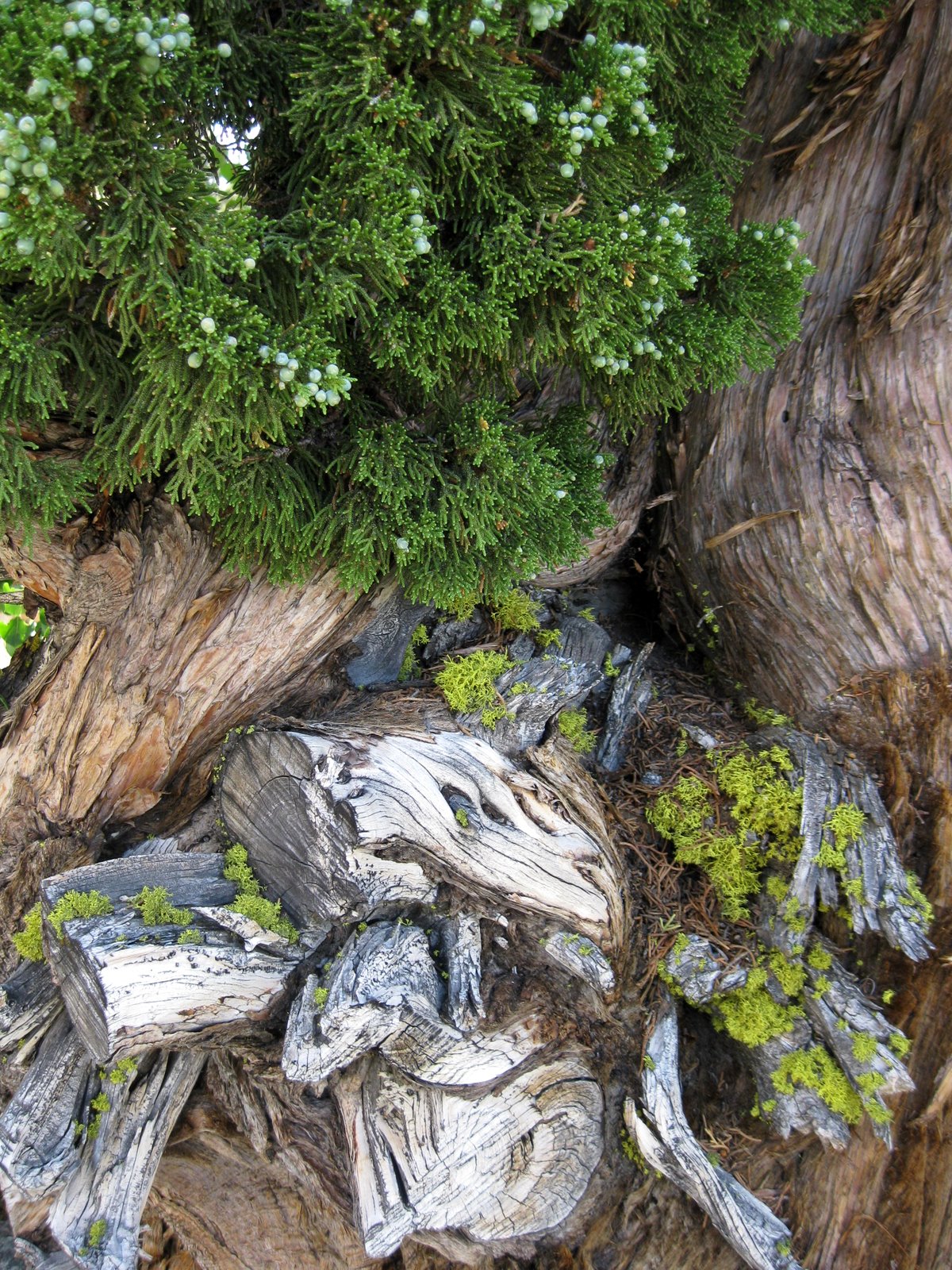
They are nice up close too.

You never know…

…what (or who) you’re going to find along the road.

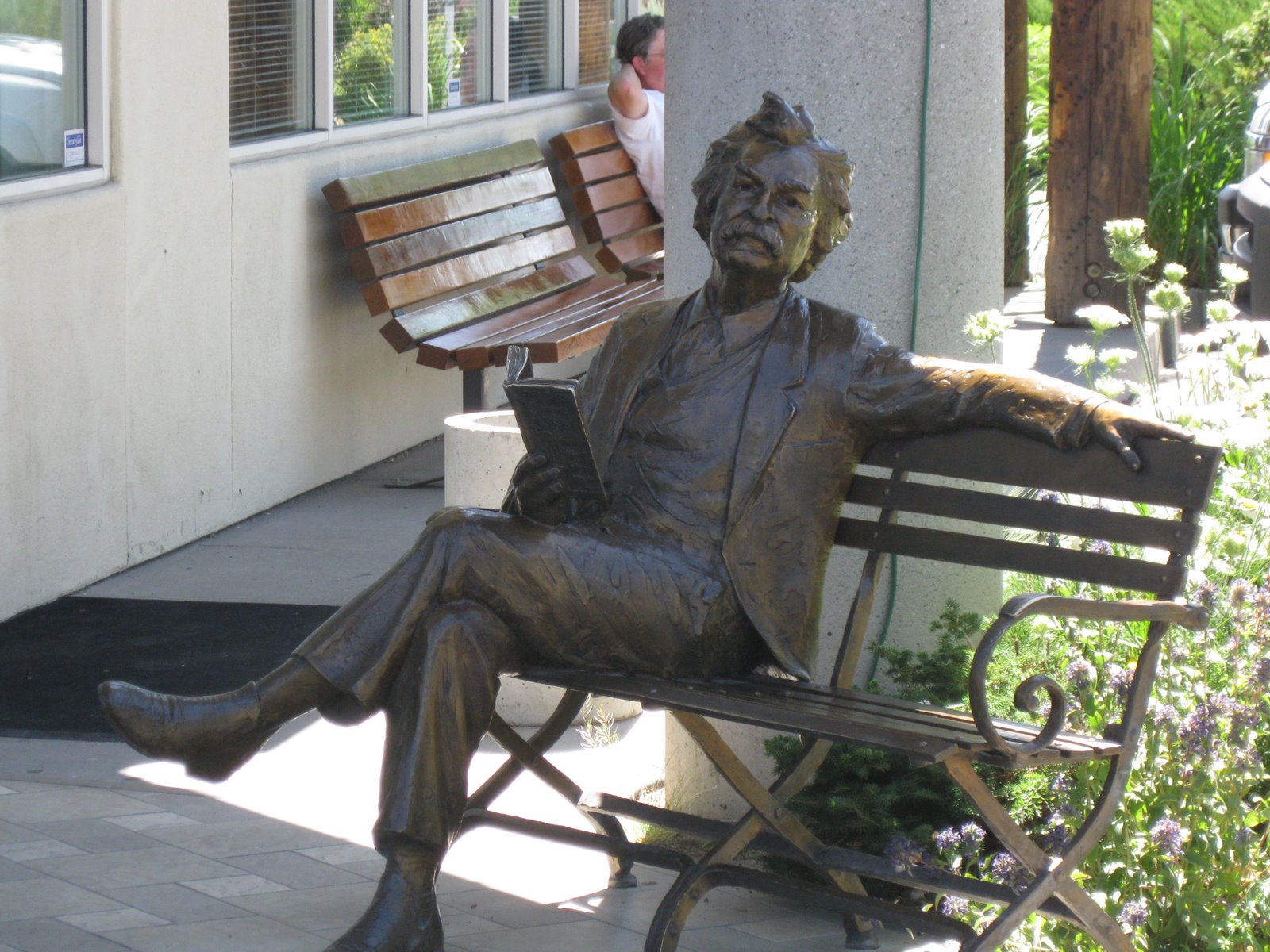
For instance, Samuel Clemens himself (and friend) kicking back outside a gas station convenience store on a hot July afternoon near Reno Nevada, listening to a latin/jazz guitar version of “What Child is This”.


I felt a little silly snapping a picture at a gas station, but Clemens didn’t seem to mind.

How to get a drink

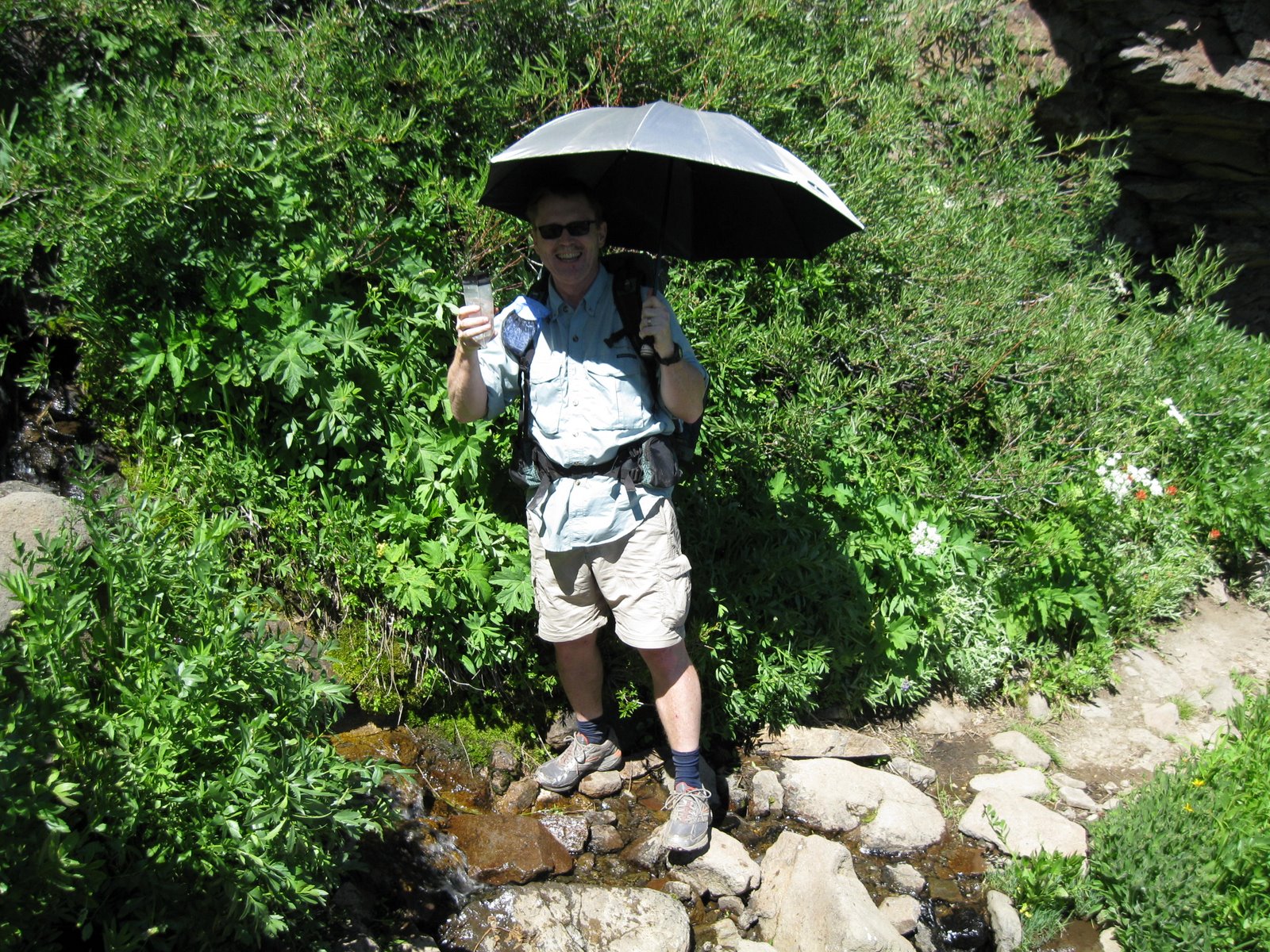
A brief tutorial on the fine art of drinking water from a mountain spring.

First, scoop up some water. I use a small plastic bag, which works with very shallow sources–look for where water is slipping down an sloped rock and press the bag to the surface. It was sunny and hot this day, hence the trailside fashion that caused Brian’s kids some embarrassment. That’s Mr. Patrick Poppins if you please.

Hmmm, wonder if this has giardia…?

Clear, cold, and coming right out of the hill is good – Cheers!

Try not to let water run all over your face. The plastic bag is not always ideal as a cup, but Brian has respectfully zoomed out to conceal any evidence.

Not a bad life.

The Danish Blacksmith’s Mountain

The blacksmith in this case being Peter Lassen, and the mountain Lassen Peak. Tangentially, Megowan means “son of the blacksmith”, though some sources suggest this is not in Danish.

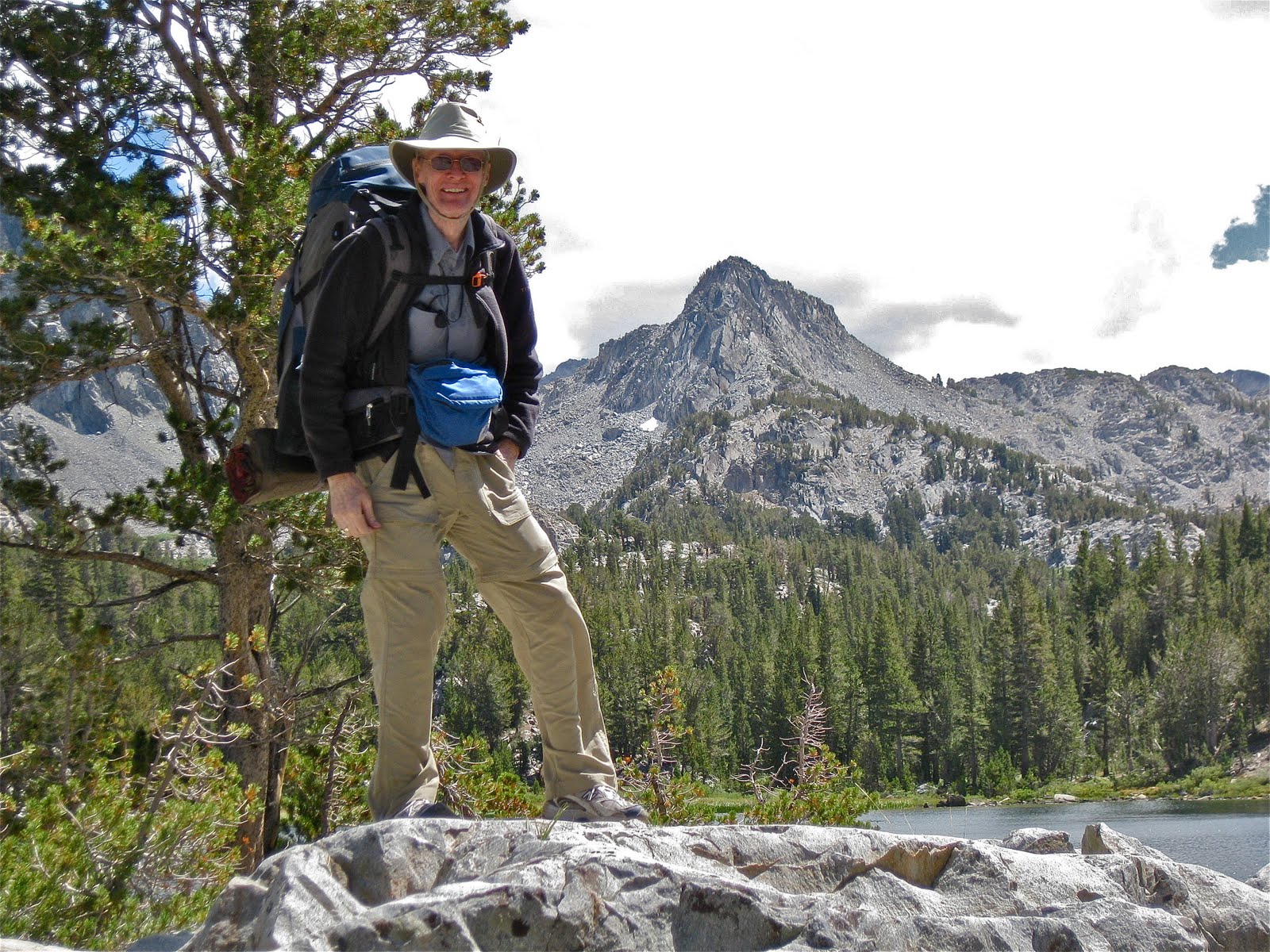
Done hiking the Klamaths (until another year), it is on to the southernmost major peak of the Cascades. Here are my brother-in-law Brian and his sons Matt and Kyle in front of Helen Lake, w/Lassen’s summit behind. Matt and Kyle are very strong; I think they should have carried us, but it didn’t work that way.

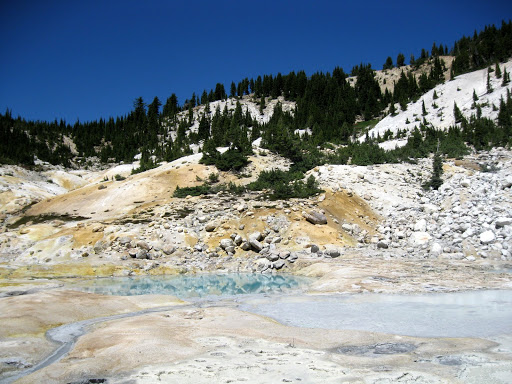
Bumpass Hell was much prettier than the name suggests, but you definitely don’t want to repeat the mistake of Kendall VanHook Bumpass, who in the 1860’s twice broke through crusts in this 16 acre hydrothermal hotbed to scald his leg, the 2nd time eventually requiring amputation. What with fumaroles steaming, springs boiling, and mudpots blurping it smelled a good deal of rotten eggs here. One boiling spring was coated with a slick of fool’s gold, though in the light it looked black, not gold. Other boiling pools had a wonderful pale turquoise color, like this one:

The following day we climbed Lassen, a bit over 2000 feet of ascent on a scenic and generally well graded though exposed trail. From the summit plateau you could see Mt. Shasta far to the north, a final trailside view of the mountain I spent the last two and a half weeks skirting via the Klamath Mountains.

This lovely view is currently obscured by smoke from a complex of fires just to the north, and the summit trail is closed.

The black lava in the picture’s middle ground is allegedly the most recently created rock in California, black dacite from the 1915-17 eruptions. Other quartz-speckled dacites near the summit are brown, gray, yellowish, and even a dusty plum. Even on these dry and inhospitable slopes there were occasional bright patches of flowers blooming post haste in the short growing season.

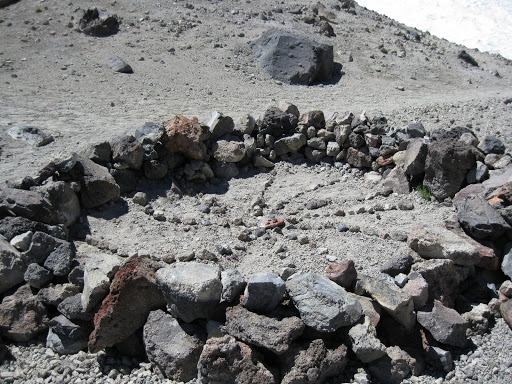
Lurking off the main trail in a maze of lava towers in the summit crater was this:

A crop circle, proof of aliens!

Cool Water

“All day I face the barren waste without the taste of water–Cool Water. Old Dan and I with throats burned dry and souls that cry for water–Cool Water.”

OK, it hasn’t been as bad as the cowboy song paints it, but “For three or four hours I didn’t snack, along the track, because my pack had no water–Cool Water. The Fritos sat, no good to Pat, too much salt and fat, without water–Cool Water” just doesn’t make the grade.

So where’s the water coming from? So far it’s been very different from past trips where lakes and streams have been the main sources. Since the trail stays near the ridge tops many water sources have been springs–he very beginnings of creeks and ultimately big rivers. I have drunk from headwaters of the Klamath, Scott, Salmon, Trinity, and Sacramento rivers, often just a few feet from where the water comes out of the ground–mmmm!

All springs are welcome, but few were more anticipated than this one below an abandoned lookout near Devils’s Peak in far northern CA. I had hiked several miles since a 5:30am start w/out seeing any water I liked, and was facing a rapidly heating 4400 foot descent. Only minutes earlier I had encountered a rattlesnake which had further dried my throat, probably from jumping several thousand feet into the air. This tiny oasis under Doug firs was just the ticket. The trickle was quite small, taking minutes to fill a liter bottle, but eventually it could fill containers faster than I could drink, so all was well. I stayed here for quite some time listening to the birds, which are often one of the clues that water is near.

A few days later I came upon this idyllic spot in the Salmon Mountains, and lingered for hours soaking it up (and soaking my very mosquito-bitten feet). Some years ago a trail crew building a new section of the PCT had camped nearby for 3 months, and the rockwork specialists had taken special pains where the trail crossed their home creeklet, which originates in snowfields just above. This place will stay with me for a long time.


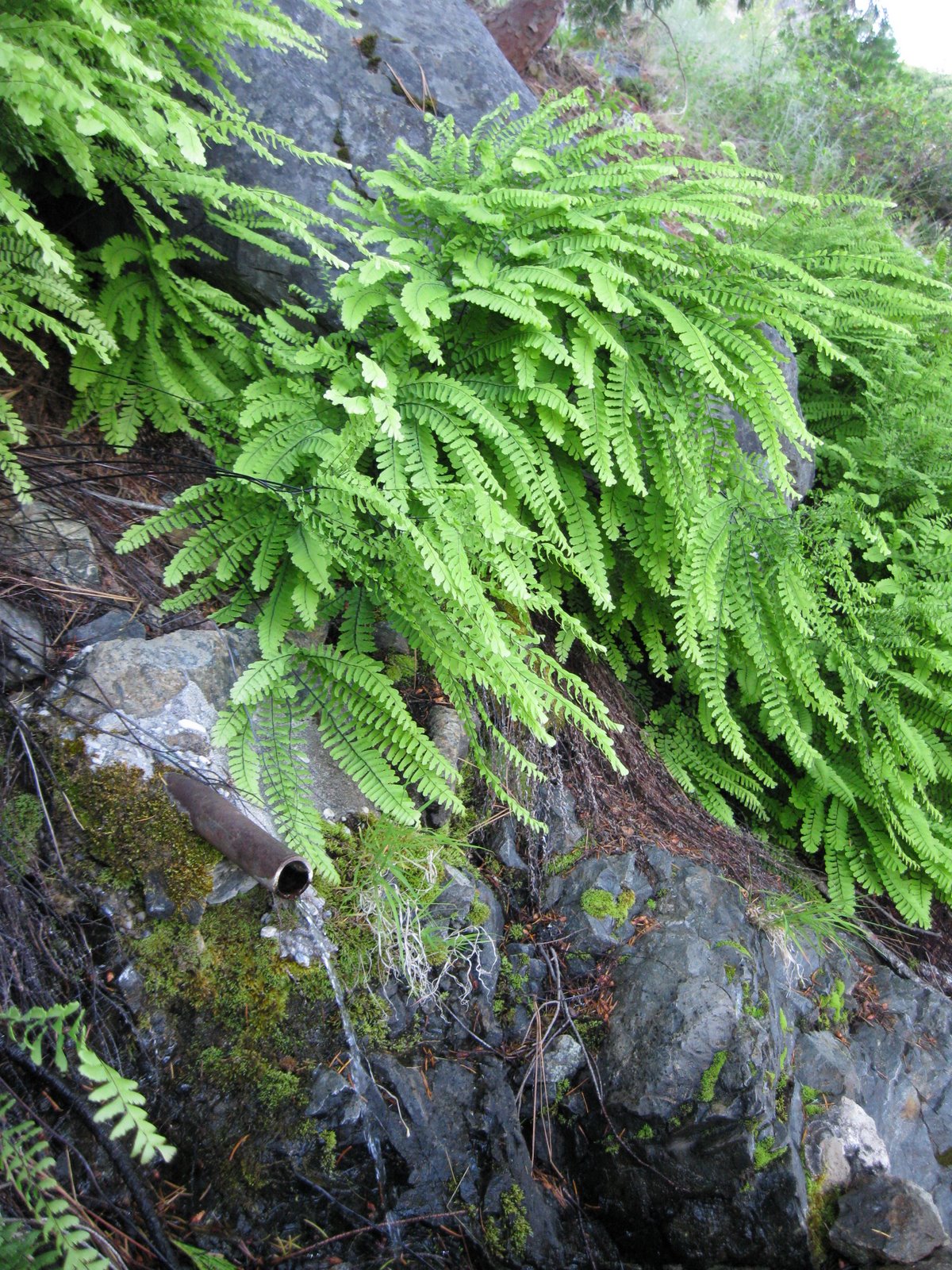
Another spring pops out just feet from the trail. Sometimes they are literally underfoot, though I feel better when the originated on the upslope side of the trail.


Here is a welcome sight, with spring written all over it…

…and sure enough, tiny but vigorous, cold, delicious, and decorated with monkeyflowers–what’s not too like? With sources like this I do not treat or filter the water. It is interesting how different the waters can taste from the various rock formations.


Nearing the end of the Klamath Mountain section was a series of creeks draining the great granite mass of Castle Crags, sluicing down chutes and carving out bowls along the way. Very pretty but I was more cautious taking water out of these as they originated further upslope.


Wait a doggone minute, what is this doing here?

Ah, yes, well…after the Klamaths I was staying with the very hospitable trail angel JoAnn Michael in Weed CA and contemplating how I might sleep better through the frequent warm nights, during which mosquitoes conduct repeated raids on my tentless camp. Deciding that fetching my tent was in order and that a Greyhound bus ticket home was cheaper than mailing things, it was a pretty easy call–Ann and the kids, friends, Cirello’s pizza, good coffee, such a life.
However there have also been issues with banking, plumbing, the woodwork business, garden, vehicles, and so on, reminding me that is not trivial to achieve escape velocity. Already it has taken a day longer than what appeared to be a generous schedule–but then again more time with family and home has its rewards.
Tomorrow I depart for Lassen.

200 miles


The first segment of the trip–through various ranges of the Klamath Mountains (Siskiyou, Marble, Russian, Salmon, Scott, Eddy, Trinity Alps, Castle Crags)–is over. A day or so ago I crossed into the Sacramento River drainage, heading eastward back toward the southern Cascades. What a great area this has been! And a bit quirky.

On the horizon now is Lassen, just visible over the granite walls of Castle Crags,


and not far beyond start the Sierra, the original siren call for the trip. I’m eager to get there, though the trails will be more rugged and the pack heavier because of less frequent food resupplies. My body has been surviving so far, but the Sierra will be a big challenge. Fingers crossed.

I’m at the home of trail angel JoAnn Michael outside Weed, CA, with a phenomenal view of Shasta from the back yard. Tomorrow we drive to Old Station, flipping over (in trail-speak) a section better done in a cooler season. My brains were baked descending alongside Castle Crags, I’d like to avoid an immediate repeat.

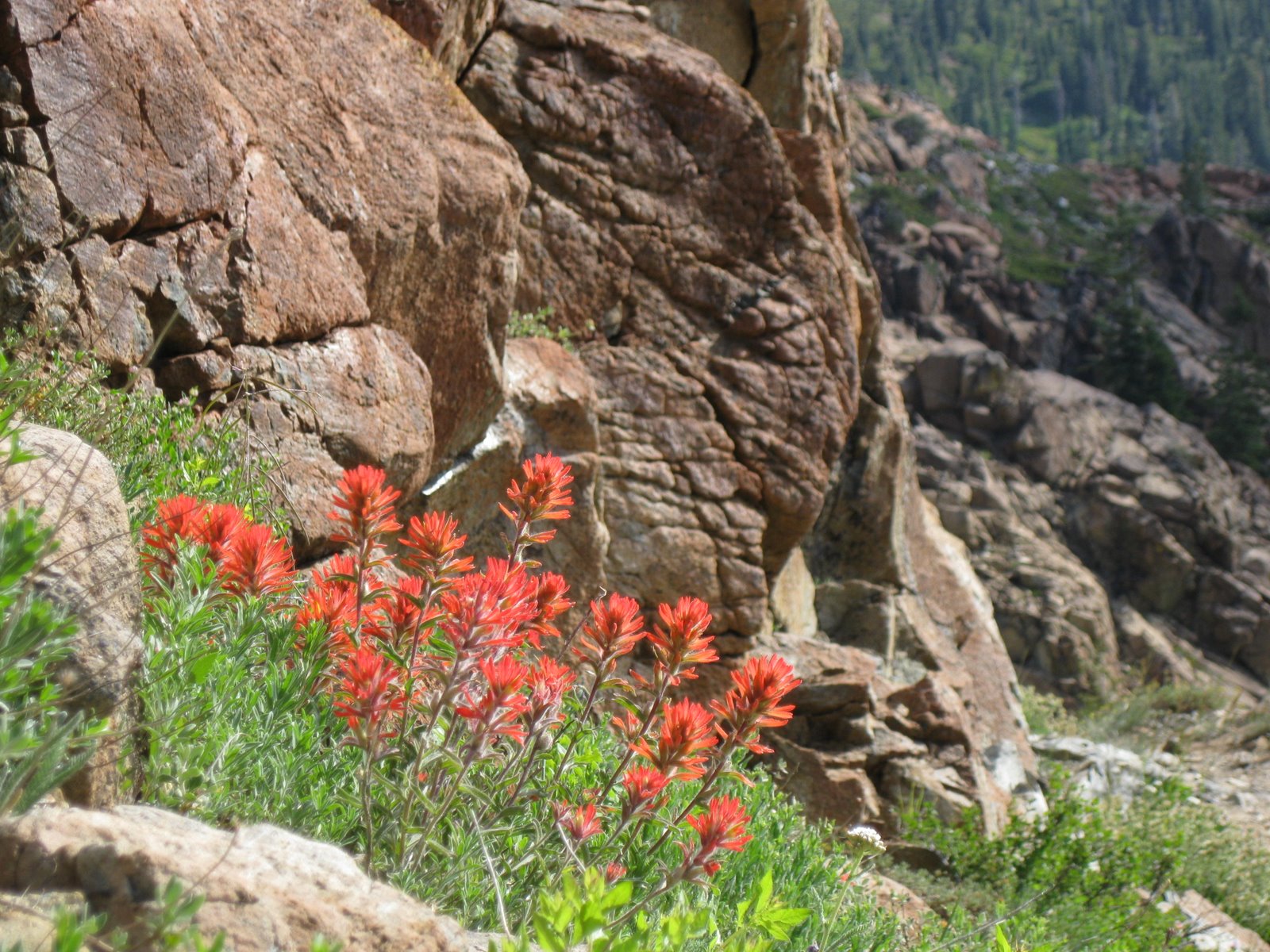
A couple final images: paintbrush adorning an ultramafic outcropping,


and the final reward of a hiking day that ended much too late on windy saddle.