Blog

Every Hand Plane Needs a Tuneup – a Reply

I did not intend to go into video, in fact I fought it…but in the end it was no use.

The problem is, I know smart, careful woodworkers who read Fine Woodworking (FWW) closely, and when they see an article from an apparently gold-plated authority–Tommy MacDonald has his own woodworking how-to show on PBS called Rough Cut, does it get any more legit?–they are liable to follow it diligently.

In this case, though, the magazine and author are the ones that ought to be liable. Exhibit A: 

http://www.finewoodworking.com/toolguide/toolguidearticle.aspx?id=35026

No disrespect intended, as both the author and FWW have inspired and taught many, but in this case some really bad advice slipped through, advice that could easily ruin a $400 handplane while attempting to improve it.

Here is my response, with very amateur production values and as one friend said, narrated by a homeless person–ouch! Another said the shop looks too clean–can’t win.

Writing desk revisited

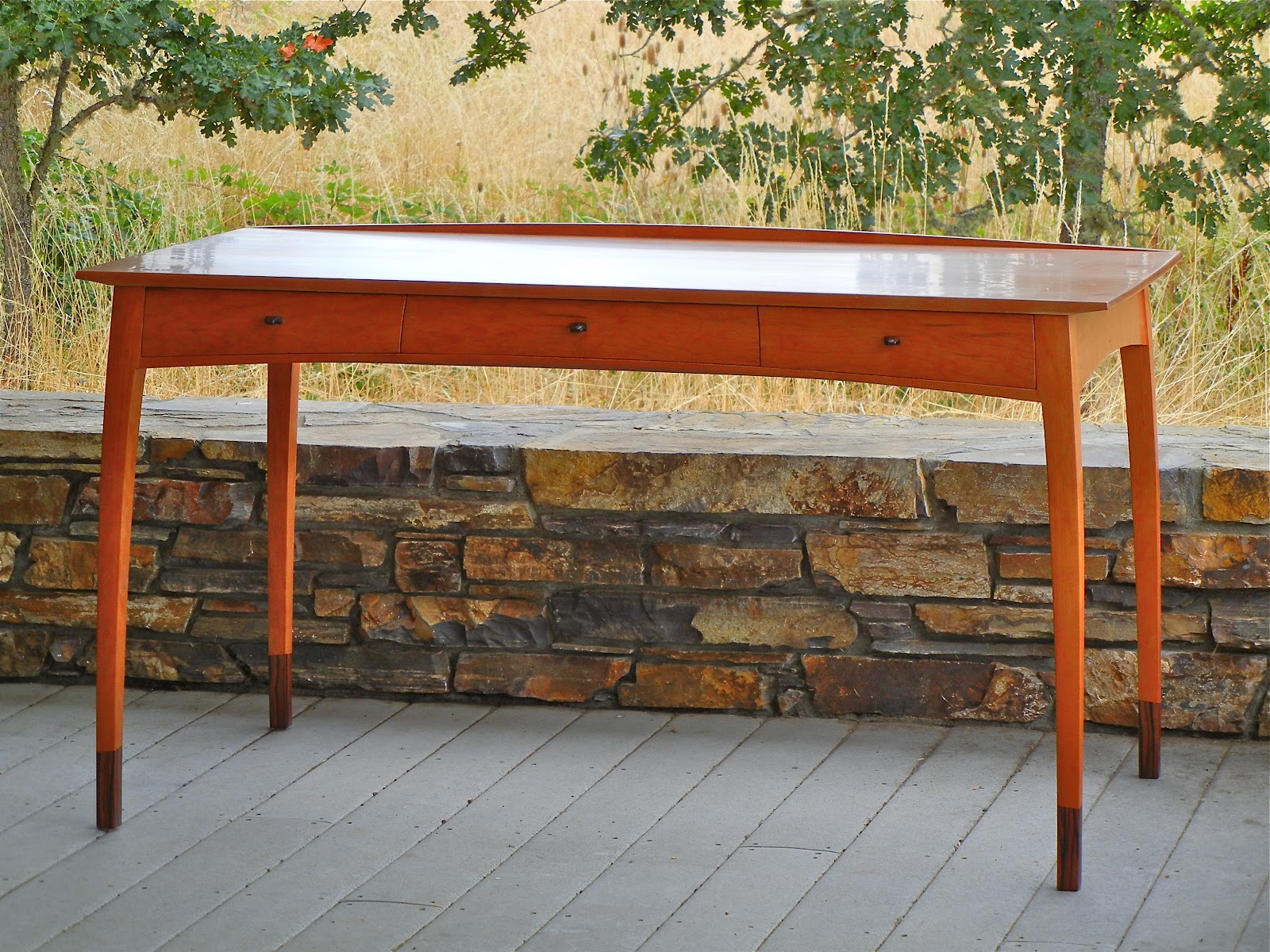
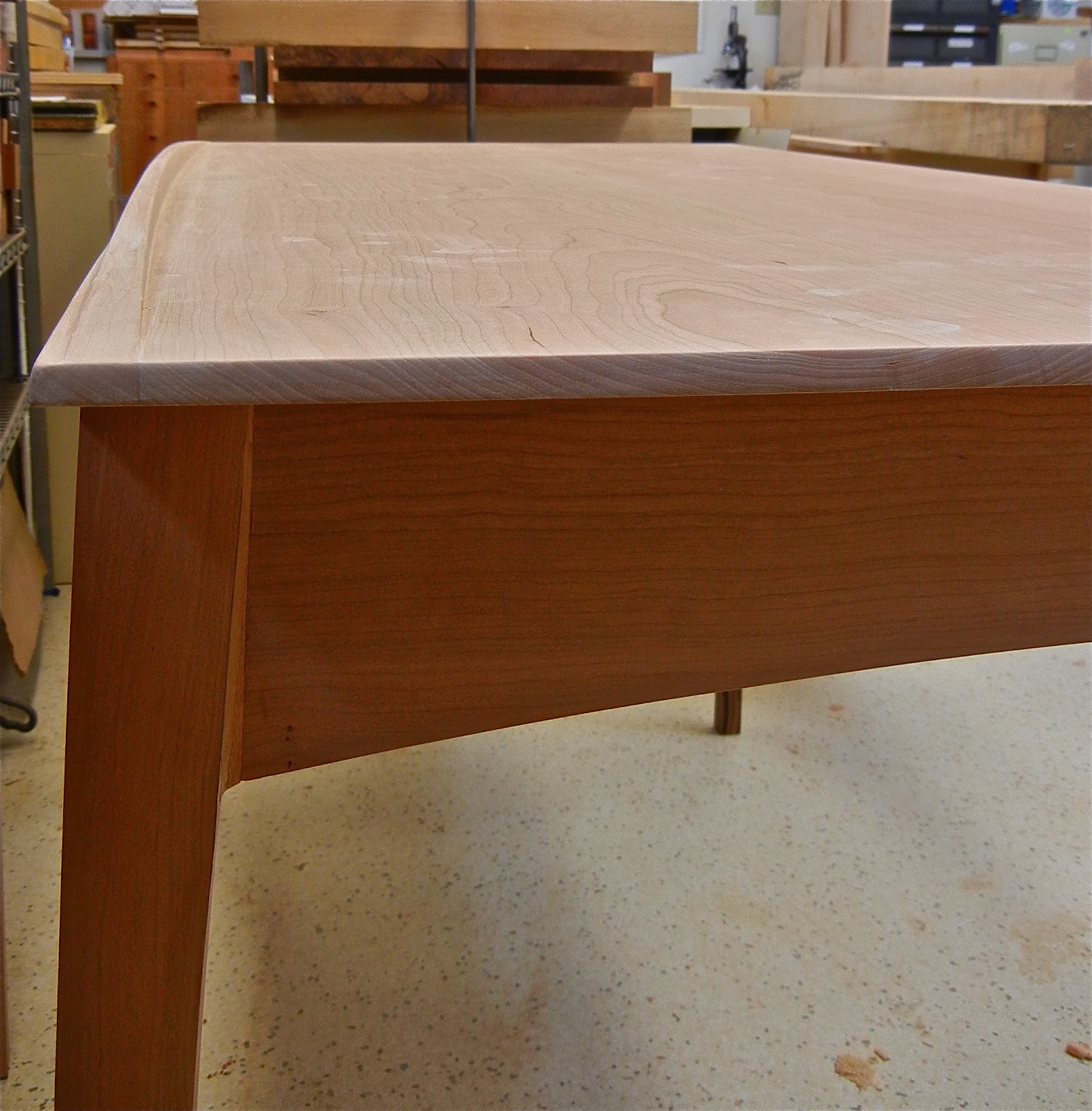
At last: a picture that doesn’t make the writing desk look bowlegged. Sure wish I could work outside like this all year, but alas, even in August it was sprinkling two hours after taking the picture.

These drawers aren’t quite square because of the curving desk front, but they still slide like butter; I admit, it’s quite gratifying; please pardon me while I pat myself on the back.

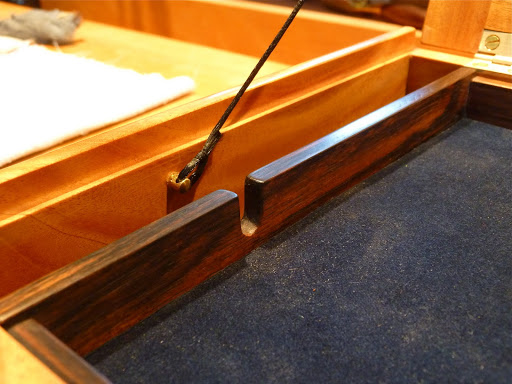
The little Macassar ebony pulls are scooped out deeply underneath for a secure two finger grip. Because the drawer fronts are angled and curved in two planes, the pulls are slightly recessed into the front in order to appear flush all the way around. Fussy work, didn’t think ahead that far during design.

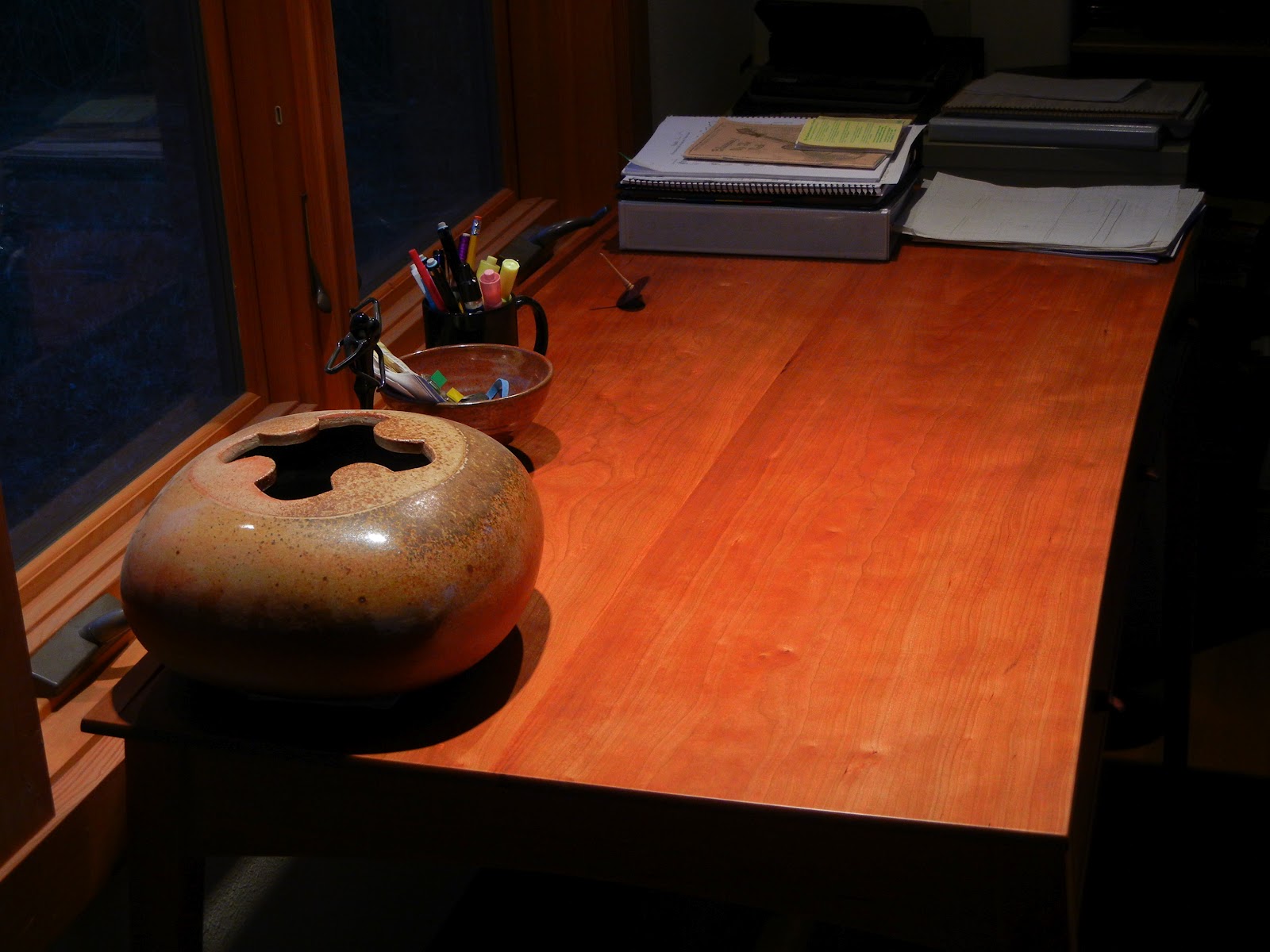
Use testing. This piece will have another home, but I want to gather ideas for building it again…which I was ready to start the day I finished!

Where’s the woodworking?

The long absence of woodworking content is raising suspicions that this blog is just a cover for pretty hiking pictures, but not so–at least not entirely. In the interest of retaining credibility, I offer these: 
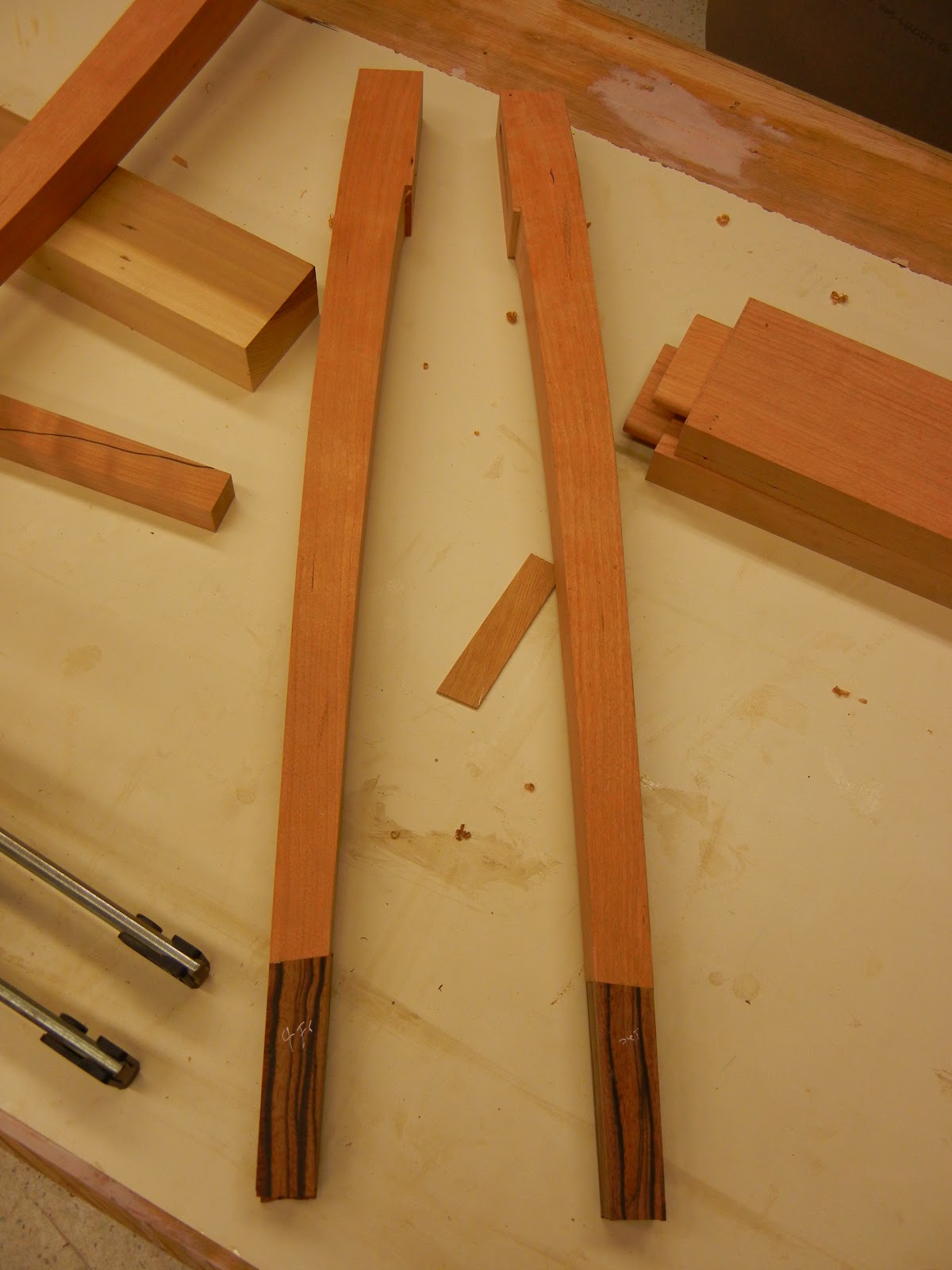
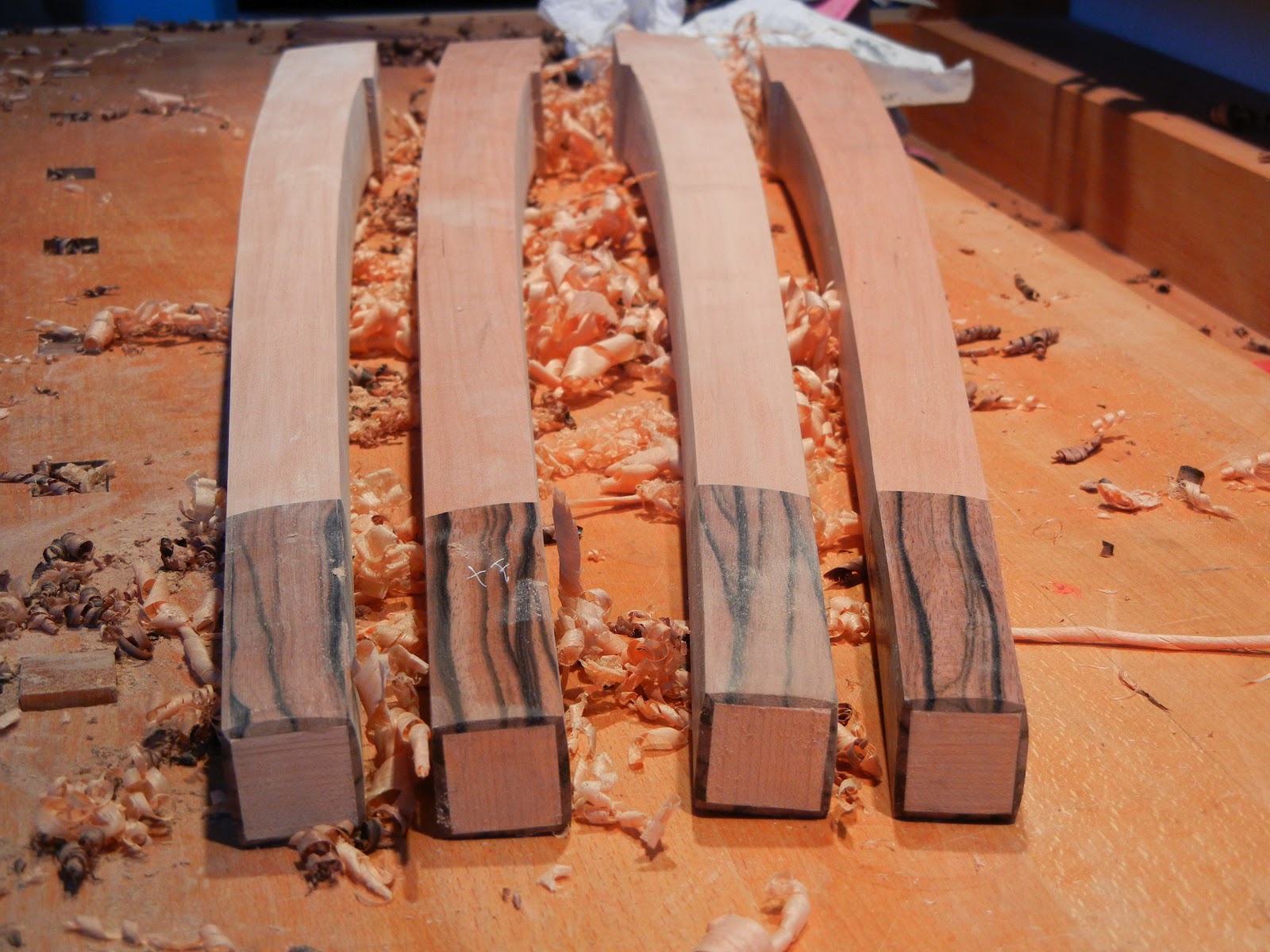
Legs for a cherry writing desk, with about $1500 worth of ebony socks (based on the time they took):
Nothing else about the desk is flat, so neither are these

Blending the leg and rail–getting there but not yet sweet.

Drawer bottoms are cedar of Lebanon, such fragrance…

Really need a professional shoot for this piece, it’s easy to distort the curves, as this picture ably demonstrates. The curves are softer than this suggests, and do not bow in at all. In fact this is downright horrible, but the only pic of the complete piece so far.

Don’t other folks wear shavings too? This fashionable European maple headband is a handplane shaving from a cello back blank that wasn’t quite up to snuff for an instrument, but made glorious drawer sides. Big thanks to John Preston of Old World Tonewood for helping with this wood!

1000 miles in 6 days

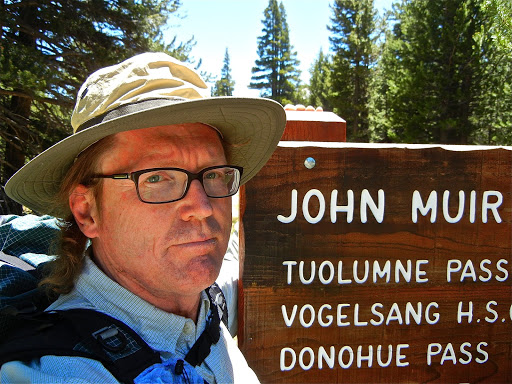
I set out this summer to walk alone some 1000 miles through the Sierra Nevada backcountry, a plan built of hero worship, inspiration, gluttony, and a hint of desperation.
Colin Fletcher wrote “The Complete Walker” in 1968, and his ideas assumed near-mythic status in my eager teen mind. At the core of his walking and writing was this:
Many experienced outdoorsmen – and all responsible hiking organizers – contend that the greatest danger in wilderness travel is one that permeates this book:
Walking alone.
They may have something too. But once you have discovered solitude – the gigantic, enveloping, including, renewing solitude of wild and silent places – and have learned to put it to creative use, you are likely to accept without a second thought such small additional dangers as the solitude imposes.”
In hundreds of subsequent pages he imparted the means—well-honed, intricate, even charming—but I imprinted on hisessence: real walkers walk far, in solitude. Fletcher also wrote “The Thousand Mile Summer”. You can see it coming…
Some ten years earlier, following a precipitous one-lane descent to Devil’s Postpile in my grandfather’s giant blue Cadillac—including being run off the road once—I had imprinted on the textures and currents of the young San Joaquin River and the Sierra Nevada mountains, John Muir’s “range of light”. How can one notwish to soak in every corner of this magical and extensive kingdom? Inspiration and gluttony are eminently sensible responses.
Wikipedia informs me that Fletcher was 36 on that epic summer walk up California. I suppose I should feel better now. Humph. For several years I have noticed backpackers my age being pruned out of the backcountry, seemingly with little warning; an injury or illness, a trip with too many grueling ascents under a leaden and sweat-soaked pack, even demon golf. ALERT! Time Running Out!
And so out I went.
I chose the first leg with moderate mileage and elevation change compared to my 400 mile hike in ’09: from Tuolumne south to a quiet corner on the edge Yosemite where the Merced River arises, then north and west as it swells (and hosts a prodigious quantity of mosquitoes), and finally zig-zagging to an airy bivouac on the summit of Cloud’s Rest, 6000’ above the floor of Yosemite Valley.
Those 6 days and 60 miles were a flash flood of experiences, I’m still awash in it. That’s good, because the miles also devoured my knees; there’s plenty of time for reflection.
On the final descent into Tenaya Lake I summoned maximum grit when passing oncoming hikers so they wouldn’t stop me and call for a rescue. In retrospect they were probably occupied by their own suffering, but I was moving so slowly and awkwardly it was embarrassing. On the return shuttle bus my kneecaps threatened to burn right through the skin. I’ve been here before, just before my surgeries when I toasted my knees reffing too many soccer games. A few days of lounging and care only confirmed that I needn’t restock the bear canister with food for the next leg.
I texted my nieces Jen and Nicole about going to their favorite Irish bar in Sacramento—to learn to drink whiskey. Pub crawling in Ireland seemed like a hiking frontier still within reach, and if not the whiskey would provide a fuzzy glow, so WTF. I made a last very flat walk in the 90 degree morning air of Yosemite Valley, drank from an ancient spring for luck, had a pastrami sandwich at Degnan’s for old time’s sake, and headed out of the mountains to Sacramento. 

Well whadyaknow, take two

Last September in a blog entry I celebrated a personal first–my mahogany sideboard’s appearance in a book–and commented “only 5 billion more publications to catch up with Sam Maloof”.

A few weeks ago a friend mysteriously ordered me to do a Google image search on “Maloof trestle table”. Incredibly, one of Maloof’s trestle tables looked EXACTLY like my sideboard, even down to the lighting and backdrop. Well whadyaknow!

Oh wait…it is my sideboard, courtesy of Google’s search algorithm and my silly comment. A timely  coincidence with NPR’s “On The Media” this evening, which had a segment on personally targeted search results that Google and other search and social media programs increasingly deliver.

Having mentioned Maloof four times in this post, perhaps someone will order one of his famous rocking chairs from me. I’ll do a nice job…

Repeat offense

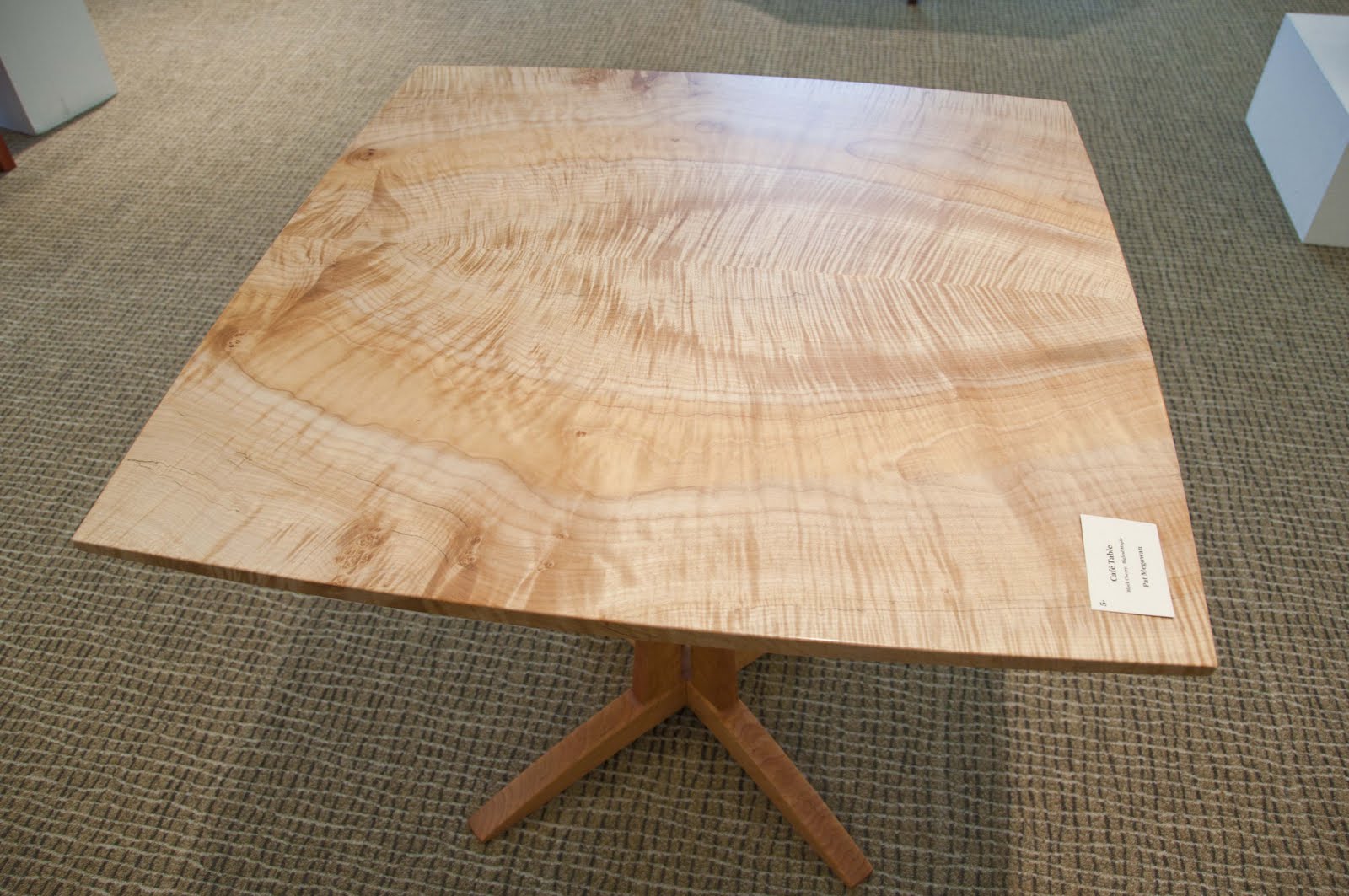
What is it about March? Our perennially late February daphne coming into full bloom, the Ides of March, St. Patrick’s and St. Joseph’s days, the start of spring, the first restless geese heading north…and the urge to make a dining table. Naturally. 
Or maybe it’s the annual guild show falling on the first weekend in April, and a notion that designing and building a table in a week isn’t as obviously ridiculous as a chest of drawers or china hutch. If the woodworking referees gave yellow cards for foolishness, I’d have been sent off the field last year after on a second yellow for this:
Maybe the ref was looking the other way. In any case, the third year running was the tightest schedule yet, six and a half days until the show load in. The goal was a pedestal table that would look good with last year’s trestle table. 
These boards from local sawyer Stu Hemphill were just the right size for a generous cafe table.

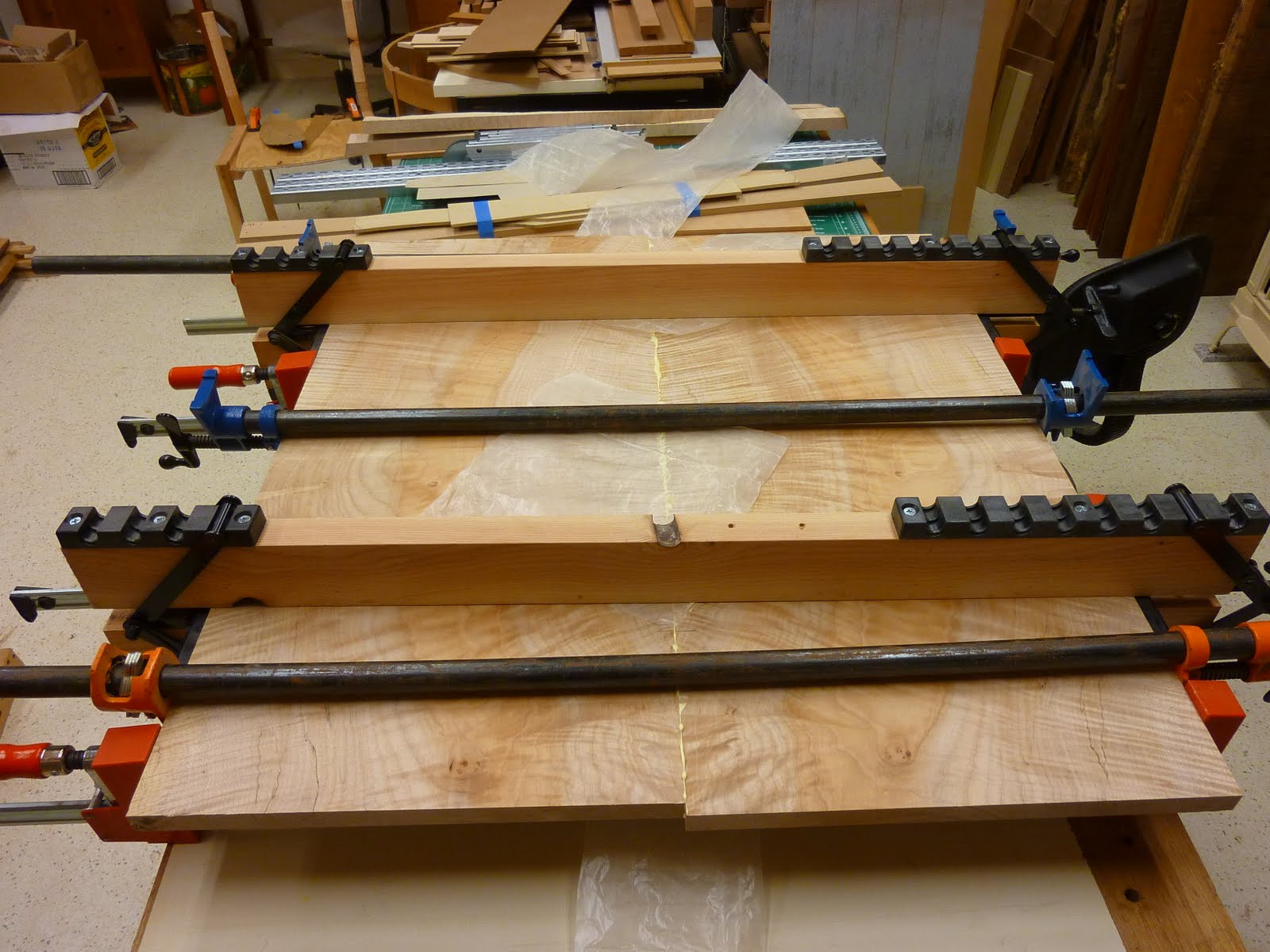
So it was off to the races. After trimming the planks were 17″ wide, proving yet again that whatever size jointer you get–mine is 16″, enormous by small shop standards–it’s never enough. Nonetheless day one ended with the top glued up, a key milestone given how long finishing takes.

The following day I prepped the top for finish with a secret weapon: a high angle smoothing plane from my friend Konrad Sauer. Cute as a bug, smooths wild wood better than magic.

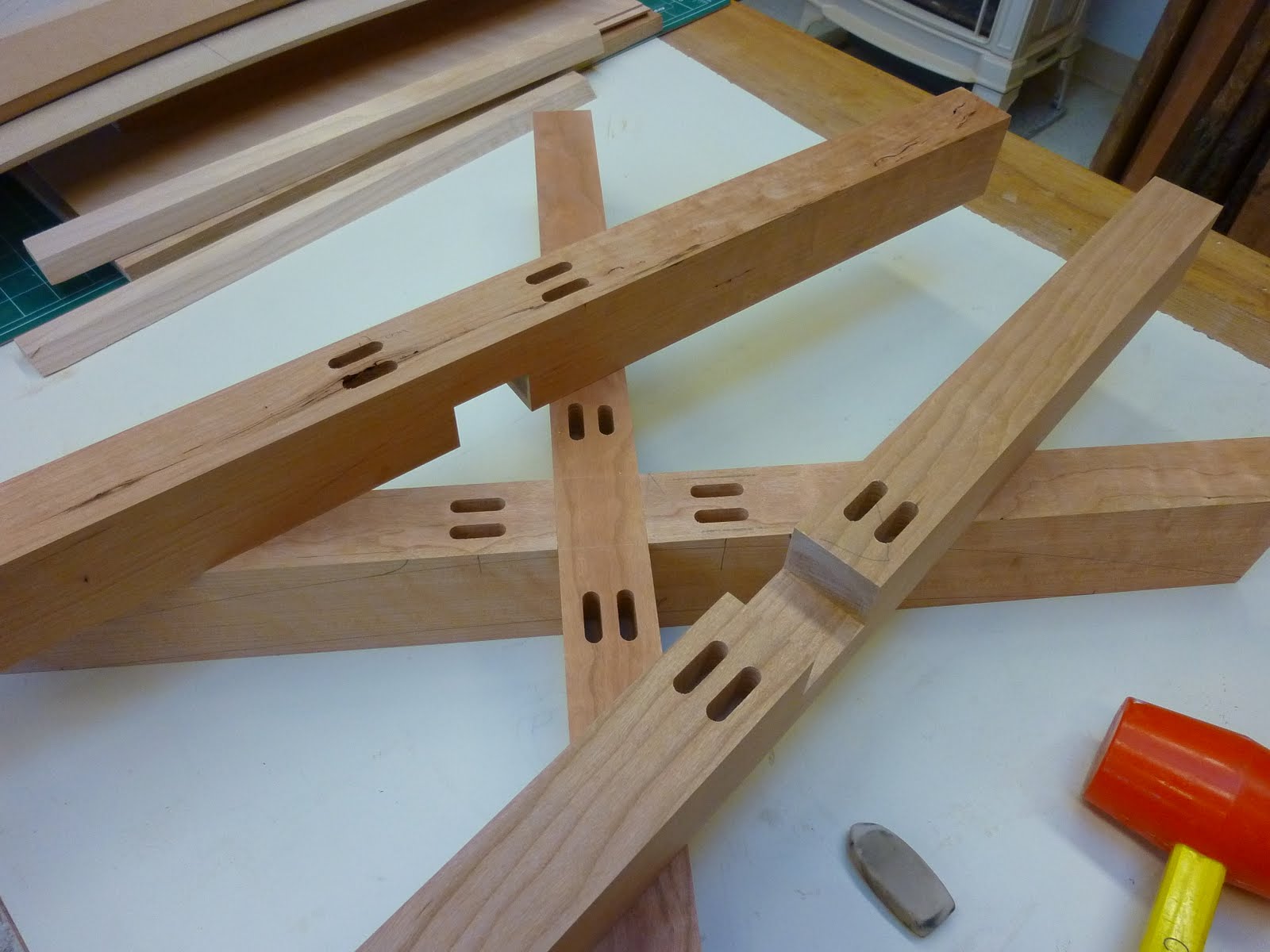
On to joinery, lots of it.

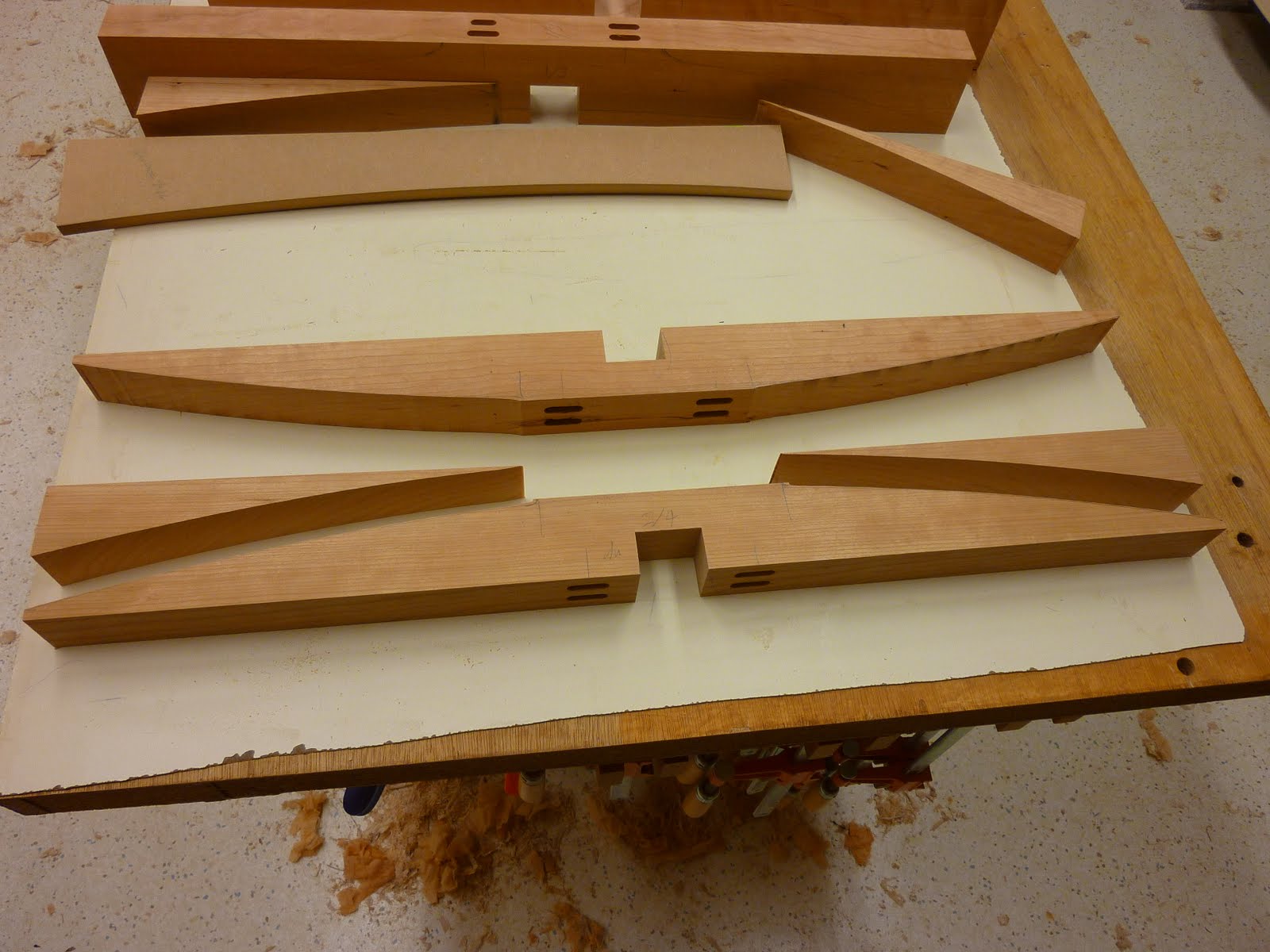
And then the apparently mandatory dyslexia moment–can you see what went wrong on the crosspieces that support the table top?

Yep, I cut the curve on the wrong side of the lower piece. The attempted repair

would have been strong enough and inobvious to most, but I’d have regretted it forever so instead made a new piece ever so carefully.

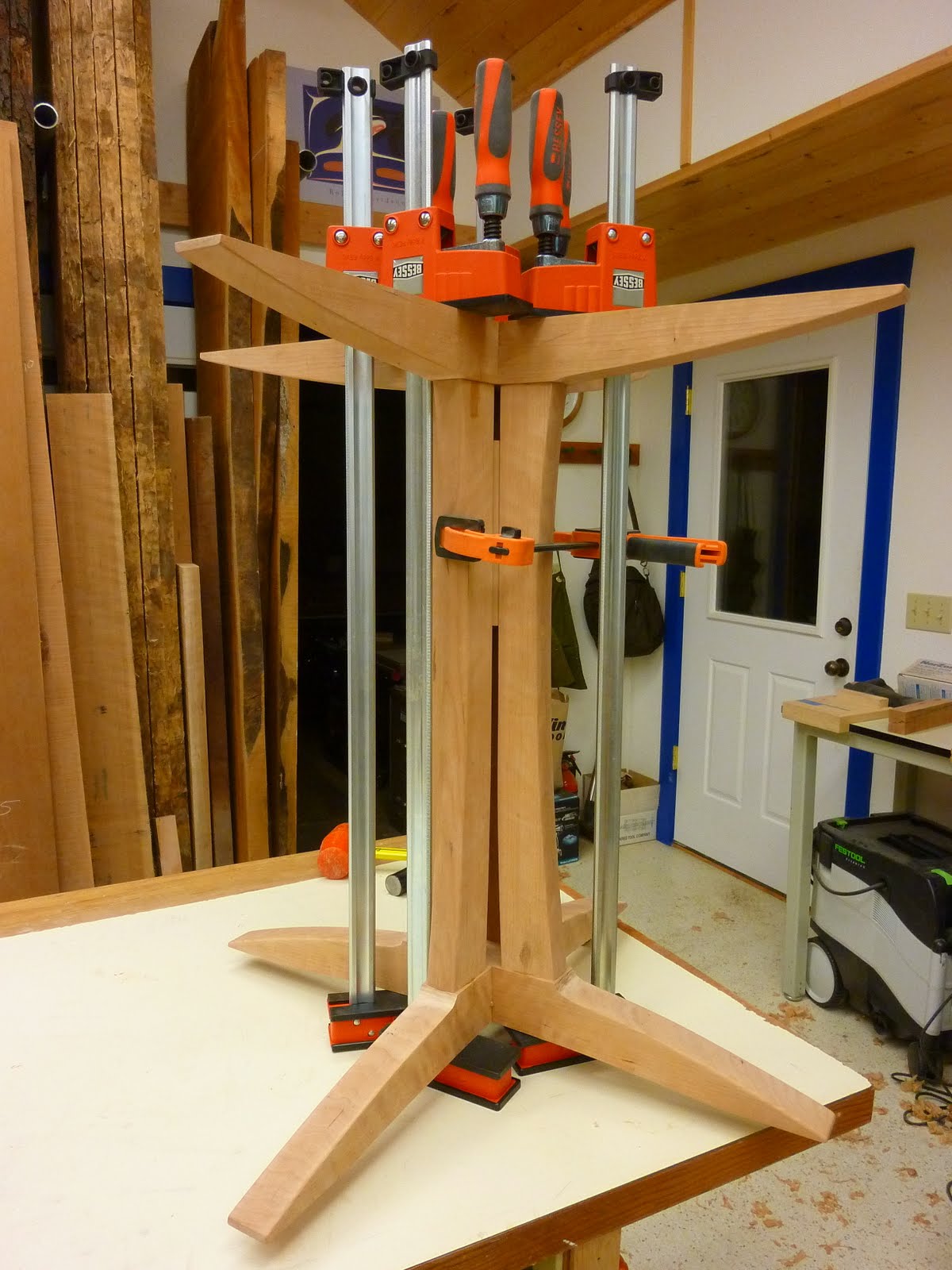
Given how things interlocked it seemed best to glue up the entire bottom in one go, an exciting but hazardous prospect. Old Brown Glue made it possible; it has a long working time and lubricates rather than locking up like the more common white and yellow glues. It requires gentle heating to get the right consistency and strings out like hot mozzarella, but after a glue up like this the subliminal suggestion of pizza is best acted on at once.

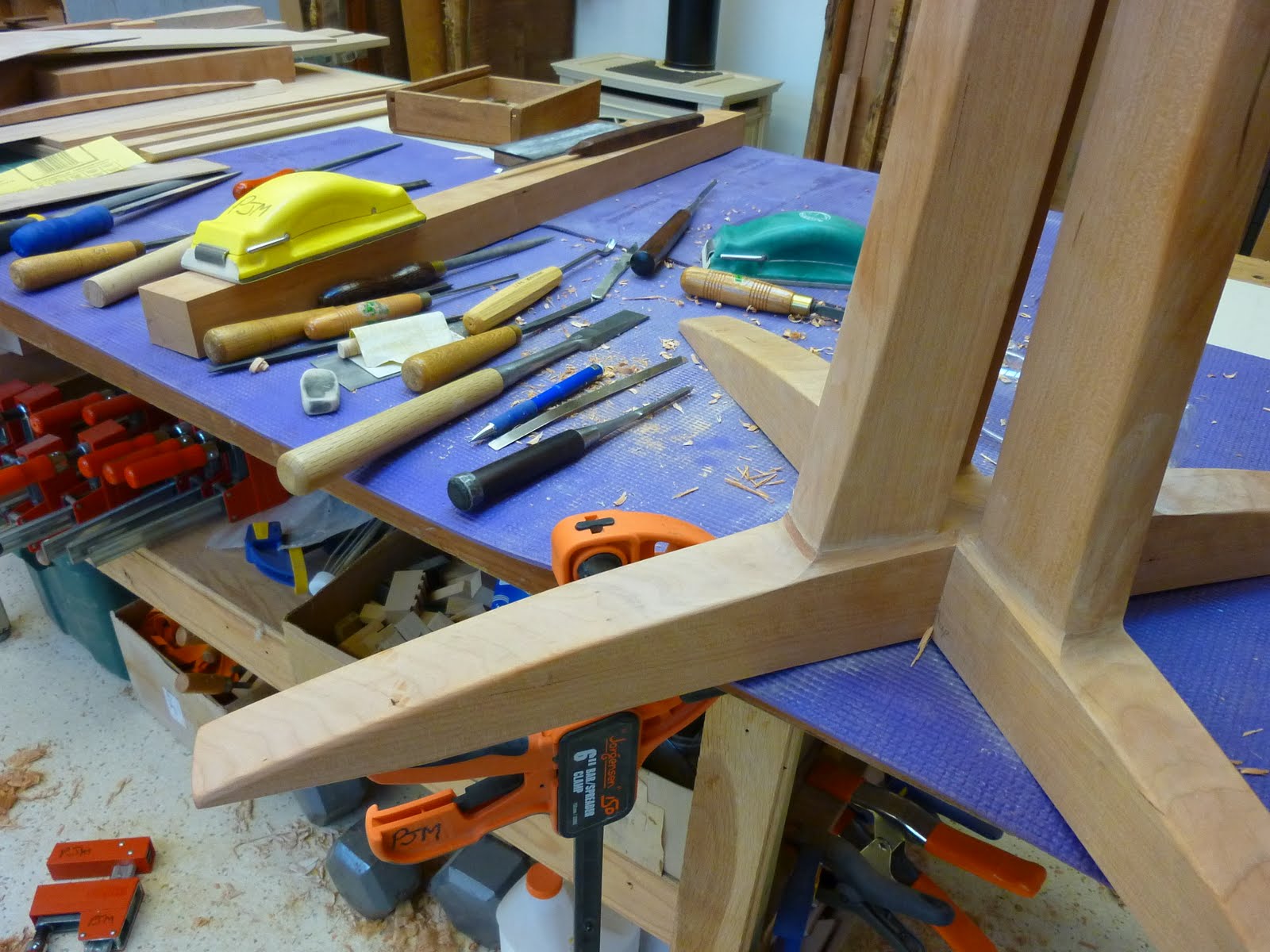
By the time glue had dried the show setup was barely 30 hours away, not enough time to carve the foot to leg joint as I had envisioned. But it was appalling to consider leaving it like this:

Oh well, it’ll have to be a bit late. This would have been easier before glue up, now it was tricky to approach from a workable direction.

Although it doesn’t show here the cherry is quite curly, which makes the carving trickier. I went through quite a few tools looking for solutions.

Much nicer!

Fast forward: at the show, one hour after the doors opened. Tables look lonely w/out chairs, so I snatched some from my friend Bill Storch’s table. Bill puts up with a lot–he’d already sprayed the table top finish and cured it in his sauna, a story for another time. But he got the last laugh, his table with chairs won best in show. Nice work!

Konrad, commenting on the subtle wood choice this time around, said that a red air raid siren would be a perfect finishing touch.

Talk about the pot calling the kettle black. Here’s a piece of his work:

What might have been

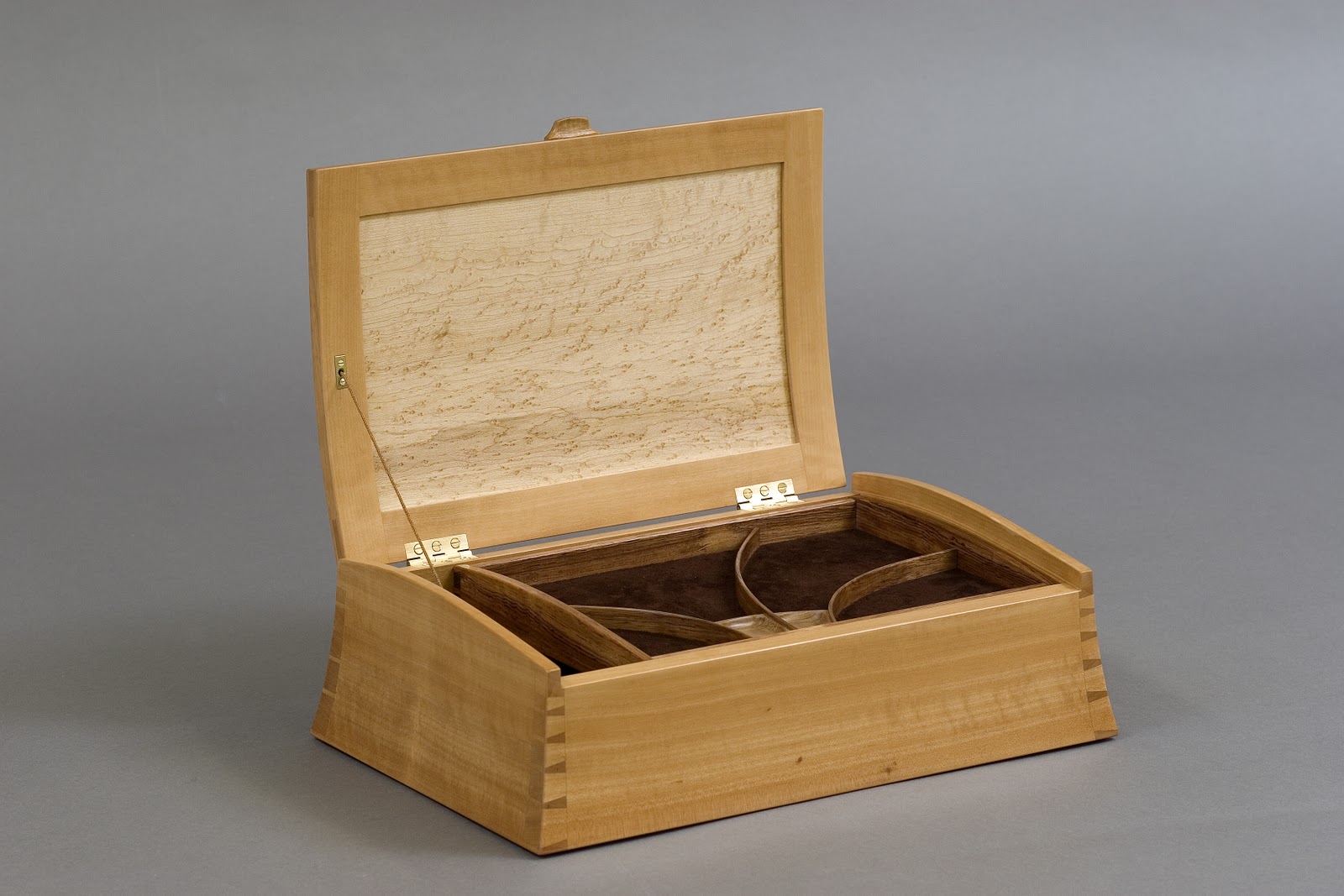
The Cuban mahogany box is now in the care of UPS, speeding to Seattle for a just-in-time appearance in the Annual Box Show at Northwest Fine Woodworking. The last few days had more adventure than I might have wished, including an out-of-proportion circus concerning the bottom of the tray.

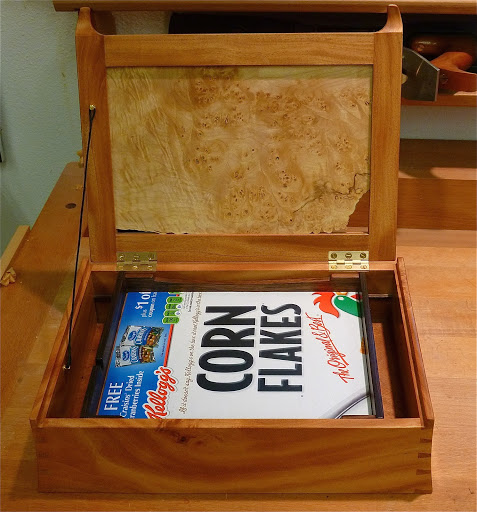
I like to open a box and find a prize inside, kind of like Cracker Jacks. Lacking time to make an elaborate tray I scoured my wood supply for something special and stumbled on some maple left from a tree taken down for the renovation of Kearney Hall at Oregon State. Most of that wood went to a gift commissioned by OSU for the major donor in the project:

but a single sawn veneer remained. Its strong graphics complemented the Macassar ebony of the tray sides and provided a satisfying surprise when the lid was raised. I made up a panel with the veneer (an overnight stay in the vacuum press), but it tore out badly when I planed it to thickness the next day. I tried to remove the tearout in the usual way with a handplane, but the panel was small and warped slightly from the pressing and resisted. 
Anxious to get this minor piece of the project complete, I tried to emulate my friend Bill Storch–who can perform miracles with a belt sander–and safely sand the tearout away. The panel tried a new trick: each time I sanded a side, the panel would warp the opposite way, presumably something to do with the heat that sanding generated. Stopping often to check the work and flip it for a balanced result, I gradually removed tearout until, just as the last torn fibers were disappearing…a ghostly pencil mark appeared in the center. 
A pencil mark? How can a pencil mark appear while sanding? Sanding makes pencil marks disappear, and anyhow there wasn’t a pencil mark in the first place. Except for one on the side I had glued down. 
Bad words. 
Yes, even though there appeared to be plenty of margin when checking the process, the center had become so thin that you could see the pencil mark on the glue face, and the bland face of the core. 
It would have been nice,

but no luck. I thought about inlays and various other fixes but the sand-through was in an awkward spot and there was nothing to do but cover it.

This was probably my favorite option:
but I wasn’t sure the gallery would approve, so I went conventional in the end, shown here with the chisel used to carve the handles:

In this close up you can see a bit of the striped Macassar that I liked with the sadly unusable maple.

And here is one of the handle/pull/grabber-do things.

I started using these after watching everyone lower the lid on my madrone box (pictured in previous post) by grabbing the corners even though there is a perfectly good handle in the center. They are also fun to make, though they resist being finalized; I recarved them slightly three or four times after applying the finish, the last time barely an hour before packing it to ship. They need to be just so. 

Fine old Cuban

Mahogany that is. An odd shaped scrap broke from the end of a big plank where a bark inclusion had weakened the connection. I need wood for a entry to the rapidly approaching box competition at Northwest Fine Woodworking, a great Seattle gallery. This material is famous for its good working qualities…so it’s off to the races.

It’s hard to see but a big knot makes much of the scrap unusable. On the other hand, when I opened up the plank there were nice pin knots next to the bad knot.

There they are behind the corner I just finishing sawing.

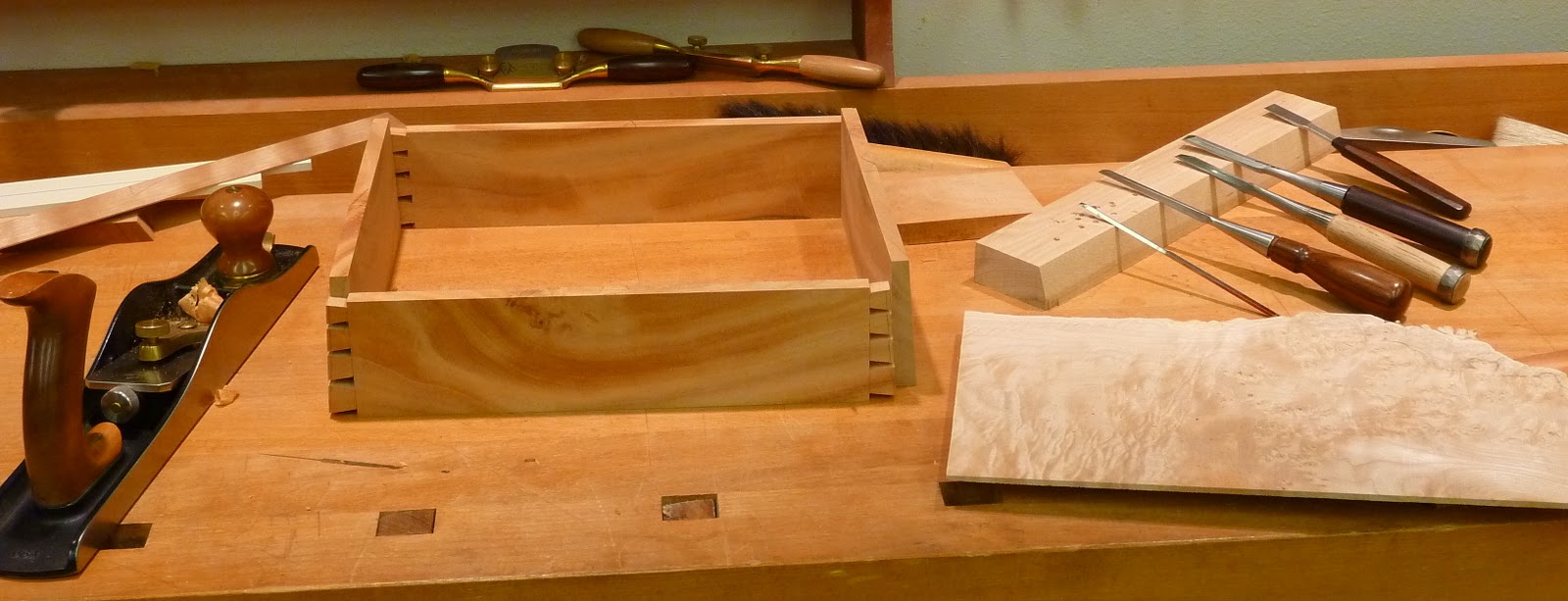
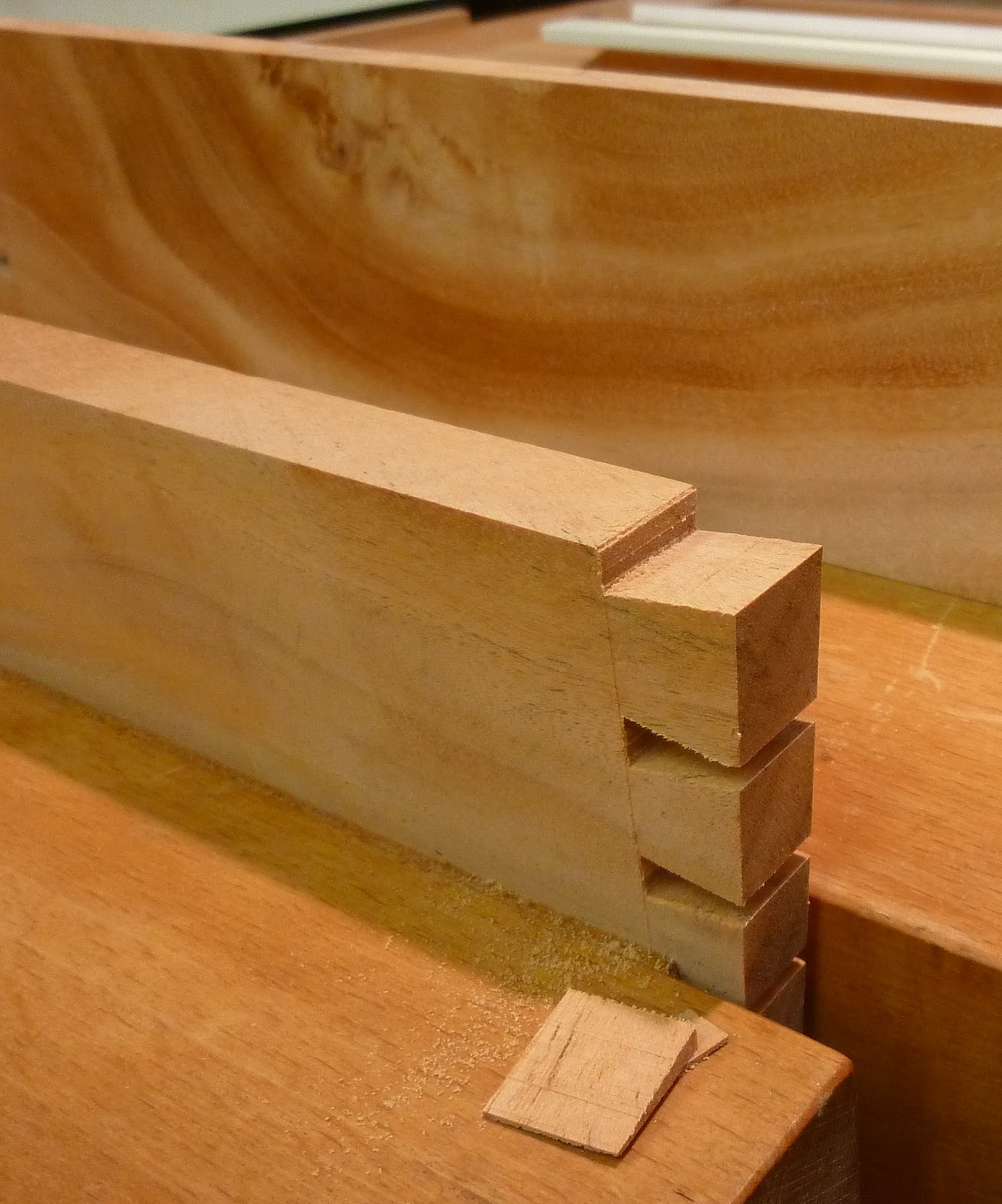
I also decided to taper and curve the corners of the box. However, given the schedule I will refrain from doing that to the inner shoulder of the dovetails, which would add many hours of work as it did to this box:

Starting to look like a box

Here’s the top, some bigleaf maple burl left form a box for my big sis Colleen. And more pin knots, why not! I’ll blend them somehow.