Blog

Walk with me

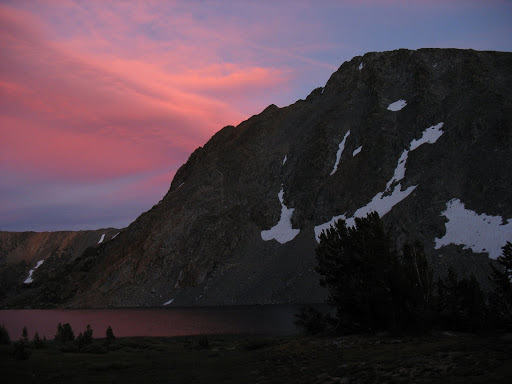
Sunset from Buckhorn Spring, northern end of Marble Mountains.


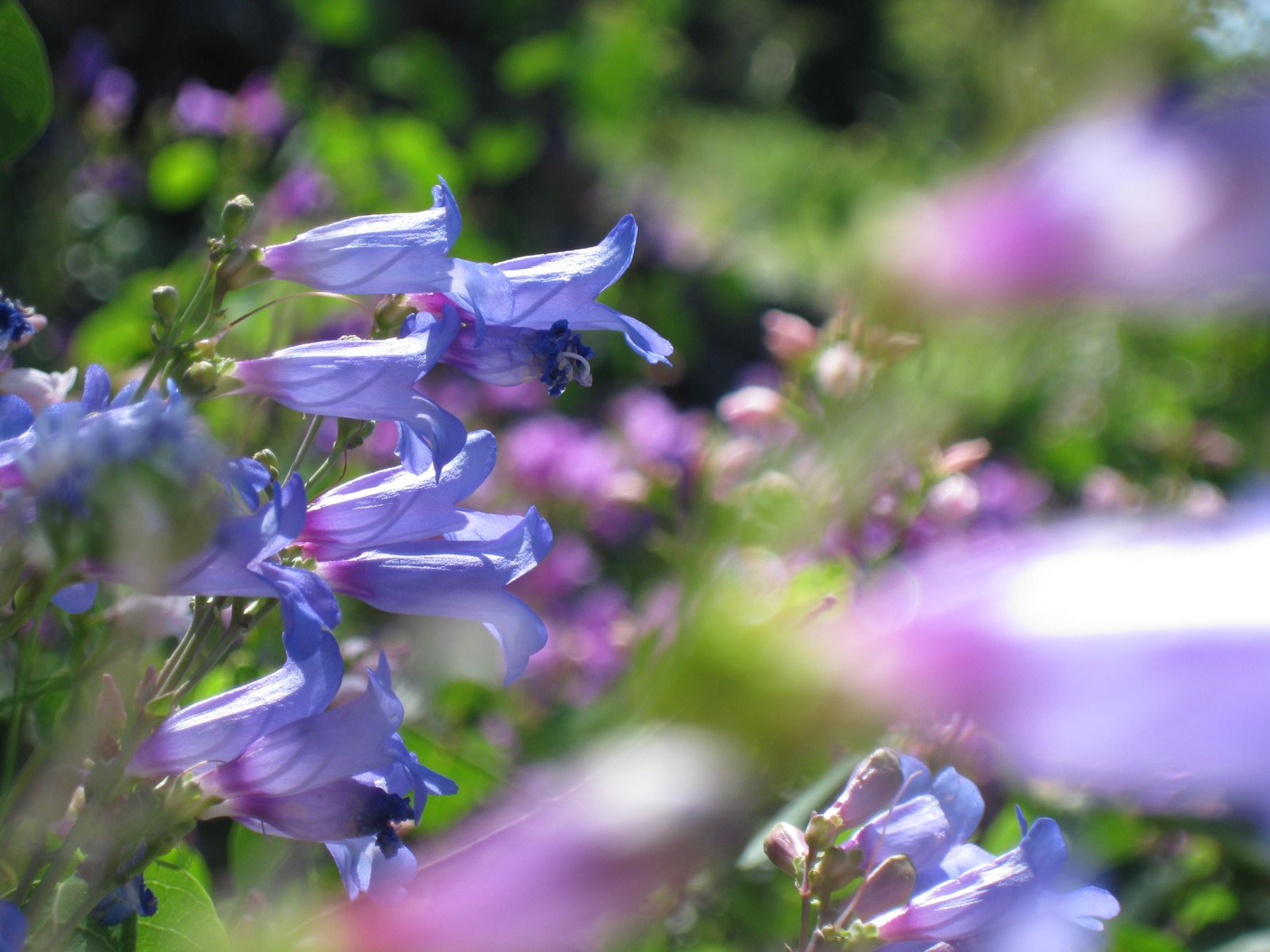
Penstemon – there are so many colors and varieties along the trail.


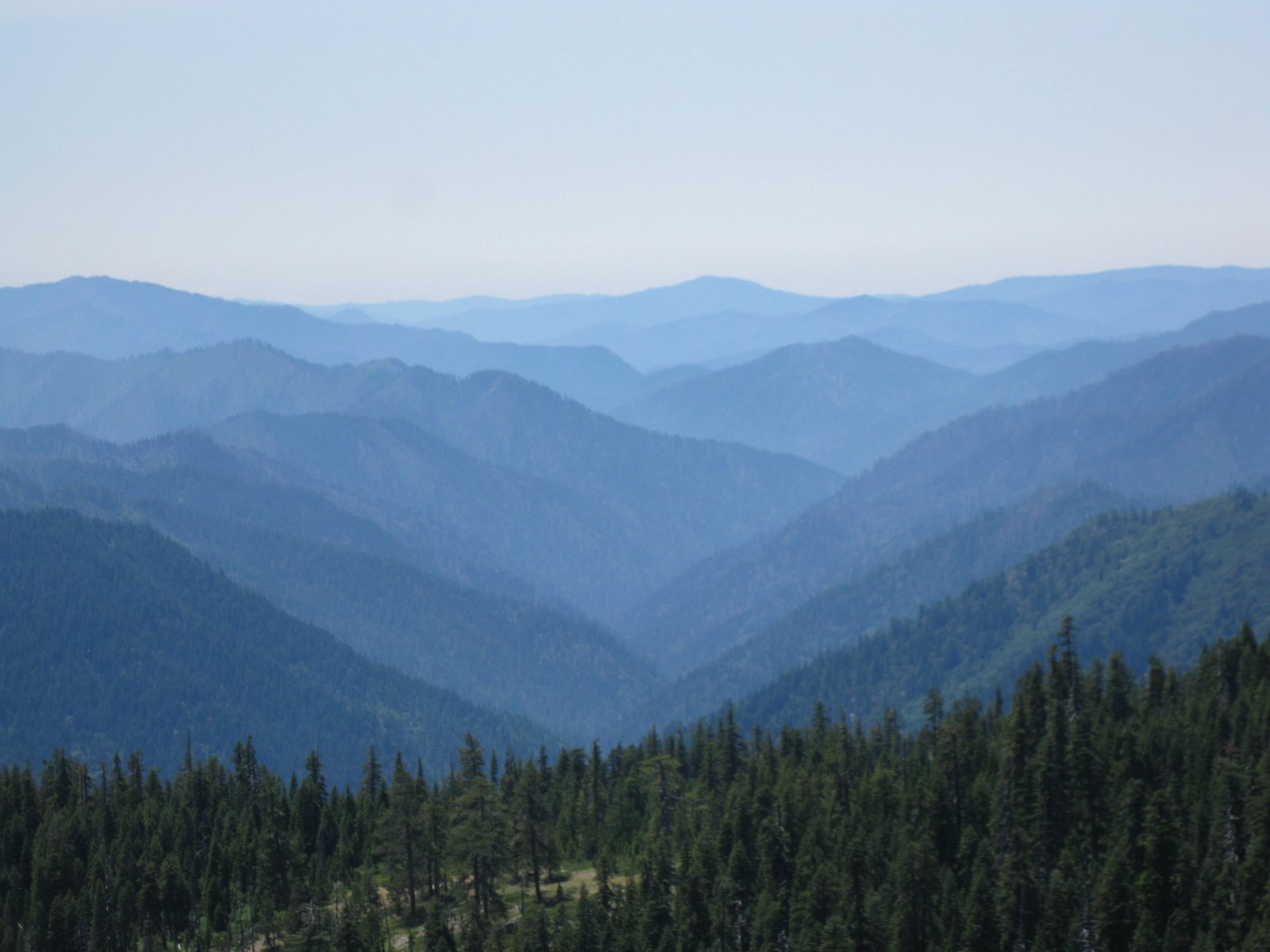
Suddenly aliens abduct me and deposit me in the Blue Ridge Mtns along the Appalachian Trail.


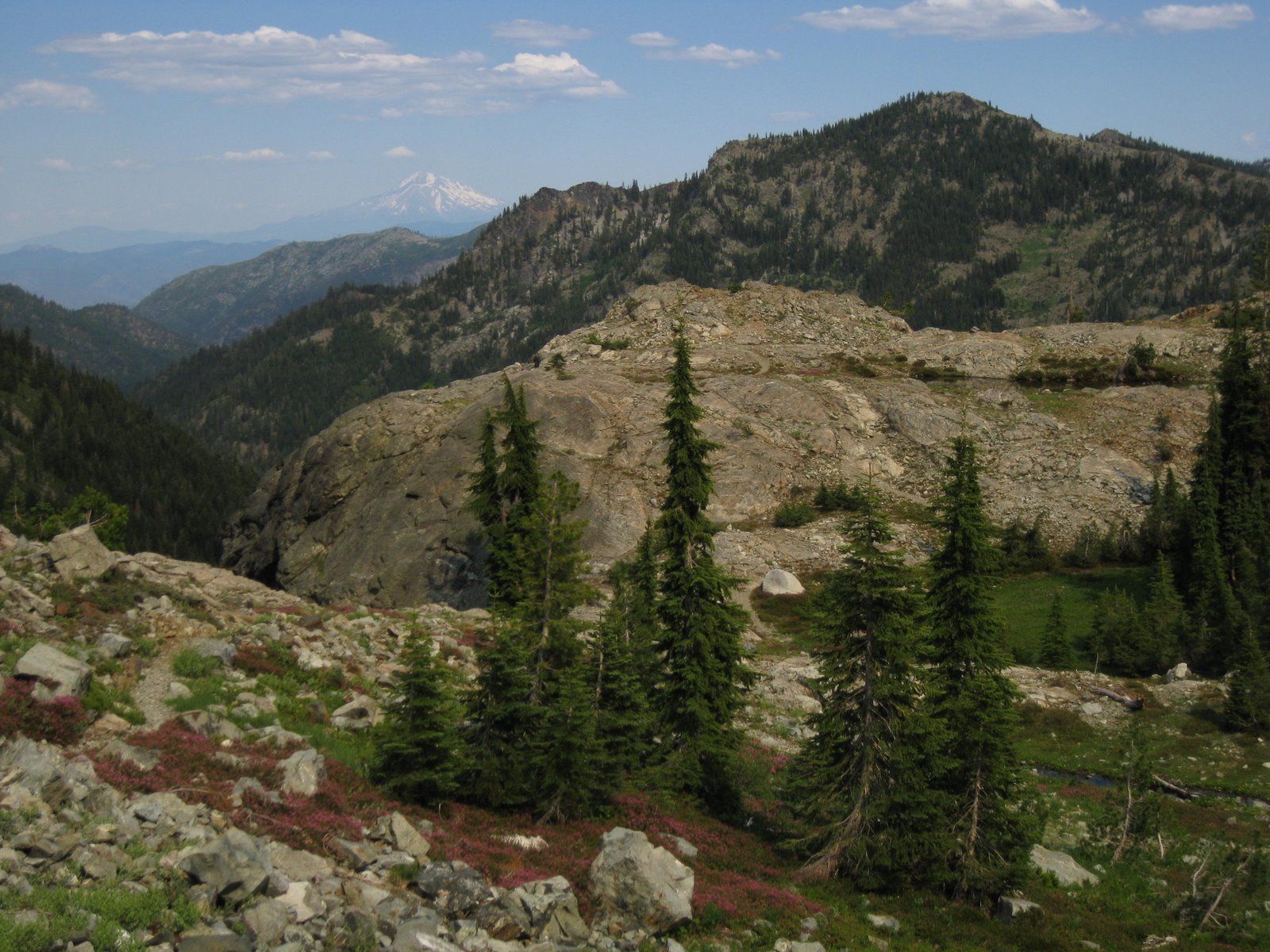
And then return me to a perfect mountainside with a snow-cold creeklet, pink heather, and Mt. Shasta in the distance.


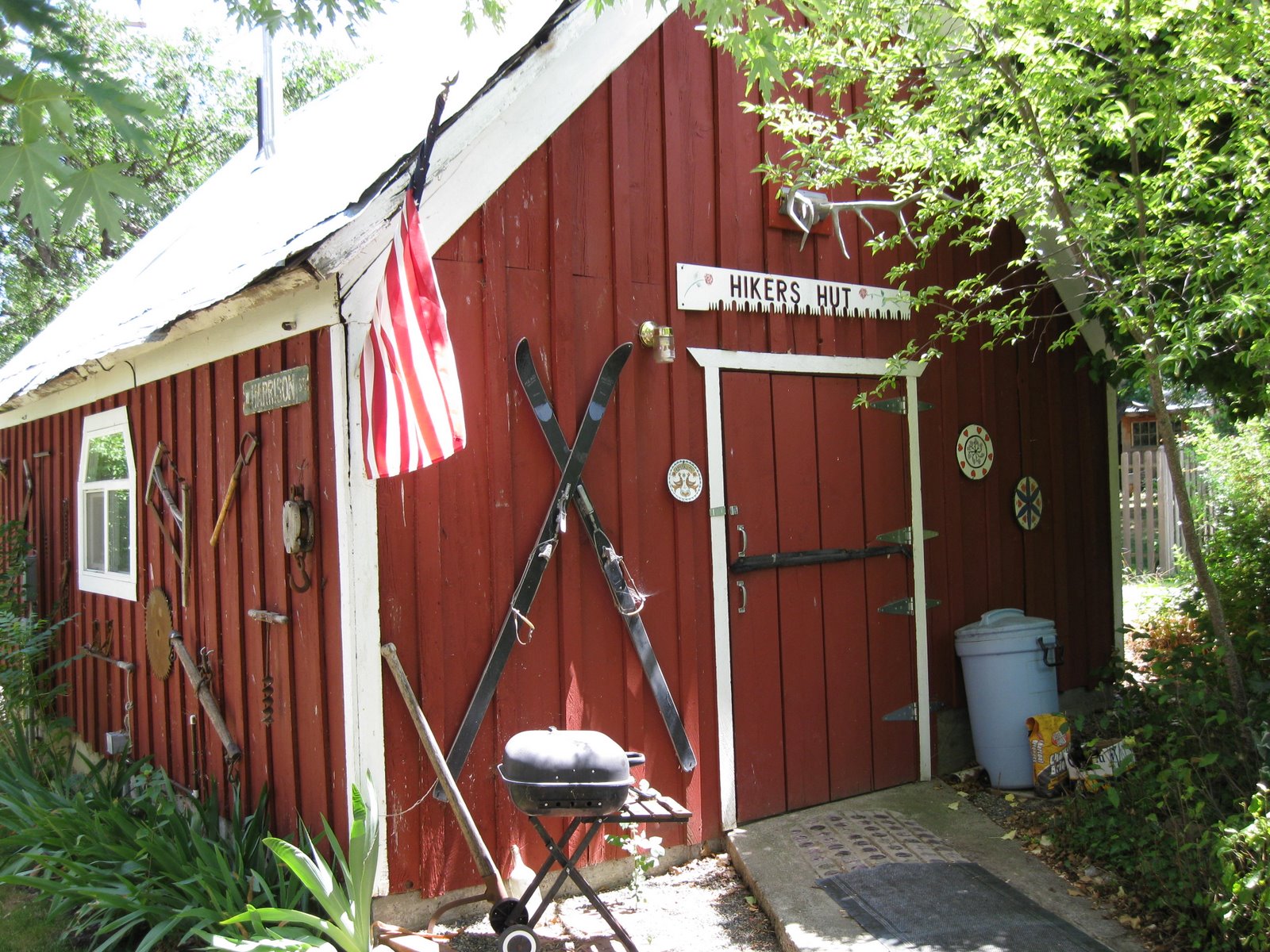
The famed Hiker Hut, at Alderbrook Manor B&B in Etna, CA. An extremely welcome break after the first 100 trail miles. Etna is a great trail town, with an old fashioned soda fountain at the drugstore, tasty smoothies at the Wildwood cafe, killer sandwiches from and Ashland trained chef at the deli…hmm, a little food fixation perhaps?

100 Miles Along

Retrospective weather report from Etna, CA for Pacific Crest Trail (PCT) – man has it been hot! I was using my shiny chrome umbrella for shade by 6:30 in the morning, feeling as if I would need to apologize or at least explain should I meet someone. I even wore my white cotton kitchen gloves with the fingers cut off to protect the back of my hands. However, it was the first day on trail where I saw no one, 15 miles of solitary scenic walking.

Four days ago was really tough; I climbed out of Seiad Valley in 100 degree heat ascending 4850 feet over 15 miles, and the water stopped about halfway. There was supposed to be a good spring at the top under an outstanding triple trunked red fir, but no go…so a dry night, and 5 miles the next morning to get to water. After finding water I met a trail crew and ended up working with them for the afternoon and sharing a tasty pork loin dinner afterwards. Good deal!

Recap: I started June 29 near Long John Saddle in the Oregon Siskiyou Mtns, about 12 miles shy of the planned trailhead (the road was really rough), and have walked approximately 100 miles through the Siskiyous and the length of the Marble Mountain Wilderness in California. It has been a early season riot of flowers, springs and creeks, snowpatches…and mosquitoes.

Except for the trail crew holiday I have been walking 15-22 miles per day, and may scale that back a little. I have seen one rattlesnake, which added 5 feet of elevation gain to that day (in a single adrenaline powered jump), tons of butterflies, a robin that sung 24/7 (according to one sleep deprived trail crew worker), and a deer with a rack that would make a hunter’s heart go pit-a-pat. No bear, though one couple I met had seen 9 in the past 3 weeks.

I have met several northbound PCT hikers who skipped the snowy Sierra, but just one who has walked all the way from Mexico; the unreal Eric D on his 7th PCT thru walk. He is averaging almost 40 miles per day, but taking off approximately one day in three–probably for alternating knee replacements and IV rehydration. I will not try to match this.

No pictures this time, the computer doesn’t support it, hopefully soon. See ya!

The Things We Carry

What exactly does one carry for 100 days on the trail?

At little as possible–you’re cartin’ this stuff on your back!

Then again…as much as it takes to be happy, and reasonably comfortable and safe. And therein lies the rub…literally: the shoulders, hips, neck, back, and soles of the feet all have opinions about weight, and those opinions get sharper as the day progresses. A skimpy little day pack hardly matters, but over 10 or 15lbs a pack starts to be noticeable. The difference between 20 and 30 is abrupt–at 20 (with a well fitted pack) it still feels like a pleasant stroll, but at 30 the word toil comes to mind. I used to carry 40-60lbs regularly (including food), and toil didn’t begin to describe it!

I’ve spent a lot of effort trimming down my pack to make this trip possible. Sometimes this simply involves finding lighter gear with comparable functionality, but often it goes deeper. A pack offers a glimpse into one’s closet of fears; decades ago I was stuck in the snow, so cold that my legs repeatedly went numb for two days. For years afterwards I carried a 7lb tent, heavy rain gear, and numerous warm layers of clothing–and still stressed out when the weather hinted rain.

To this day I carry a stouter shelter and more warm clothing than many long distance hikers, but I’ve learned a bit about staying warm and dry so it’s much reduced. Here is my “stately pleasure dome” for this trip:


Warmth was much on my mind one winter night years ago when I joined an intrepid group for a night outdoors in the Cascades without tent or sleeping bag. The weather was dreadful, high winds with snow and freezing rain, so my partner and I dug a snow cave, the king of winter shelters. We were beautifully protected but nevertheless absolute popsicles despite roughly 20 layers of clothing, many times what I would realistically carry on a trip. Only one of our number had a decent night, in a crude shelter no less. His secret? Warm drinks every 90 minutes or so. While some long distance hikers forsake a stove and therefore warm food, I remember that night and carry a 3 ounce stove.

That scary snow experience resulted from a series of misjudgments and careless mistakes, which brings to mind a fellow hiker named Scott Williamson. He has hiked the entire Pacific Crest Trail (henceforth PCT) nine or ten times. I expect to see him on the trail this year as he attempts a record walk, covering the nearly 2700 miles in 66 days, averaging 40 miles per day. When Scott was asked what his favorite piece of gear is, he replied “My brain. It’s free and it’s always helped me out of jams”. Scott travels very light, probably less than 8lbs of gear total–yep, that’s the pack and everything in it except for food and water. Amazing what you can do w/skill and experience.

I don’t have as much of either, and no surprise my pack is heavier – about 13-14 lbs, but much nicer than the 30+lbs carried by the normal backpacker. A few points of comparison:

  • Scott’s pack weighs well under a pound, basically a stuff sack with straps. Mine currently weighs 3lbs, but this is less than half of my favorite old pack…which Dana now uses to carry the pizza oven and Oreo double stuffs! I’m ready for a 1.5-2lb pack, but the current one will be great for this trip, with plenty of room for the bear canister I’ll have to carry from Yosemite onward.
  • Scott’s sleeping pad weighs less than 6 ounces, mine still weighs nearly 20. I haven’t learned to sleep on a 1/4″ foam mat, and don’t really plan to. Back in the day my pad weighed over 2lbs.
  • Scott carries no insulating clothing to speak of, I have a 10oz insulated coat, 5 oz windshell, 2oz liner gloves and balaclava. A few years back it was a 21oz jacket and 20+oz. goretex parka.
  • Scott carries an ~8oz flat tarp for shelter, I carry a 15oz shaped tarp which will handle an arctic gale. Not so long ago it was the 7lb tent mentioned above.

And on it goes. This gear represents a set of tools that I feel confident I can stay safe and comfortable with today. As the trip progresses perhaps it will shrink, but we shall see. Many people go out each year w/gear and experience that don’t match even the most optimistic scenarios, and that is plain wrong–it is shifting the risk to other hikers and the rescue community. While anyone can get in over their head, it’s essential to cultivate personal responsibility.

Clothing is an area where experienced hikers can often prune weight. During the day I’ll wear light colored synthetic pants and long sleeved shirt, sun hat, and boots or running shoes. The pants zip off to become shorts for warm weather, but the long sleeve shirt stays on to control sunburn, as I’ve already had one round of skin cancer. In a handy outside pocket of the pack I have the 5oz windbreaker (amazingly useful), light gloves, and a 5oz spun-bonded raincoat, very waterproof and breathable (and only ~$20!). Carefully double bagged to stay dry in the pack (important!) is the insulated jacket, balaclava (warm hat that covers neck), and spare socks, along with running tights and a featherweight synthetic t-shirt to wear at night to keep the sleeping bag clean. Like this…


This is close to twice the clothing of the hard core ultralighters. It probably doesn’t sound like enough, but it’s possible to be very comfortable with this kit. You do have to come to terms w/more dirt than is normal at home, but that doesn’t mean being Pig-Pen. Not for too long, anyhow; some stretches of trail are so dusty it’s unavoidable for some period, but in general frequent washings allow you to live happily with yourself and your trail companions.

One gear area that drives me crazy is first aid/repair/emergency. It has so many little things to debate the necessity of, and so much conflicting advice. Some hikers shun complexity and carry only duct tape, a needle, and hand sanitizer. Some barely stop short of a medevac helicopter. I’m in the middle, able to clean and dress wounds, manage pain, infection, allergic reaction and diahrrea, start a fire under adverse conditions, signal for help, and improvise repairs to more extensive gear or body damage.

This nominally adds up to 4 or 5 ounces, but in reality almost everything in the pack could play a role in emergencies. The aluminum pack stays could providing splinting for broken bones, the sleeping bag warmth to manage shock or hypothermia, dental floss for sewing, articles of clothing for padding or slings and so on. Multiple Use is important to assembling a light pack.

Another excellent example is the humble and ubiquitous backpacking ukelele: in addition to the soothing alpha-wave-inducing music, it is useful as a mosquito-swatter, a paddle (for either boating or spanking, as appropriate), a pillow–koa is among the most comfortable and compliant of pillow woods–and of course for self defense, driving off whackos by playing Tiptoe in the Tulips, or Paul Anka tunes.

I am reluctantly leaving behind a few favorite things in order to lighten my pack for the abundant miles: my faithful little Leica binoculars, one of my all-time favorite purchases and something I carry every day in my shoulder bag; the nifty fabric contraption that turns my sleeping pad into a chair, so comfy for sitting around camp – but with the long days I won’t have that much time in camp; and an ice axe…true, I haven’t carried one for years, but they are so cool! If I had left 3 weeks ago as originally planned I would have needed one, but that’s an extra TWO POUNDS. Good thing for all these delays.

Things I won’t do without include toothbrush and floss, washcloth, mirror (part of the compass, also good for emergency signalling), camera, cellphone (roadend use checking in w/Ann) and substantial quantities of chocolate.

One good friend asked if I would bring a gun, but it’s too heavy for a wimpy not-quite-ultralight (that would be under 10lbs for gear) backpacker. Besides, you folks out there in civilization need a gun more than I. However, if I happen upon a frozen mountain man with a .50 caliber Hawken, I will re-evaluate this decision carefully.

I’m up in the air about an mp3 player. I generally find hiking w/music distracting, like being stuck in a movie soundtrack, but it might be fun to listen to audiobooks or learn new tunes, and occasionally Led Zeppelin would be just the thing to get past a tough stretch. Probably not though.

This is probably more than you wanted to know, so I’ll stop before discussing toilet paper…or the lack thereof.

The Thousand Mile Summer…

…is a book by Colin Fletcher that fired my imagination decades ago. A thousand miles–now that’s a hike. It’s dwarfed in comparison to doing the entire Pacific Crest Trail in one season (or the Continental Divide Trail, Appalachian Trail, and others), but it’s always had a nice ring to me.

Late each winter I get cabin fever and start dreaming of long walks in the mountains. Since having knee surgeries I have also been researching the ultra-light backpacking methods commonly used by long distance walkers. As I was studying (and worrying about one still-cranky knee and the approaching soccer reffing season) I realized that it’s not getting easier to do a hike of this magnitude.

Hey, I don’t claim to be quick.

Other hiking acquaintances have had to scale back or quit backpacking for various reasons, and the increasing scope of woodworking commissions as I get ever larger bandsaws will compete for time. These factors converged on the idea of doing a thousand mile Tour de Sierra this summer, visiting areas long on my wish list and capped with a grand 500 mile trek the length of the range.

Research led to an entire community involved in long distance hiking (not just hikers–the subject of a future post), many of whom generously shared their information and experience, and gradually the idea of a single continuous journey took hold. Starting in Oregon sounded cool, and by chance the trail distance from the border to the south end of the Sierra is…you guessed it…a thousand miles.

This link shows a map of the Pacific Crest Trail; I plan to walk south from the Oregon border past Mt Shasta, Mt. Lassen, Lake Tahoe, Yosemite, and Mammoth Lakes to roughly 50 miles past Mt. Whitney–north-south-wise about halfway between Fresno and Bakersfield.

I’m planning just over 100 days to the journey, winding up in early October. This was partly to permit a slow, knee-preserving pace, and partly to experience the full course of summer in the mountains; early season’s lingering snowpack and abundant springs, the ensuing explosion of flowers (and mosquitoes…), high summer’s warm days and thundershowers, the transition to vibrant colors and falling leaves as the days rapidly shorten, and fall storms warning of winter’s hard edge.

Often over the years at work, as I tried to keep a hundred balls in the air (so it seemed), I imagined the smooth passage of days and nights in the Sierra; sun, clouds, moon, water, rock, trees, flowers, fish, pikas, ouzels…sometimes it was hard to feel they really existed. This summer I’m checking it out…in detail.

The Eagle has landed

The overload alarm on the rented Home Depot truck stopped when the truck was put into drive–thank God! After all, it was only 3100 lbs, less than 5% over limit. Surely this vehicle was designed with a substantial margin of safety? A short drive at a very timid speed brought me to the drive in front of the shop:

A friend noted that the front wheels of the truck looked a bit splayed out, but it must have been a trick of perspective.

Getting it down on the ground was too dicey for pictures, but went alright and the truck groaned with relief.

Next we set to disassembly with cordless drivers. The crate was very sturdy indeed, held together with hundreds of screws; many many hundreds, and multiple recharges of the drivers. This took a while.

A long while.

Once uncrated it had to be lifted off the pallet, another process too gripping for picture taking. We wrapped a sling around the gooseneck and hoisted the saw with the forklift – it swung to a crazy angle but then stayed put, and we scrambled to drop the pallet, which was quite a snug fit with long bolts. The pallet must have weighed 250 lbs, I nearly killed myself moving it.

Once off the pallet the saw was short enough to fit in the shop, but moving it was now even more unnerving–it has a very narrow base for the forklift to engage. We strapped it to the mast of the forklift and did everything was slow motion…or at least as close as this neophyte fork lift operator could make it. Finally–with numerous retries–it was just right.

Whew, was I relieved! It needs new tires and 3 phase power, and with the upcoming hike won’t get those for a few months, but it’s exciting all the same. That’s a bandsaw!

A mad dash

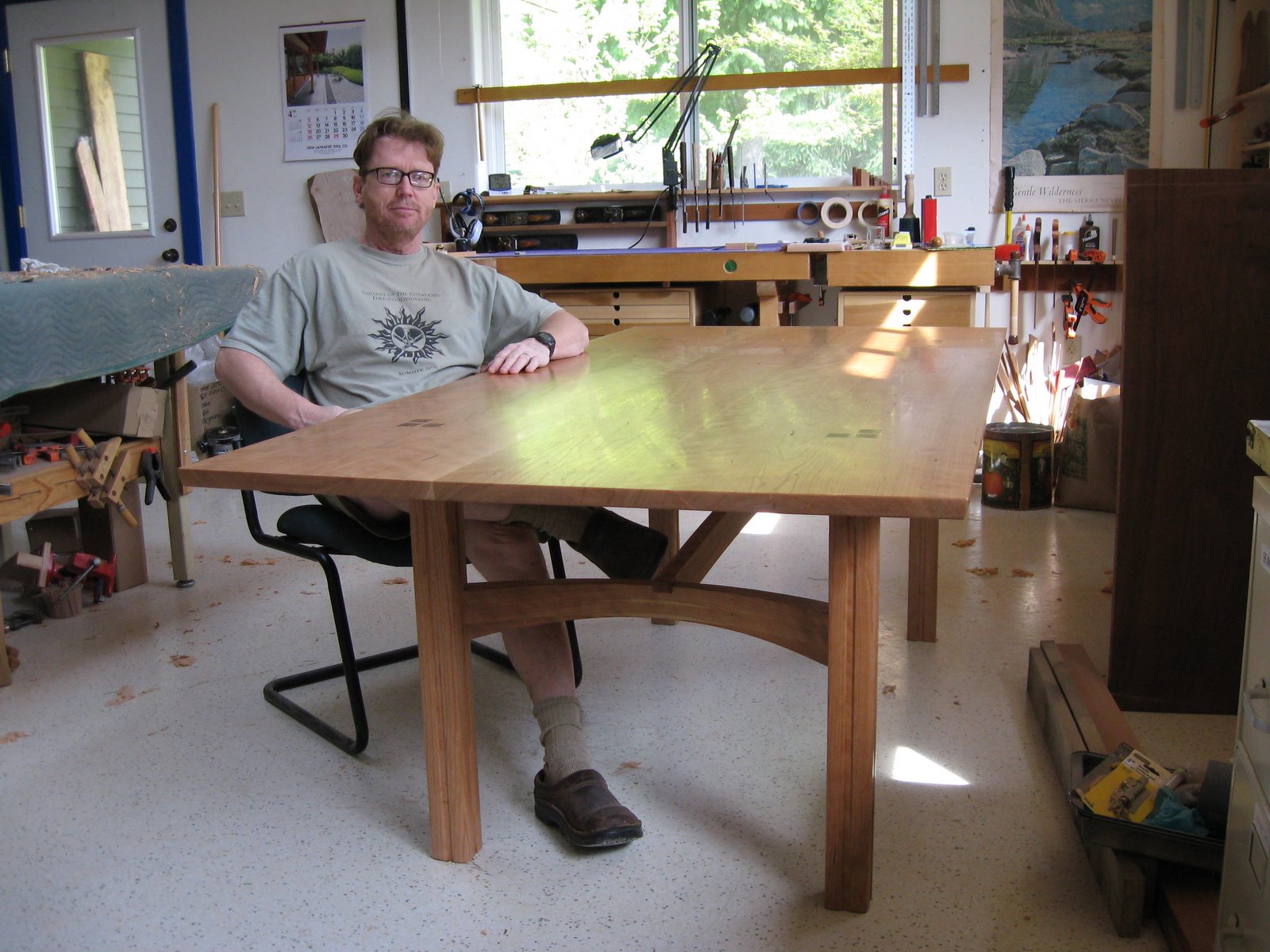
The Mid-Willamette Woodworking Guild Show is up and the dining table made it in, but it was a sprint to the finish–and with the finish, as I was applying oil/varnish only hours before stuffing the table in the van. Dry finish, dry I say!


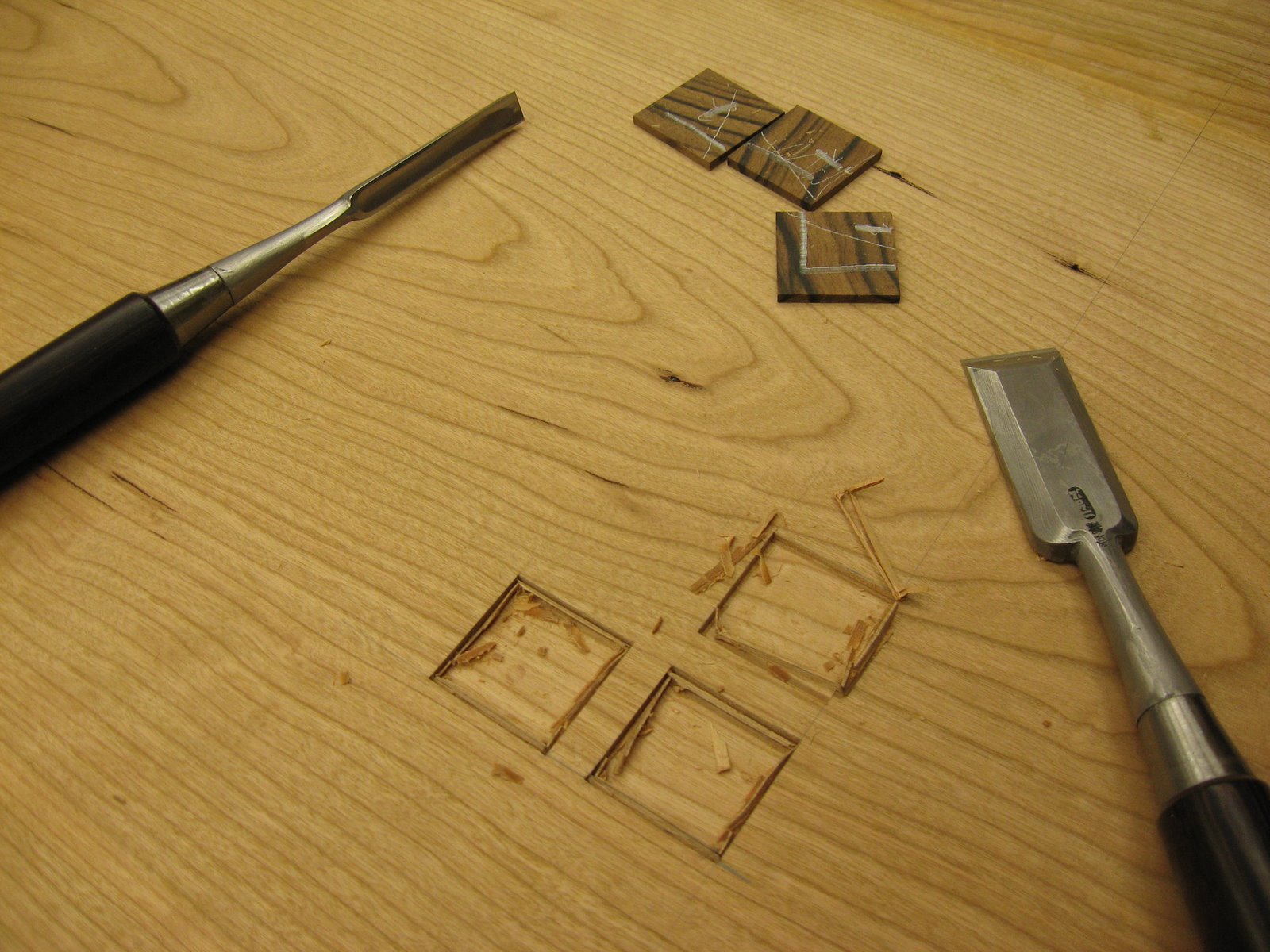
Picking up after the glue up (and the close of Cabaret), next came the inlay process. I was originally planning to inlay rosewood, but a billet of Macassar ebony that has been lurking in the shop for 16 years had some curvy figure that looked promising, so I sliced of a 1/8″ thick piece on the bandsaw and cut it into squares. I then laid out lines with a scalpel so the inlays would land right over the table legs, hogged the bulk of the material out freehand with a router (after burning a couple hours on a router template that was not satisfactory), and cut to the lines with chisels. Love those chisels!

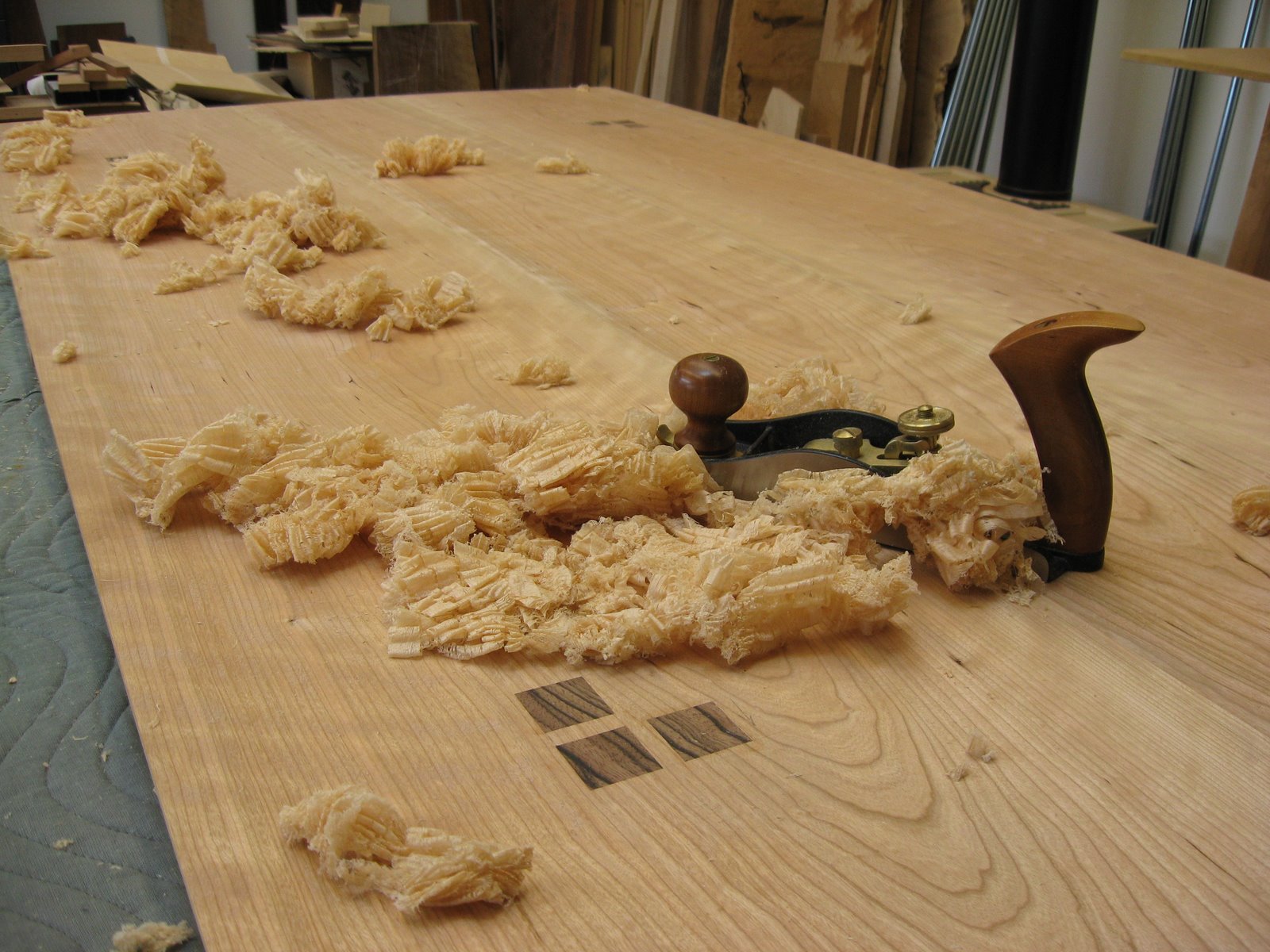
Then it was time to level and smooth the top, a real extravaganza of fluffy shavings. I had to sharpen frequently to avoid tearing out the reversing grain of the quilted cherry, and it turned out splendid–thankfully, because it was a ton of work.

Some of the Macassar inlays planed nicely in the same direction as the cherry and some did not, but there was no way around this if the curves were to flow nicely. Needless to say I lost track of direction and created tearout in some inlays. A card scraper saved the day, to me the most amazing tool in the shop; a seemingly unremarkable flat piece of steel that performs miracles. It deserves its own post some time.

My friend and helper David planed part of the underside of the table, and he is now heading down the road to handplane addiction. The shavings are so lovely, and when you take a clean pass over this cherry it looks as if someone turned on a light bulb inside the wood – the figure and color jump out! Hogga Dogga!

On to the edge profile of the table top, but is a sweetly curving bevel enough? No, or course not. We have Lots of Time, let’s carve a detail into each side as tribute to my teacher Kevin Rodel, Arts and Crafts designer and maker extraordinaire, with whom I studied at the Center for Furniture Craftsmanship some years back.


At this point the top was ready to start sloshing finish on, and it was time to construct the base. Since everything readily visible was built from four sequential 5/4 planks from a single tree, the first step was milling and gluing up blanks for the legs and other thick parts. Daughter Meghan stayed late that night to keep me on task and lend a hand. Another day she brought me Cirello’s pizza–Love you Meg!


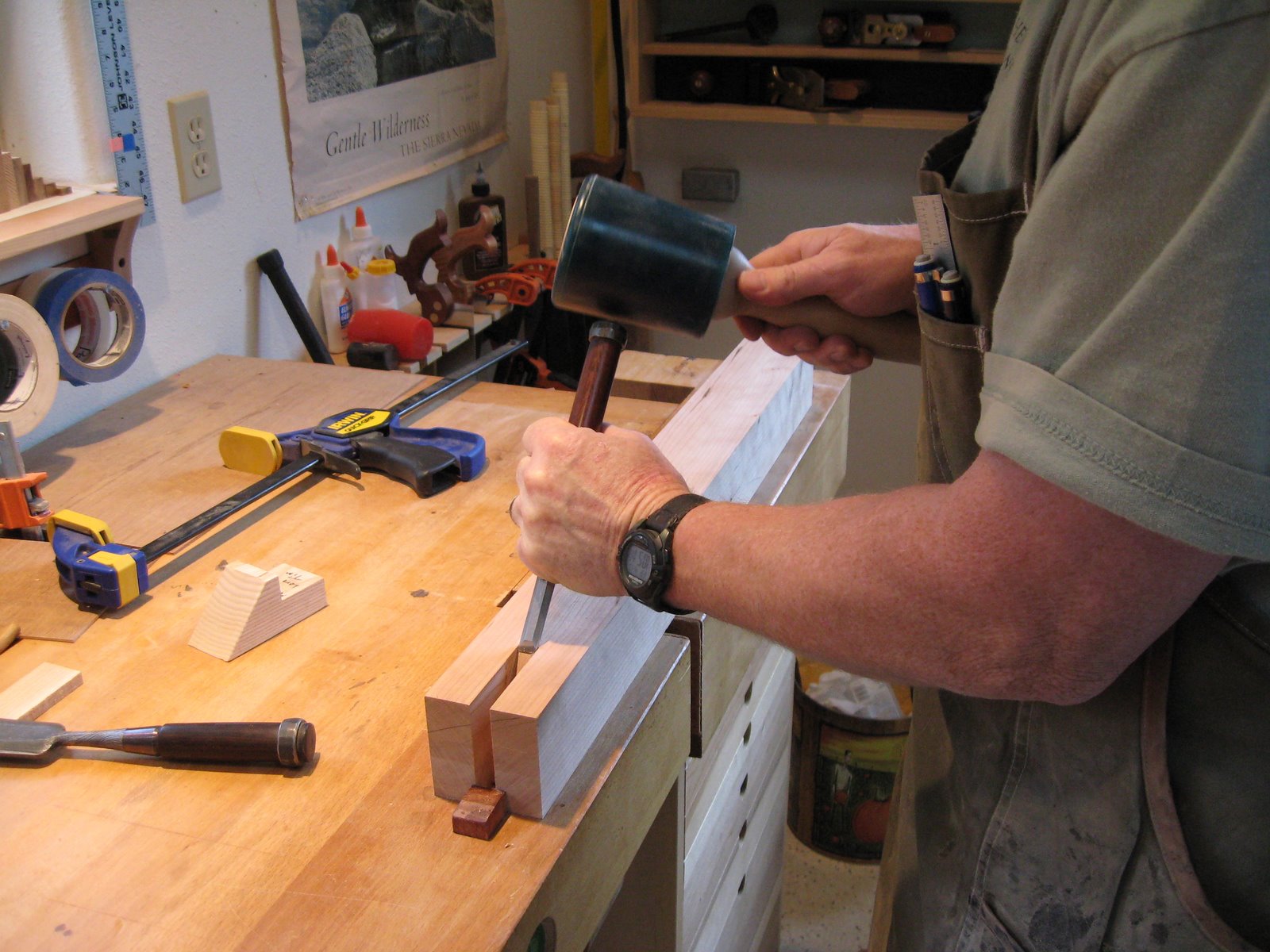
Then some killer joinery–I want thing thing as solid as a rock for centuries. Some was cut at the tablesaw


but a lot had to be done by hand. More fun with chisels.

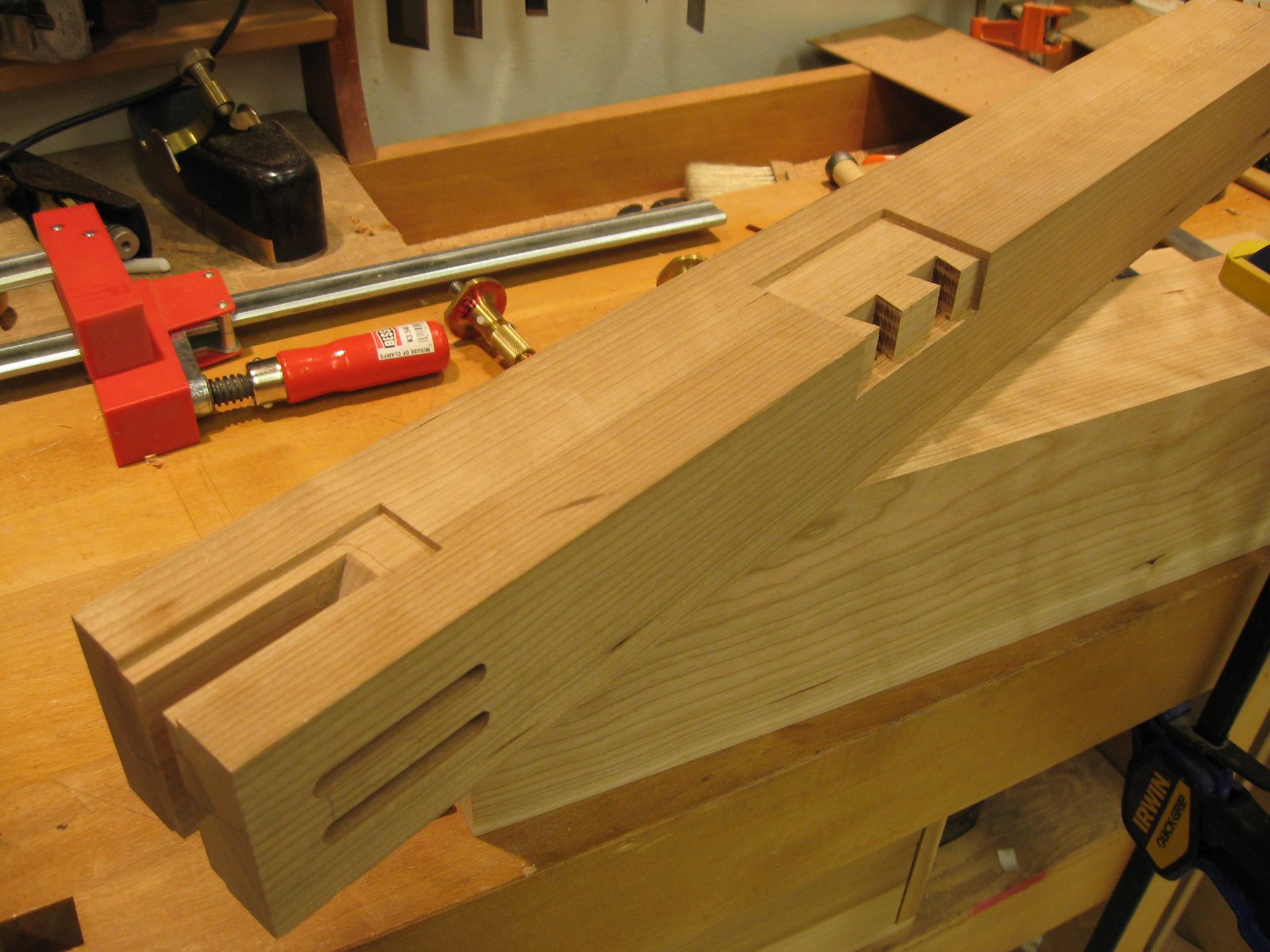
There is a good bit of joinery going on here, and it came out nicely; the mortise and tenons give a satisfying POP when pulled apart, like a champagne cork.

With the joinery complete it was time to refine and detail the shapes. The big curving stretchers were bandsawed, spokeshaved, and finally sanded into soft fair curves. It was a huge workout with time running short and made a humongous mess in the shop, but for me these give the ooh-la-la to the table. Straight stretchers would have been easier, but that wouldn’t have been The Cowboy Way.

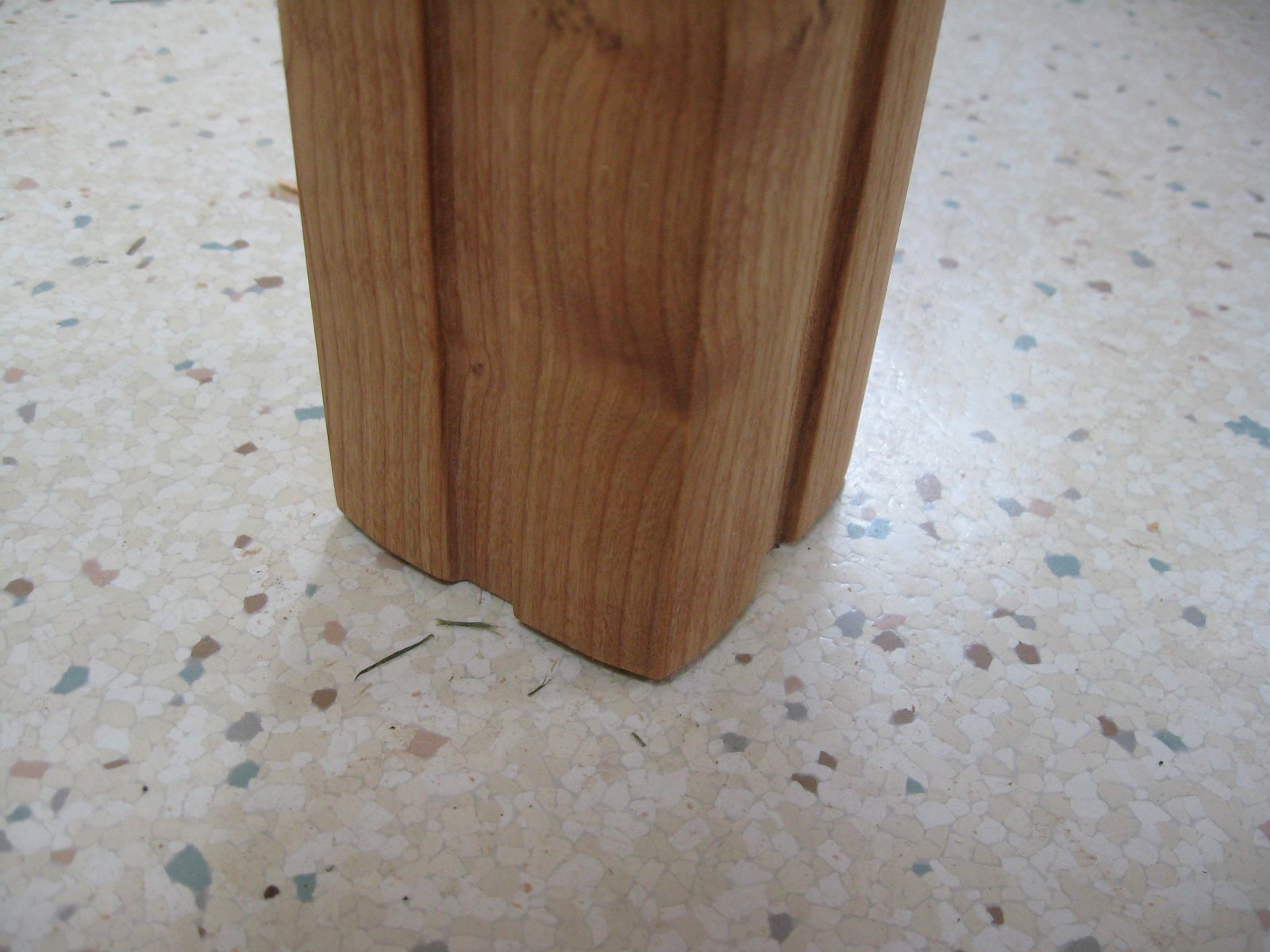
I shaped the legs with router, tablesaw and handplane into a highly abstracted flower form (that’s how I see it, anyhow). The grooves on each face have nice soft inside edges, not the hard right angles that a typical router bit or saw would make.

Yikes, only a couple days until the show, and nothing is glued up yet. I applied a coat of oil/varnish and urged it to dry more quickly by setting it in the sun on an unseasonably warm day…which caused little beads of oil to keep forming on the surface. Nice try. At least by finishing before glue up the few little beads of glue squeeze out were easy to remove and there were no pale splotches where the finish couldn’t penetrate.

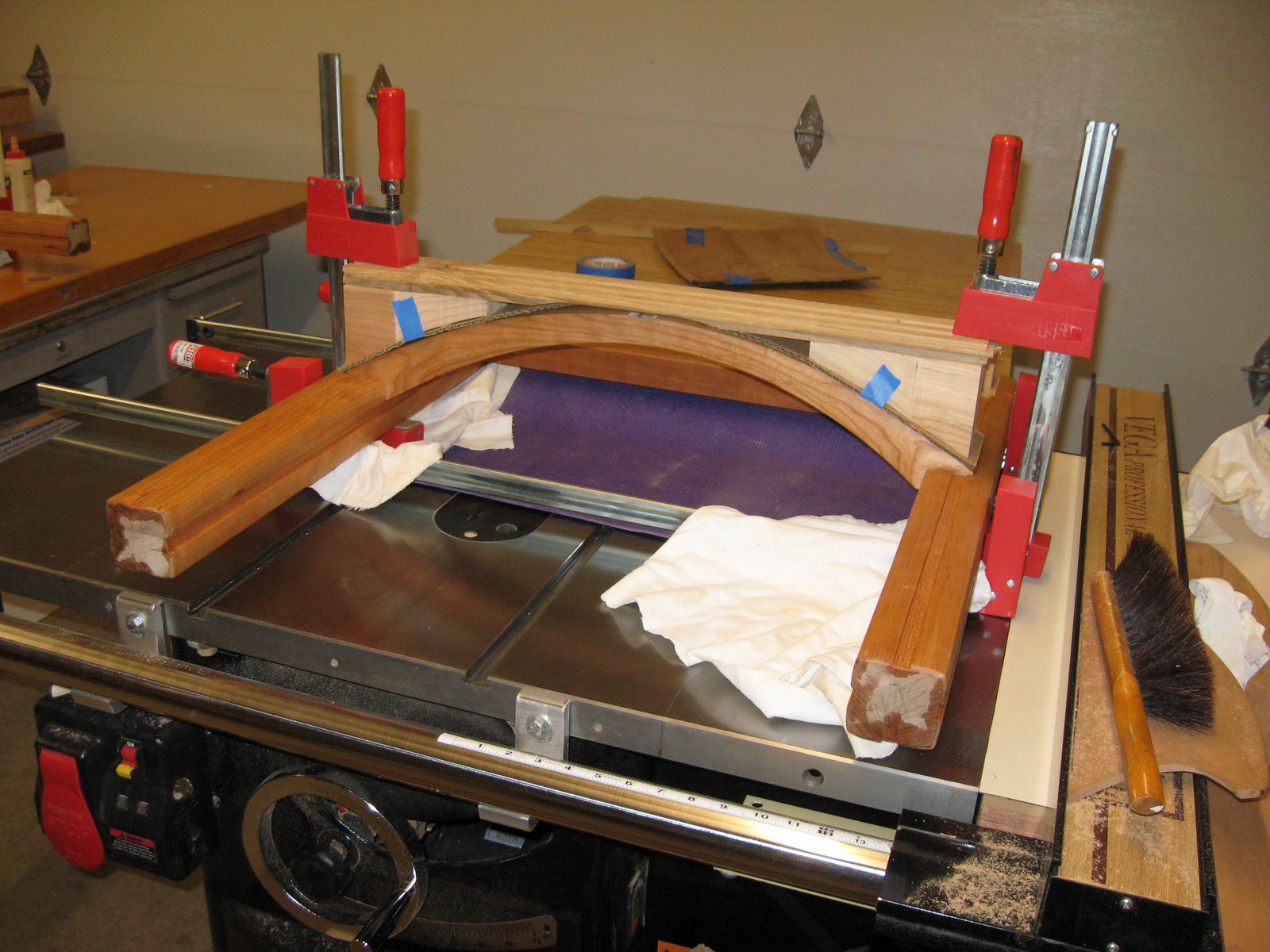
Here is the end subassembly finally glued and clamped, with fancy cauls that David made to handle the curving stretchers.

While doing a dry run of the glue up I managed to install one curving stretcher upside down (don’t ask), which slightly compressed the shoulders around the sliding dovetails. So next morning (30 hours and counting) I had to “dust” the joints, and it is euphemistically called by some; putting something sticky into the hairline gap (I tried oil/varnish, it worked OK) and then working in some sawdust. Tick tock, another 90 minutes, but at least the joints look as good as before I dry-fitted that piece wrong. Almost. Well, not really, but better than undusted. Arghhh. Most people would have needed a microscope to see the gap even without dusting, but this is one of the curses (or blessings) of my severe near-sightedness – take off my glasses and I can see really fine details. On through the day and into the night refining detail after detail.

Morning, 8 hours until delivery. Dry assembled everything and it is solid as a rock without glue–decided not to glue long stretchers in place in case I want to refine more details after the show, which will be easier if the end assemblies can be handled separately. Made cleats of hard maple to attach the top to the base. Flipped the top upside down, positioned the base, making sure it lined up with those inlays!

Then a scary step – drilled into the underside of the top to attach the cleats. Drill too far, and there will be a nice hole in the table top, just about big enough for a single stemmed rose. From my funeral bower. Bad idea, must not drill too far!

And suddenly…

It’s a table. And I’m exhausted.

Life is a Cabaret

old chum, come to the Cabaret. And boy did I–we just closed a run of this wonderful dark musical last night, and struck the set today. Closing night I collaborated with Margie the makeup queen to give director Leah Burgy some shock therapy. Looking in the mirror certainly gave me a shock!


The end is a bittersweet time; friendships often bloom during community theater shows, but this was a particularly wonderful cast, talented and warm and funny, and I’ll miss working with them; on the other hand, we get our evenings back and don’t wreck our skin applying and removing pounds of makeup each day. Ah well, big hugs to everyone, and (in her own words) a sloppy wet kiss to our fabulous Director Leah Burgy for bringing us together to sing this story.

Finishing a project can likewise be bittersweet, but there’s no time to ponder that just now – only a week and a half to finish the dining table for the Guild Show – yikes!

Announcement: http://www.midwillamettewoodworkers.com/show.htm

Yo ho ho…

and a bottle of glue!

There is a certain piratical combination of planning, savvy, recklessness, and brute force needed for a major glue up, and the Jolly Roger was flying in the shop today as the dining table top went together. Days of work were on the line in a seven minute sortie, a choreographed mayhem of glue and wood and clamps and big mallets (just in case). Afterwards a bottle of rum doesn’t sound like a bad idea at all.

Good friend–er, make that scoundrel, brigand, and reckless libertine–David Otto helped, and together we got the job done. Arrrgh! Here be the treasure:

Two barrels

at 30 gallons apiece, plus the beautiful wisps on the floor from hand planing, and the pile that spilled when I waited too long to empty the dust collector. That’s a lot of shavings, especially considering that they came from just three planks of fine Pennsylvania black cherry–how can there be anything left?

Three days ago they were sequential flitches – stout planks the full width of the tree, like slices of a carrot going the long way.

A day of looking, hoisting, flipping, composing, squinting to see growth rings, grain graphics, curl orientation. Another two days of milling: commitment anxiety before the first cut on the bandsaw, brute strength pushing a 16″ wide cut over the jointer, wondering whether THIS planer pass will finally remove the last sawmill marks (please…), the whisper of a freshly sharpened plane on the edge joints.

The shavings have gone out to the yard for mulch, lots and lots of mulch–surely there can’t be much left of those 3 big flitches. But there they are: a 7′ long dining table top with a gentle herringbone-patterned curl, ready for glue up. Much has been taken away, but much has also been put in.